


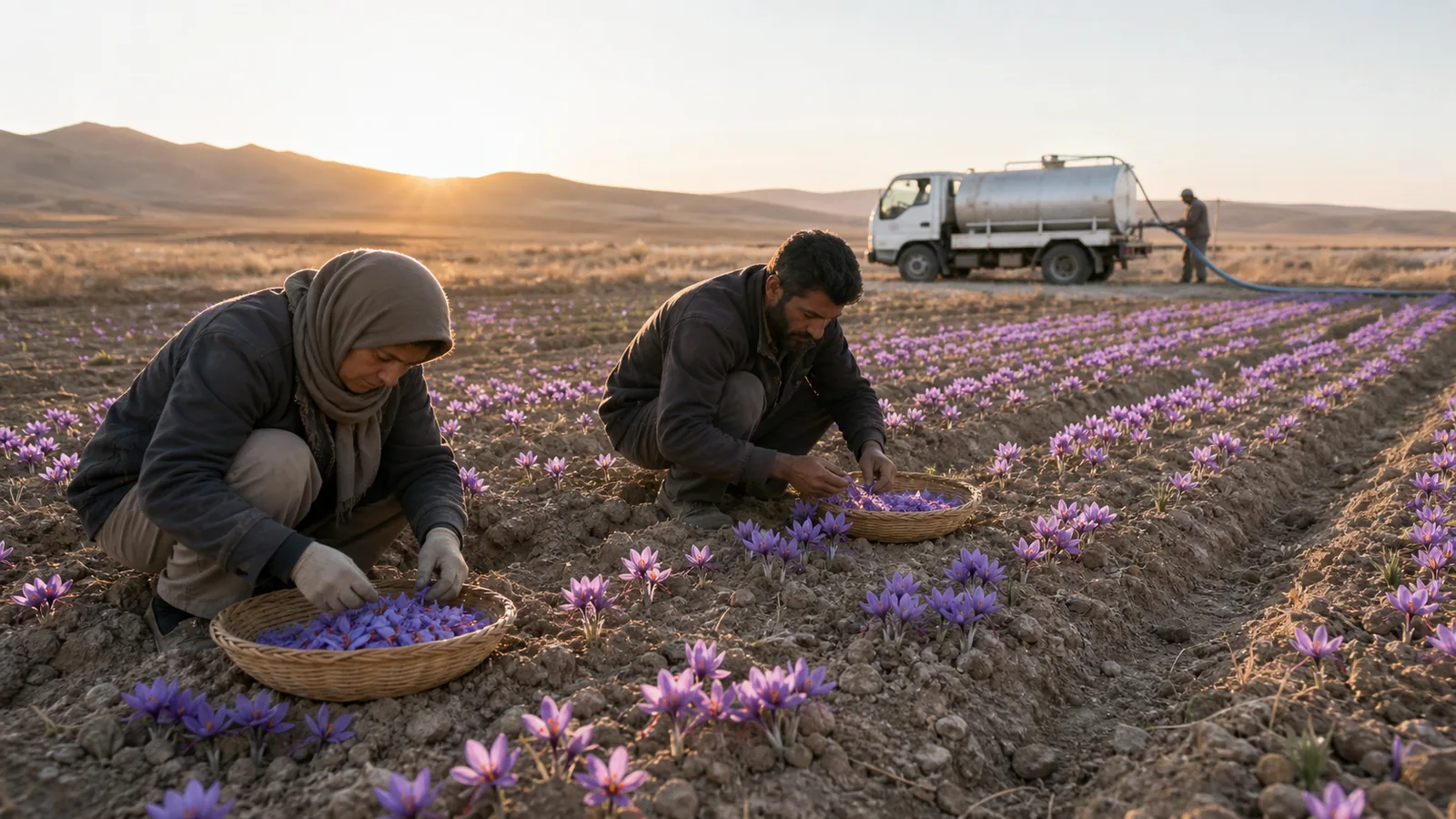
When the saffron harvest begins around Torbat Heydarieh, the purple flowers are only the visible part of the season. Behind them are decisions about water, fertiliser, labour and when to sell. In a 2015 interview, local farmer Jalal Javid described those pressures plainly. His account explains why the problems facing saffron farmers did not end when the crop reached the field.
The figures and proposals below belong to that 2015 report. They are kept as a record of what growers and local officials said at the time, not presented as current prices or programmes.
A short harvest season puts several demands together
In Torbat Heydarieh, the main harvest starts in early Aban on the Iranian calendar, usually late October or early November. Javid, a grower from Kaj Derakht village, said the work in his area was concentrated into roughly a month and a half. Many farms therefore needed water, workers and transport at the same time.
That concentration matters. A problem that might be manageable in another month can become expensive during harvest because there is little room to delay. Flowers need to be picked promptly, the stigmas must be separated, and the crop must be dried and protected from moisture. The farmer is also making selling decisions while these jobs are under way.
Saffron uses less water than many conventional crops, but that does not mean a field can produce without reliable water at the right stages. Research on Crocus sativus describes the quantity, quality and timing of irrigation as part of closing the crop’s yield gap in dry regions. The practical schedule varies with soil, weather, field age and the irrigation system; there is no single calendar that is right for every farm.
Water access was the first problem farmers named
Javid called severe water shortage the leading agricultural problem in his village. Some growers had to buy water by tanker. In the original account, a 12,000-litre load cost 80,000 tomans. That is a historical local figure, not a present-day quotation, but it shows the kind of extra cost a smallholder could face just as the season became most demanding.
He suggested that public support for pressurised irrigation could help. That idea should not be read as a universal recommendation for sprinklers. Comparative field work has examined sprinkler, drip, furrow and basin methods, and the appropriate choice depends on water quality, soil, field design, flowering stage and local expertise. A grower needs a site-specific irrigation plan rather than a technology label.
The broader lesson still holds: low total water use is not the same as low water risk. A delayed supply, poor-quality water or the wrong timing can affect flowering and corm development. Anyone planning a field should begin with a water budget and local agronomic advice; our guide to saffron irrigation timing explains the stages without prescribing one fixed interval.
Fertiliser was available, but not always on useful terms
The second complaint concerned access to suitable fertiliser at an affordable price. According to Javid, the local Agriculture Jihad office offered white fertiliser in a single allocation, while the difference from the open-market price was only about 1,500 tomans. A farmer who lacked storage or did not need the full quantity at once might therefore prefer to buy smaller amounts from the market.
This was not simply a complaint about price. It was a mismatch between the way an input was supplied and the way a small farm could use and store it. Buying more fertiliser than a field requires is not good agronomy, even when the unit price is lower.
Modern studies reinforce the need to treat nutrition and irrigation together. In a multi-year field experiment at Ferdowsi University of Mashhad, different combinations of irrigation interval and soil amendments produced different yield and quality outcomes. Those results do not provide a ready-made recipe for every farm. They show why a soil test, water assessment and locally appropriate nutrient plan are safer than a blanket application. The same principle runs through our practical saffron cultivation checklist.
Harvest-time prices can force a difficult sale
Price instability was the grievance Javid returned to most strongly. He said saffron prices tended to fall when harvesting began and that intermediaries bought at the lower seasonal price before selling into export channels at a higher value. The report did not publish transaction records that would let us calculate those margins, so it is more accurate to treat this as the farmer’s experience than as a measured market-wide spread.
The timing problem is easy to understand. Small growers incur harvesting, cleaning and drying costs at once. A household that needs cash immediately cannot always hold the crop for a later buyer, even if waiting might improve its bargaining position. Storage is only useful when the saffron has been dried correctly, kept away from light and moisture, documented by lot, and stored securely. Holding a poorly prepared crop can destroy value rather than preserve it.
Javid argued that saffron should receive a defined level of support comparable to other strategic crops such as wheat. He also said the sector lacked one clearly accountable authority. These were policy proposals made in 2015, not evidence that a guaranteed-purchase system exists today.
What local officials proposed
Saadat Ali-Nia, then director of Agriculture Jihad in Torbat Heydarieh, also identified price stability as the growers’ main concern, especially during harvest. He referred to proposals for an agreed government purchase and for a national saffron master plan developed with the National Saffron Council and the provincial agricultural authority.
The idea was to give the crop a more coherent administrative home, potentially through a dedicated organisation or deputy within the Ministry of Agriculture, centred in Khorasan Razavi. The interview recorded a proposal, not a completed institution. That distinction matters because an old announcement should never be mistaken for a current service available to a farmer.
Why the discussion focused on productivity, not more land
Ali-Nia cited a research estimate of 220 person-days of agricultural employment per hectare. With about 7,500 hectares then under saffron in the county, he said the sector supported nearly 8,000 permanent jobs and around 15,000 saffron-producing households, most of them smallholders. These are dated local estimates from the interview, but they explain why water, input and price decisions affected far more than a single harvest.
His stated goal was to raise output and quality on the land already planted. Expanding the cultivated area was not considered rational while water resources were constrained. Later research in Iranian saffron systems has reached a compatible practical conclusion: better use of existing land, labour, water and nutrients can matter more than simply adding hectares.
For a grower, productivity is not just kilograms per hectare. It includes the cost and reliability of water, the health of daughter corms, labour available during the narrow flowering window, stigma quality, drying losses and the price actually realised. A larger crop that arrives with higher costs or poorer quality may not improve household income.
The farmers’ saffron problem is a chain, not one fault
The 2015 Torbat account remains useful because it does not reduce the difficulty to one villain or one technical fix. Water scarcity affected the cost of production. The way fertiliser was distributed affected cash and storage. The compressed harvest raised labour and handling pressure. Immediate expenses weakened a smallholder’s position when prices fell.
A durable response has to connect those parts. It starts with field-specific soil and water planning, realistic input quantities, careful harvest and drying, traceable lots, and access to buyers who can judge quality. Public policy may influence the market, but a grower should not base a season on an old promise or an undated price.
That is the meaning behind the original title, Not all the problems of farmers: the flower can perform well while the farming household still carries water, input and market risks. Preserving the crop’s value requires attention to the whole route from the field to the buyer.
Sources and further reading
- Saffron water requirements, in Saffron: Science, Technology and Health (2020).
- Does nutrient and irrigation management alter the quality and yield of saffron?, Agricultural Water Management (2022).
- Qanat-based Saffron Farming System in Gonabad, Iran, FAO Globally Important Agricultural Heritage Systems.

![Exporting Saffron to Turkey + Price Guide [Complete 0 to 100]](https://img.rowhanisaffron.com/20260827003933/saffron-export-turkey-quality-inspection.webp)



