


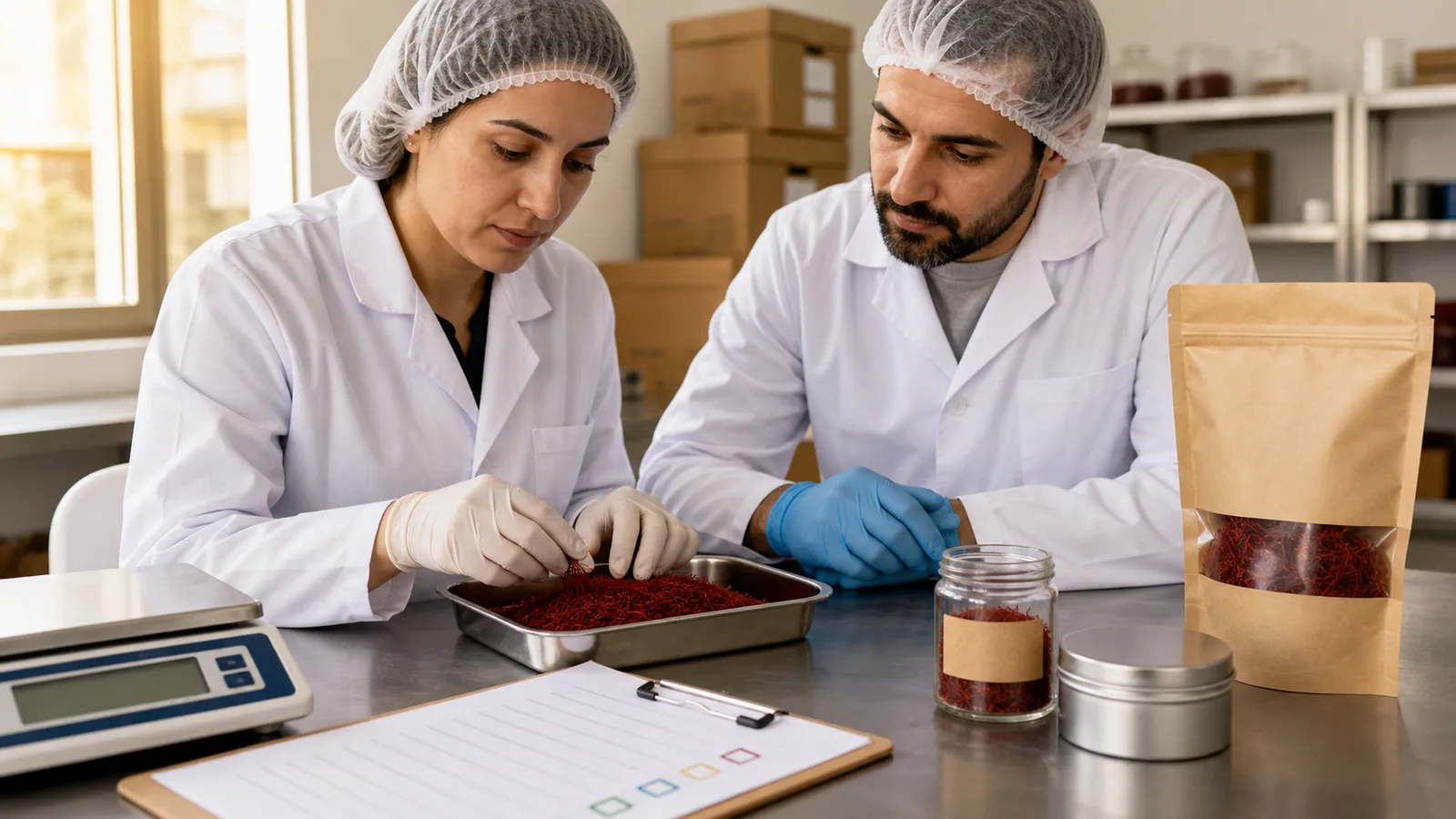
Saffron is tailored to customer requirements packing was the central message of a 2015 harvest report from Rashtkhvar in Khorasan Razavi. The wording is awkward in English, but the commercial point is sound: saffron packaging should be designed around what a real buyer needs, while protecting the spice and documenting exactly what is inside.
That means more than choosing an attractive box. The buyer may need filaments rather than powder, a particular tested grade, a retail or food-service weight, a defined shelf life, traceable origin and a label that meets the destination market’s rules. None of those requirements can be fixed at the packing line if the flowers were mishandled in the field or the stigmas were dried badly.
The Rashtkhvar harvest behind the packaging argument
Mohammad Abbaspour, then director of Agriculture Jihad in Rashtkhvar, told the Iranian Students News Agency that harvesting had begun across about 5,500 hectares. The 2015 forecast was for 15 to 17 tonnes of dried saffron, with an average yield of roughly 3.2 kilograms per hectare.
He identified Fathabad and nearby villages as the county’s largest production area, with saffron also prominent around Baraku, Eshratabad and Rashtkhvar. The harvest was expected to continue through the end of Aban, the Iranian calendar month that usually runs from late October into late November. For the county, those weeks brought both a different rhythm and a burst of seasonal employment.
Abbaspour described Rashtkhvar as Khorasan Razavi’s second-largest saffron cultivation centre after Torbat Heydarieh at that time. This was a dated regional ranking, not a current league table. He also cited an annual provincial output of 180 tonnes. Both numbers belong to the conditions and reporting period of the interview.
Production pressure did not end at the field edge
Drought and insufficient water were among the problems Abbaspour named, even as the county’s agricultural management supported an increase in saffron area. He also pointed to limited access to production and processing technology. The tension is important: planting more land can raise total volume, but it also increases the number of flowers that must be picked, separated and dried within a narrow window.
The report said fertiliser had been supplied to local growers and that a saffron-development initiative supported by the United Nations Industrial Development Organization had begun training local specialists and farmers that September. Its goals included a coherent network of producers, practical demonstration plans, and better cultivation and processing.
That initiative should be read as a historical programme, not as funding or training available today. The broader design is documented in UNIDO’s 2014 diagnostic study of Iran’s saffron value chain. It found that the largest opportunities for adding value sat in the relationships among processing, packaging, sales and final users, not in the package alone. Our separate account of the UNIDO saffron value-chain initiative records its locations, stages and dated funding claims.
Customer requirements begin with a written specification
A serious order starts with questions. Is the buyer purchasing whole filaments, cut filaments or powder? What analytical specification applies? How much goes in each unit? Is the pack for a household, restaurant, manufacturer or bulk distributor? Which language, lot code, origin statement and date information must appear? How will the product travel and where will it be stored?
The current Codex standard for dried saffron recognises filament, cut-filament and powder styles. It addresses purity and quality provisions, hygiene, declared contents and labelling, including the product name and commercial grade or class where applicable. ISO 3632-1:2025 likewise specifies requirements for dried saffron in those three forms, while its companion test methods are used to assess relevant properties.
These standards are a starting point, not a universal sales label. The destination country’s law and the buyer’s contract may add requirements. A packer should turn them into one controlled specification before production begins, then keep the laboratory result, lot record and approved artwork connected to the physical batch.
What packaging can and cannot do
Good saffron packaging protects a small, high-value product from moisture, light, contamination, crushing and unauthorised opening. It also carries information that helps a buyer verify the lot. The container should be food-contact suitable, close reliably, and be proportionate to the declared contents without impairing quality.
Packaging cannot make weak saffron stronger. It cannot restore aroma lost through slow or excessive drying, remove an adulterant, or turn mixed grades into a consistent lot. Nor does an expensive presentation box prove purity. Those qualities have to come from controlled handling, representative sampling and appropriate testing.
The form matters as well. Powder can be convenient for manufacturing and dosing, but visual inspection is harder and the product is more vulnerable to undetected substitution. Whole filaments allow more visual assessment, although appearance alone still cannot establish compliance. The choice should follow the intended use and verified specification, not a claim that one form is always best.
The customer’s pack is built through five linked decisions
- Define the use. A retail cook, pastry kitchen, beverage producer and laboratory buyer do not need the same unit size or handling format.
- Approve the product specification. Record the saffron style, agreed grade or analytical limits, lot size and any buyer-specific acceptance criteria.
- Select a protective pack. Match the material, closure and outer carton to light, moisture, breakage, transport and tamper risks.
- Approve the label. Check the product name, net quantity, lot identification, dates, responsible business, origin information and destination-language requirements.
- Keep the evidence together. The purchase order, test report, packing record and dispatch documents should identify the same lot.
Customisation is safe when it changes the size, presentation or information while keeping the product identity and evidence intact. It becomes risky when a buyer request would hide origin, blur the lot, overstate a grade or omit legally required information.
Harvest labour determines whether the specification survives
Abbaspour said labour shortages were a major concern because the flowers had to be collected quickly and the red stigmas separated from the petals. The original report referred to protecting four sensory factors—colour, taste or flavour, and aroma—through early picking, suitable processing and correct storage after drying.
Picking before sunrise was presented as the local practice. It should not be turned into a universal quality guarantee: weather, dew, flower condition, travel time and processing capacity also matter. The practical aim is to collect fresh flowers promptly, keep them clean and shaded, and avoid a backlog before separation and drying.
Mechanisation was suggested as a response to the seasonal labour bottleneck. Any new machine has to be judged against the delicacy of the flower and the quality of the resulting stigma, as well as its cost and effect on local work. A faster step is useful only if it reduces delay without adding damage or contamination.
Why Spain appeared in the 2015 comparison
The historical interview contrasted Iran’s production strength with Spain’s position in international trade. Abbaspour argued that Spanish businesses were better equipped to sort, process and package saffron to advanced standards and specific customer demands. He presented Spain as the largest exporter at the time.
That statement should not be reused as a current ranking without a year, product code and trade dataset. Export country is also not the same as harvest origin: saffron may be imported, packed and re-exported. The useful part of the comparison is the market lesson. A producer retains more value when it can supply verified quality in the form, quantity and documentation a final buyer requests.
A pack should answer the buyer’s practical questions
Before accepting a customised saffron order, a packer should be able to answer: Which lot is this? What form and quantity does it contain? Which specification was tested? How does the container protect it? What information must the receiving market see? Can every carton be traced back to the packing record?
When those answers are clear, tailoring supports both the customer and the product. When they are missing, custom packaging is only decoration. The Rashtkhvar report’s lasting point is that market value is created through a chain—from water and harvest labour to careful drying, verified quality, accurate labelling and a pack made for an identified use.
Sources and standards
- Saffron Industry Value Chain Development in Iran: Diagnostic Study Report, UNIDO (2014).
- Standard for Dried Floral Parts—Saffron (CXS 351-2022), Codex Alimentarius.
- ISO 3632-1:2025: Spices—Saffron—Specification, International Organization for Standardization.

![Exporting Saffron to Turkey + Price Guide [Complete 0 to 100]](https://img.rowhanisaffron.com/20260827003933/saffron-export-turkey-quality-inspection.webp)



