


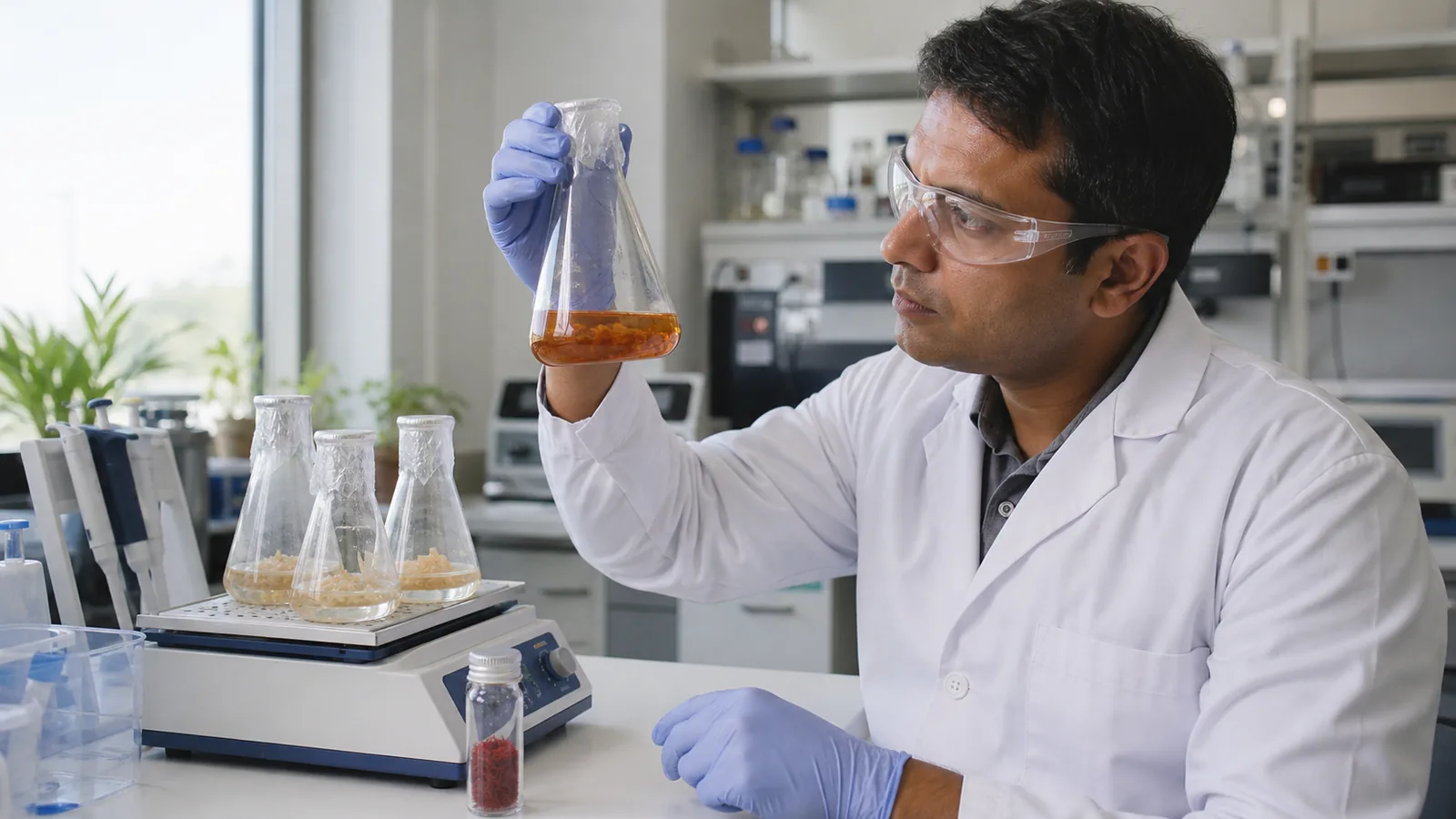
Production “crocin” saffron cell culture was announced at laboratory scale by Iran’s Food Science and Technology Research Institute in 2015. Dr Seyed Mehdi Ziaratnia, then a faculty member at the institute, described it as the first production of saffron crocin by cell culture in Iran. The report documented a research milestone; it did not show that low-cost commercial production had already been achieved.
The distinction matters for anyone searching for crocin saffron. Crocin is not another name for the whole spice. It is a family of water-soluble, carotenoid-derived compounds that contributes much of the intense colour released by saffron stigmas. A cultured cell system may produce crocins without producing the same mixture of aroma, flavour and other constituents found in dried saffron.
What the Iranian announcement actually said
In the account carried by the ISNA research service, Ziaratnia said the institute had produced crocin at laboratory scale using a cell-culture method. He presented the approach as a way to make a saffron active compound outside a farm and therefore with less exposure to field conditions and environmental limits.
The project was also motivated by labour. Conventional saffron production requires corm cultivation, flower picking and hand separation of the stigmas within a short season. Ziaratnia argued that cell culture could eventually offer a more economical route to crocin and create higher-value inputs for food, pharmaceutical, cosmetic and hygiene-related industries.
His stated long-term goal was large-scale, lower-cost production for relevant industries. The old article did not publish the culture medium, cell line, crocin yield, purity, batch variation, extraction process, cost model or bioreactor result. It therefore supports a laboratory announcement and an industrial objective—not a claim that scale-up or commercial economics had been proved.
What “cell culture” means in this context
Plant cell culture begins with plant material under sterile conditions. Researchers can induce a mass of undifferentiated tissue called callus and use suitable cells to establish a liquid suspension. Nutrients, temperature, light, growth regulators and other conditions are controlled while the cells grow and make metabolites.
That is different from hydroponic saffron or greenhouse flower production. The aim is not to harvest a normal flower. It is to encourage cells to make a selected compound, then measure, recover and purify that compound from the culture or the surrounding medium.
Peer-reviewed work confirms that saffron cell suspensions can produce crocin. A 2020 study established cultures from style-derived callus and used salicylic acid as an elicitor. At the highest treatment, the researchers reported sevenfold greater crocin production than untreated control cells, but also observed growth inhibition and stress-related cell death. That trade-off illustrates why a result that raises concentration in a flask is not automatically the best process in a factory.
Crocin, crocetin and saffron are not interchangeable
Crocetin is a carotenoid-derived backbone. When sugar groups are attached, a family of crocetin esters known as crocins is formed. The exact crocin profile can vary, so a report should identify what was measured and by which analytical method rather than using “crocin” as though it were one simple, self-verifying ingredient.
Dried saffron contains more than crocins. Picrocrocin is associated with characteristic taste, while safranal is a major contributor to aroma. Moisture, foreign matter, other pigments and the physical form of the stigmas also matter when the product is sold as a spice. A cultured crocin ingredient may be useful for a defined industrial purpose, but it is not automatically a substitute for culinary saffron.
This is also why colour alone cannot authenticate saffron. A bright extract may contain a colouring compound without having the identity, composition or sensory profile of genuine Crocus sativus stigmas.
Why researchers pursue cultured crocin
A controlled culture is attractive because it can run outside the flowering season and avoid some field variability. Researchers can adjust the medium and use elicitors to influence metabolite production. In principle, a well-controlled process could offer repeatable batches and reduce the amount of agricultural material needed for an isolated ingredient.
Those advantages remain conditional. Cells can change over repeated passages; contamination can end a batch; the product may remain inside the cells; and extraction can be more expensive than cultivation. A process also needs enough biomass and enough crocin per litre to justify the equipment, labour, sterile utilities and purification steps.
A recent scientific review describes callus, cell suspension and stigma-like structures as promising routes for saffron metabolites, including work with two-stage cultures and bioreactors. “Promising” is the right word. Each platform still has to demonstrate stable productivity, product identity, purity, safety and cost at the intended scale.
Evidence needed before calling the process industrial
A commercial claim should answer more than whether a chromatogram contains a crocin peak. At minimum, the process needs evidence for:
- the identity and origin of the cultured cells;
- crocin composition, concentration and validated analytical methods;
- yield per litre and productivity over time, not only a relative increase;
- repeatability across independent batches and repeated passages;
- contamination control and genetic or metabolic stability;
- recovery, purification, residual solvents or media components, and final purity;
- stability during storage and use in the intended formulation;
- bioreactor performance, waste, energy and full production cost; and
- the food, cosmetic or pharmaceutical regulatory route for the destination market.
The 2015 press report supplied none of those scale-up datasets. That omission does not invalidate the laboratory work. It sets the boundary around what readers can conclude from it.
Food, cosmetic and pharmaceutical use require different proof
Ziaratnia referred broadly to food, pharmaceutical, cosmetic and hygiene applications. A compound’s possible use in research or formulation does not establish approval for every category. Food-colour use requires identity, purity, safety and applicable food-law compliance. Cosmetic use depends on formulation, exposure and local rules. A pharmaceutical ingredient faces a much more demanding route covering manufacturing control, preclinical evidence and clinical testing.
Laboratory studies of crocin have reported biological activity, but cell and animal experiments do not prove that a cultured crocin product treats disease in people. This article therefore makes no prevention, treatment or cure claim. “Medicinally valuable” in the original announcement is retained as the researcher’s description of the development aim, not converted into patient advice.
How this 2015 record fits the wider research
The Iranian project was not the world’s first evidence that saffron cells could make crocins. Peer-reviewed studies had reported crocin biosynthesis in Crocus sativus cultures before 2015. The specific historical claim was “first in Iran,” as reported by Ziaratnia.
Later research has expanded the field. Scientists have tested elicitors, stirred bioreactors, engineered plant cell suspensions and microbial systems. These approaches help researchers understand the biosynthetic pathway and explore alternative production, but they are not all the same technology and should not be combined into one claim of commercial readiness.
For a fuller explanation of the laboratory stages and their scale-up limits, see our guide to producing saffron crocin by cell culture. The role of this page is narrower: to preserve exactly what the Iranian institute announced, identify what the report did not establish, and show the evidence needed to move from a laboratory result to an industrial ingredient.
Sources and research
- Salicylic acid induces exudation of crocin and phenolics in saffron suspension-cultured cells, Plants (2020).
- Crocin synthesis mechanism in Crocus sativus, Tsinghua Science & Technology (2005).
- Production of bioactive metabolites in in-vitro cultures of saffron, scientific review chapter (2024).

![Exporting Saffron to Turkey + Price Guide [Complete 0 to 100]](https://img.rowhanisaffron.com/20260827003933/saffron-export-turkey-quality-inspection.webp)



