


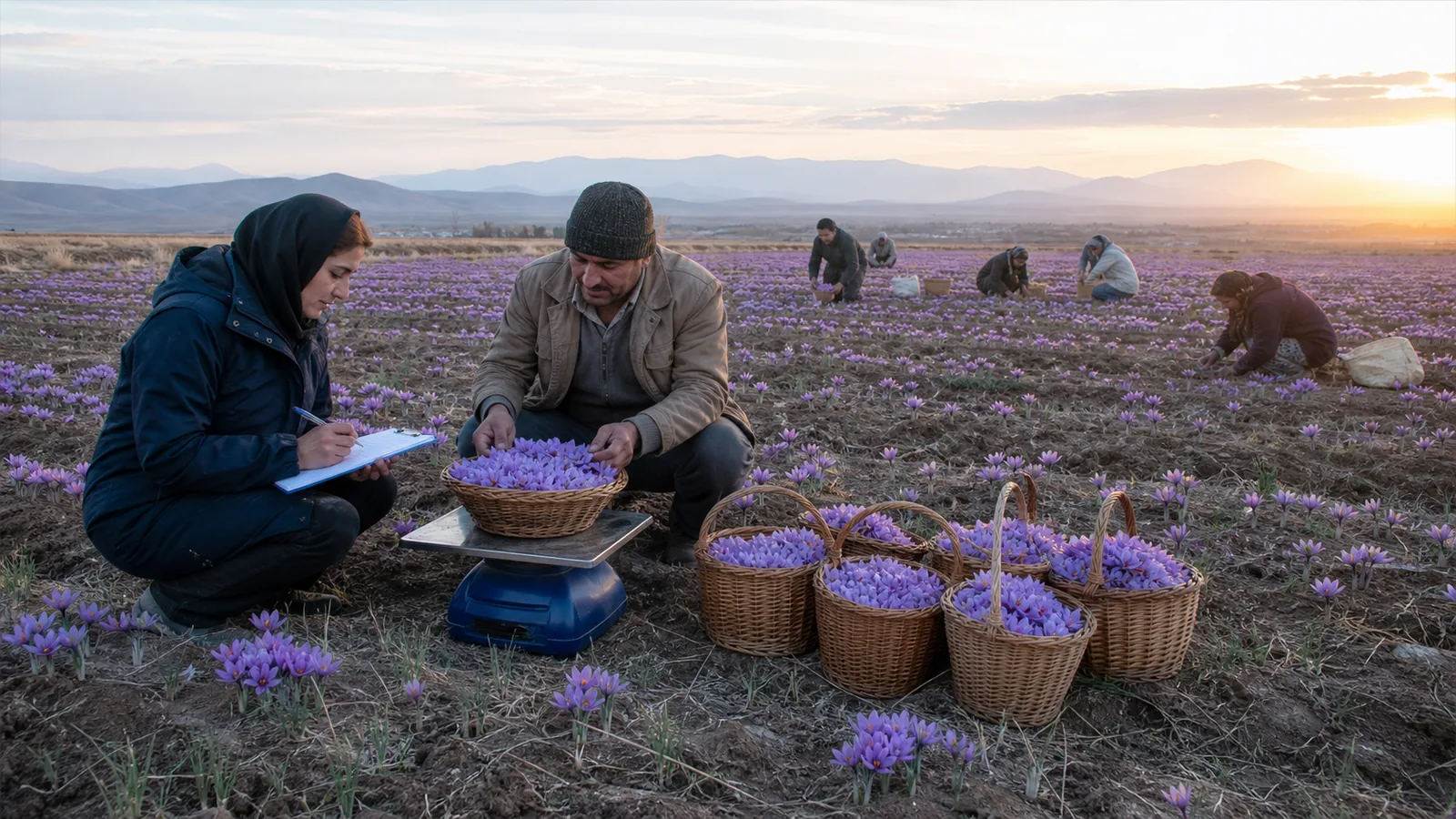
Expected to harvest 246 tons of saffron in Khorasan Razavi was a provincial forecast, not a current production figure. Ramin Esmi, the Khorasan Razavi Agriculture Jihad official responsible for saffron, said the province had produced 246 tonnes in the preceding season and expected the next Khorasan Razavi saffron harvest to be somewhat larger as planted area increased.
The archived report was published on this site in 2016, but its source text does not identify the harvest year unambiguously. Every quantity below is therefore treated as a dated forecast from that reporting period. It should not be quoted as the province’s output today.
What the 246-tonne figure measured
The original Persian described sargol: dried saffron made mainly from separated red stigma material. It did not mean 246 tonnes of fresh flowers. The distinction was lost in a later duplicate translation, which called the total “saffron flowers.”
Esmi said roughly 75 to 80 kilograms of fresh flowers were needed for one kilogram of dried sargol. That ratio varies with flower size, separation style, moisture and drying, but it makes the scale clear. Hundreds of tonnes of dried saffron imply an enormous volume of flowers picked and processed during a short season.
The report placed the previous cultivated area at 64,000 hectares and forecast 68,000 hectares for the coming season. Dividing 246,000 kilograms by 64,000 hectares gives about 3.84 kilograms per hectare, which is consistent with Esmi’s stated average range of 3.5 to 4 kilograms per hectare. The arithmetic does not prove the forecast, but it shows that the area, output and yield claims describe the same order of magnitude.
Why the harvest was expected to rise
More planted land was one reason. Esmi also referred to Agriculture Jihad’s efforts to introduce improved planting and harvesting practices. He made the forecast conditional: an early frost or unusually heavy, early rain could reduce the result.
Flowering and harvesting do not begin everywhere at once. He reported that initial picking had started in some colder parts of Torbat Heydarieh while other fields were still developing. A province-wide forecast made at that point still depended on weather and the performance of later districts.
That is why “expected” in the title matters. A forecast combines planted area, expected yield and current field observations. A final estimate should be based on harvested output. The two should not be merged simply because they refer to the same crop year.
The master plan aimed at yield, not more hectares
Esmi said the Khorasan Razavi comprehensive saffron plan targeted a rise in yield from about 3.5–4 kilograms per hectare to 8–10 kilograms. Expansion of planted area was not part of the plan.
The 8–10 kilogram figure was a policy target, not a promise to every farmer. Field age, corm size and health, density, soil, irrigation, weather, nutrition, weeds, disease, harvest labour and drying all affect the result. A target more than twice the reported average requires field-specific diagnosis; it cannot be reached by applying one input everywhere.
Peer-reviewed cropping trials support that caution. Corm size, irrigation, planting depth and density can change flower and stigma yield, but their effects interact and vary over the life of a field. A practice that raises first-year production may not be the best long-term use of planting material or water.
Why area increased even without an expansion policy
The report describes an apparent contradiction. The official plan did not seek more saffron land, yet area was expected to rise from 64,000 to 68,000 hectares. Esmi said this growth occurred through farmers’ decisions rather than a planned provincial expansion.
He connected those decisions to changing conditions in northern parts of the province, saffron’s lower water requirement relative to some alternatives, and the income farmers associated with saffron and pistachios. Sugar beet was named as a crop with high water demand whose economics had become less attractive in parts of the region.
Lower water demand does not mean water is irrelevant. FAO’s description of the qanat-based saffron system in nearby Gonabad places saffron farming within severe water scarcity and stresses the importance of a reliable supply. A crop switch should compare total seasonal water, timing, soil, crop rotation, labour, market risk and farm income—not only the selling price of the final spice.
The cultivation practices Esmi highlighted
Esmi referred to larger corms, organic fertilisers and an appropriate planting date as improved cultivation practices. For harvest, he stressed hygienic handling, timely picking and prompt drying. He also said mechanised saffron harvesting had not yet become an established option in Iran at the time.
Each point needs a boundary:
- Larger corms: well-developed, healthy corms often support stronger early flowering, but size alone does not establish health or the correct planting density.
- Organic fertilisers: an organic amendment is not automatically suitable in type or dose. Soil condition, maturity, contamination risk and nutrient balance still need assessment.
- Planting date: timing depends on local climate, soil and the production system rather than one national calendar date.
- Timely harvest: flowers should be handled without avoidable delay, but labour and drying capacity must be planned together so picked material does not accumulate.
- Drying: time and temperature affect moisture and saffron’s colour-, taste- and aroma-related compounds; faster is not automatically better.
Our saffron cultivation checklist develops these decisions without turning the historical provincial suggestions into universal prescriptions.
Price stability was part of the production discussion
Esmi said prices were influenced by the Saffron Exporters Association and other organisations connected to the sector. In his view, large fluctuations should be avoided because they created problems for both producers and exporters.
This was a policy opinion, not evidence of a fixed official price. Yield growth only helps a farm if the additional crop can be harvested, dried, documented and sold at a return that covers the extra inputs and labour. Production targets and market capacity therefore belong in the same plan.
Why historical saffron totals often disagree
An Iranian dataset submitted during development of the Codex saffron standard lists 218.348 tonnes, 69,407 hectares and a 3.1-kilogram-per-hectare yield for Razavi Khorasan in 2014–15. Those figures do not match the 246-tonne report exactly.
The difference is not safely resolved by choosing the larger number. The records may use different seasons, cut-off dates, product definitions or forecast/final methods. The correct approach is to keep each series with its source, year and definition. For more recent, explicitly dated country and regional context, use our saffron production statistics page rather than carrying this forecast forward.
How to read a saffron harvest estimate
Before comparing two production numbers, check whether each one refers to fresh flowers or dried stigma, whether it is a forecast or final estimate, which geographic boundary and crop year it covers, and whether planted or harvested area is used. Then test the arithmetic: output divided by hectares should be plausible alongside the stated yield.
The 246-tonne forecast remains valuable because it records the province’s thinking at the time: expand productivity rather than the official acreage target, account for early frost and rain, improve planting material and post-harvest handling, and recognise that farmers may change crops for water and income reasons. Its value is historical and analytical—not as a present-day total.
Sources and supporting evidence
- Iranian saffron production data submitted for Codex standard development, Ministry of Agriculture-Jahad figures for 2014–15.
- Yield and yield components of saffron under different cropping systems, Industrial Crops and Products.
- Qanat-based Saffron Farming System in Gonabad, FAO Globally Important Agricultural Heritage Systems.

![Exporting Saffron to Turkey + Price Guide [Complete 0 to 100]](https://img.rowhanisaffron.com/20260827003933/saffron-export-turkey-quality-inspection.webp)



