


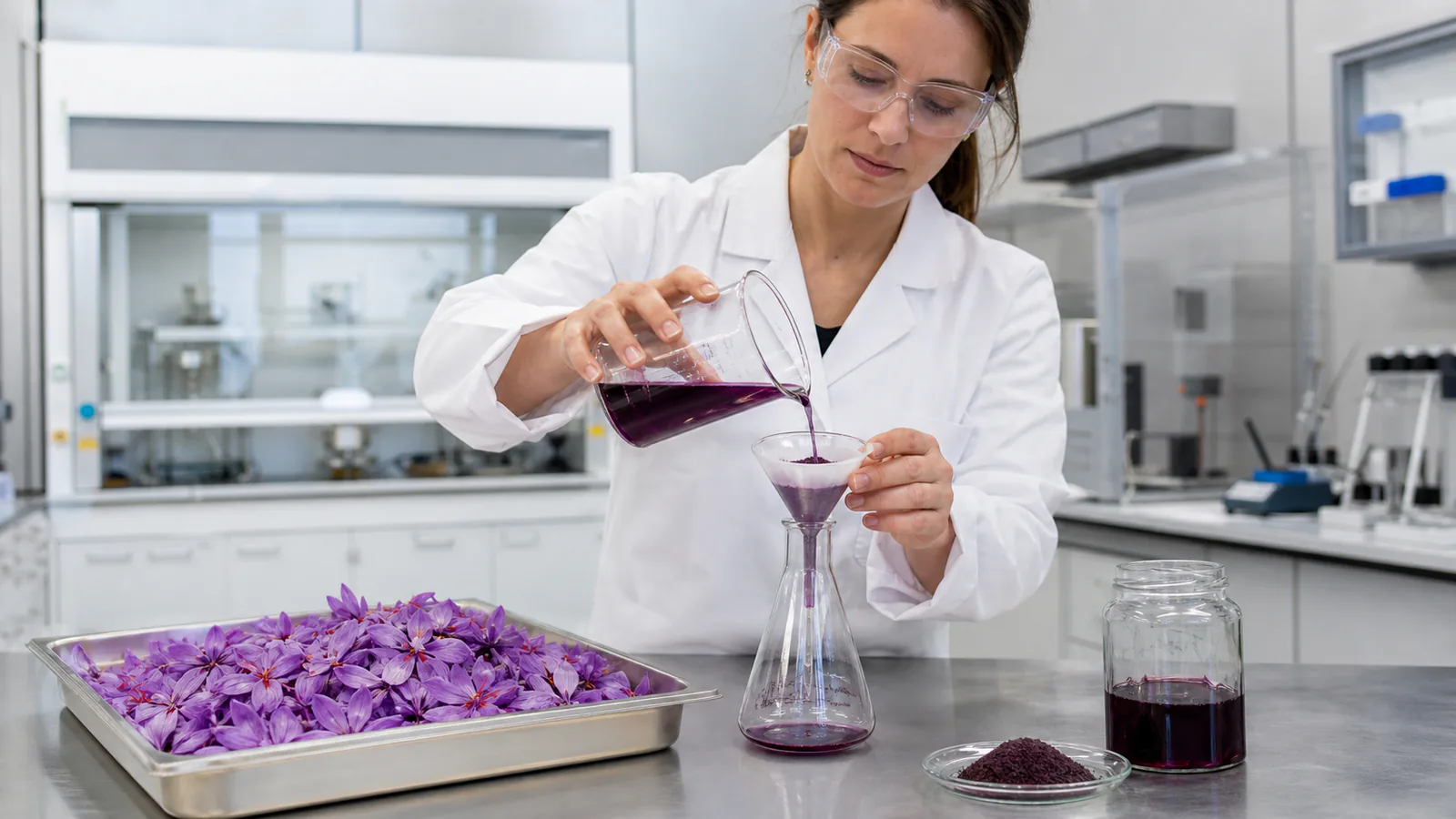
Purple saffron petals can yield an anthocyanin-rich natural colour, turning a bulky harvest byproduct into a possible food ingredient. Iranian researchers have studied how to extract the pigment, preserve its colour and produce it in liquid or powder form. The science is promising, but a laboratory extract does not become an approved food or medicine ingredient automatically.
The opportunity is significant because the red stigmas represent only a small fraction of each Crocus sativus flower. Once they are removed, the pale-purple floral material is often treated as waste. Recovering useful compounds could reduce disposal and give processors another product from the same harvest.
What saffron petal waste contains
The parts commonly called petals are botanically similar tepals. Their purple, red and blue tones come largely from anthocyanins, a family of water-soluble flavonoid pigments also found in berries, red cabbage and grape skins.
Colour is only one part of the chemistry. Saffron floral material also contains other phenolic compounds. Laboratory studies report antioxidant activity, but that result should not be turned into a treatment claim for cardiovascular disease, cancer or inflammation. The proposed commercial value here is primarily as a colour source and agricultural co-product.
How much floral material is available
The historical research announcement behind this article described saffron cultivation across roughly 70,000 hectares in the Khorasan provinces and estimated that more than 20,000 tonnes of petals were buried or discarded. Those figures reflect the production context reported at the time, not a current national waste inventory.
The exact amount available to a processor changes with flower yield, moisture, local collection practices and how quickly material can reach a facility. Fresh petals contain considerable water and deteriorate rapidly, so their theoretical tonnage is not the same as a usable supply of stable pigment.
From purple petals to a colour extract
1. Collect and sort the byproduct
Petals need to be separated from soil, leaves, damaged material and remaining stigma fragments. A food-use supply chain also needs hygienic containers and lot records. Material collected from the floor or mixed with foreign matter cannot simply be upgraded by extraction.
2. Stabilise it quickly
Enzymes, oxygen, heat and microbes can change fresh floral material. Depending on the planned process, petals may be cooled, dried or extracted promptly. The chosen method affects both yield and colour.
3. Extract the anthocyanins
Because anthocyanins are water-soluble, researchers can use aqueous or food-compatible solvent systems under controlled conditions. A peer-reviewed study of enzymatic extraction from saffron tepals examined pigment yield, colour properties and structural stability. Enzymes can help break down plant tissue, but the process still has to control pH, temperature, time and solvent composition.
4. Clarify and concentrate
The liquid extract may require filtration and concentration. If it will be sold as a powder, a drying process such as spray-drying normally needs a carrier and carefully chosen conditions. The result must be measured for pigment strength, moisture, contaminants and stability.
Why anthocyanin colour is difficult to stabilise
Anthocyanins change structure as acidity changes. They tend to appear redder under acidic conditions and can become less stable or shift hue as pH rises. Heat, light, oxygen, enzymes, metal ions and storage time also influence the result.
That means a colour that works in an acidic drink may perform differently in ice cream, a baked product or a neutral sauce. Product developers need to test the actual food matrix, processing temperature, package, shelf life and expected storage conditions. “Natural” does not mean universally stable.
Possible uses for saffron petal colour
The original Iranian project proposed both liquid and powder formats and mentioned desserts, ice cream, drinks and some pharmaceutical applications. Those are technically different markets:
- Drinks: acidity may support a red-purple hue, but light and shelf life must be tested.
- Frozen desserts: the pigment has to remain even through mixing, freezing and storage.
- Confectionery and desserts: heat, water activity and interaction with other ingredients can alter colour.
- Medicines: colour use is regulated and must be compatible with the dosage form; the pigment does not add a therapeutic property by default.
The institute’s announcement said the colour had been prepared at laboratory and industrial scale and had reached a commercialisation stage. That describes the project’s status when reported; it is not evidence that a particular product is currently authorised or on sale.
Natural and synthetic colours use the same safety principle
It is inaccurate to say that a saffron-petal colour is safe merely because it comes from a flower, or that approved synthetic colours are inherently harmful. Source and safety are different questions.
The US Food and Drug Administration explains that colour additives from natural and synthetic sources must meet safety requirements for their intended uses. An evaluation considers identity, composition, manufacturing, likely intake, immediate and long-term effects, impurities and analytical methods. Other markets have their own authorisation and labelling rules.
For saffron petals, a manufacturer would need specifications for the plant source and extraction process, limits for pesticide residues, microbes, heavy metals and solvent residues, stability data, intended applications and a way to measure the pigment reliably.
What a viable petal-colour business must solve
The technology has to work during the short saffron harvest, when fresh floral material arrives quickly. Collection cannot interfere with the careful handling of the valuable stigmas. A facility then needs enough throughput to justify equipment that may be highly seasonal.
Transport is another constraint: moving wet petals long distances means moving water. Decentralised drying or extraction near the harvest may be more efficient, but it raises questions about consistency and hygiene across sites.
Finally, the buyer needs a reason to switch. Colour strength, hue, stability, price and regulatory status must compete with established alternatives. Sustainability is stronger when measured—how much waste was diverted, how much energy and solvent were used, and whether growers or local processors received added value.
A credible circular use for the saffron flower
Extracting natural colour from saffron petals waste is a credible example of agricultural upcycling. The petals contain recoverable anthocyanins, and research has shown that extraction conditions can be designed around yield and stability.
The next steps are practical rather than promotional: secure clean material, standardise the process, test colour in each intended product, meet the relevant safety rules and prove the economics. Done well, the purple part of the saffron harvest can become a useful ingredient instead of a disposal problem.

![Exporting Saffron to Turkey + Price Guide [Complete 0 to 100]](https://img.rowhanisaffron.com/20260827003933/saffron-export-turkey-quality-inspection.webp)



