


Iranian saffron exports reached 58 tons worth $83.118 million in the first half of the historical year covered by this report. Shipments went to 45 countries, while export weight rose 22.8% and value rose 22.5% from the comparable period. Officials initially forecast 150 tons for the full year. A later end-of-harvest briefing raised the crop-year export target to 200 tons after production was estimated at 300 tons and export duties were removed.
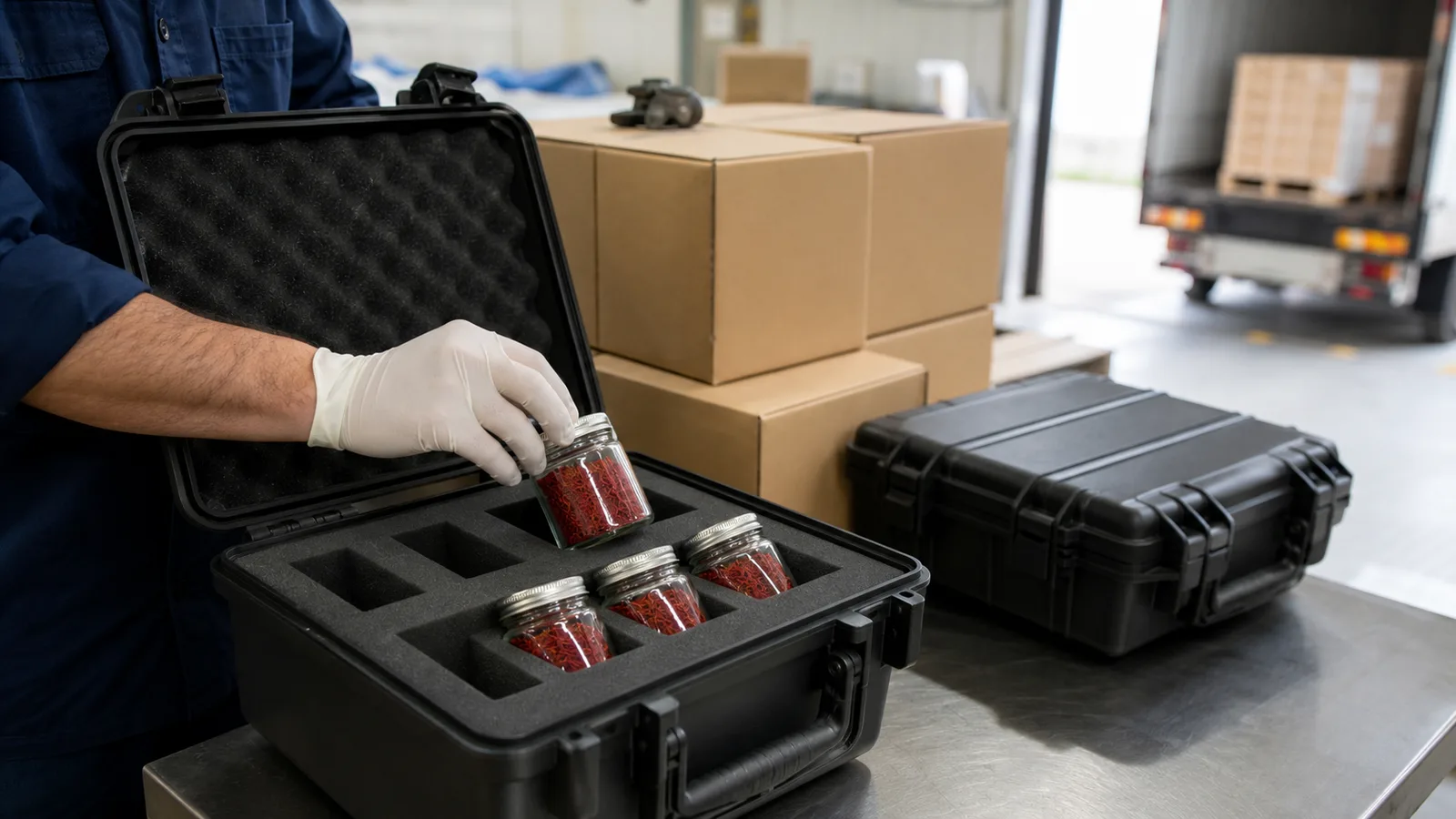
What the $83 million half-year export figure measured
Ali Hosseini, then vice president of the South Khorasan Saffron Producers and Exporters Association and a member of the National Saffron Council, reported the six-month result as 58 tons valued at $83 million and $118,000.
The translated customer list names Qatar, Spain, Saudi Arabia, the Netherlands, Australia, and Canada among the 45 destinations. Qatar appears twice in the original translation, so it is listed only once here.
Export weight and export value grew at nearly the same rate—22.8% and 22.5%, respectively. That means the reported increase came mainly from shipping more saffron, not from a large change in declared value per kilogram. Using the rounded totals, the six-month average was about $1,433 per exported kilogram. This is a broad customs-style average across grades, pack sizes, contracts, and destinations, not a retail price.
Why the forecasts moved from 150 to 200 tons
At the half-year point, Hosseini expected Iranian saffron exports to reach about 150 tons by year-end. The related source was published after the harvest and described a stronger crop-year outlook: production had risen roughly 20% to around 300 tons, and exports were targeted at 200 tons.
Those figures are successive forecasts from different stages, not two completed annual totals. The later estimate reflected information available after harvesting and a policy change that removed saffron export duties. The translated report also refers to the possible removal of an exporters’ foreign-exchange return commitment, although its wording is too unclear to define the exact rule.
A target is not the same as a recorded customs result. Realized exports still depend on buyer demand, quality, contracts, financing, transport, border rules, and currency conditions. Our broader saffron export overview explains the difference between production capacity and actual international shipments.
The 300-ton production expectation
The Ministry of Agriculture expected more than 80,000 hectares to be under saffron cultivation and forecast at least 300 tons of production. Hosseini contrasted the recent average yield of about 3.5 kilograms per hectare with an older benchmark of roughly 5 kilograms per hectare.
The rounded numbers are broadly consistent: 80,000 hectares at 3.5 kilograms per hectare would produce about 280 tons, close to a 300-ton national forecast once acreage above 80,000 hectares, stronger farms, and rounding are considered.
The yield comparison was central to the policy discussion. Adding land is not the only path to more saffron. Better corm material, field management, irrigation timing, skilled harvesting, and post-harvest control can raise usable output from existing acreage, although results remain exposed to weather and local conditions.
A five-year goal of 500 tons
Hosseini proposed reaching 500 tons of national production within five years without expanding the cultivated area. The idea was to close part of the yield gap through productivity improvements.
The translated source describes the goal as achieving one gram per square metre. That wording does not reconcile exactly with the other numbers: one gram per square metre equals 10 kilograms per hectare and, across 80,000 hectares, would imply much more than 500 tons. It may describe an incremental target, a long-term ceiling, or a translation error. The reliable takeaway is the stated 500-ton ambition through productivity rather than new acreage; one gram per square metre should not be treated as a verified achieved yield.
The destination report also mentions a multi-year National Saffron Council project to build a producer information base and improve competitiveness in South Khorasan and Khorasan Razavi. Its translated description lacks enough operational detail to assess results, but it shows that officials linked better data and field support with the productivity plan.
Why Iranian saffron was repackaged before reaching the US
The related interview described a historical re-export route created by restrictions on direct Iranian agricultural imports into the United States. According to Hosseini, Iranian saffron was repackaged in countries including Spain, India, and Afghanistan before being sold onward to American buyers.
He estimated that this route raised the final price by roughly 50%, while the additional margin did not benefit Iranian exporters or US consumers. This is an attributed historical estimate, not a current universal markup. The route, sanctions environment, shipping costs, and commercial margins can all change over time.
Hosseini’s remedy was better export packaging and a stronger Iranian identity for the product. Packaging can protect saffron and provide traceability, but origin claims also need reliable records, grading, and enforcement. Simply changing the box does not prove where the saffron was grown.
How to interpret the prices and percentages
The $83.118 million total is the value of a specific historical six-month export period. It should not be used as today’s market size or converted directly into a current selling price. Saffron values vary by grade, moisture, laboratory results, package size, destination, and contract terms.
Similarly, the reported 20% harvest rise, 22.8% export-weight rise, and 22.5% export-value rise refer to different comparisons. They can be discussed together, but they should not be added into a single growth rate. For current buying context, use the site’s saffron price information rather than the historical export average.
What the consolidated report establishes
The two historical briefings trace a changing outlook through one crop cycle. Half-year exports stood at 58 tons worth $83.118 million, with an initial full-year forecast of 150 tons. After a harvest estimated at 300 tons and the removal of export duties, the crop-year export target rose to 200 tons.
They also identify the longer-term challenge. Iran could grow more value by improving productivity, preserving origin, reducing unnecessary re-export steps, and matching higher production with credible grading, packaging, and direct market access. The numerical targets remain historical forecasts; the value-chain problem they describe is the lasting subject of the article.

![Exporting Saffron to Turkey + Price Guide [Complete 0 to 100]](https://img.rowhanisaffron.com/20260827003933/saffron-export-turkey-quality-inspection.webp)



