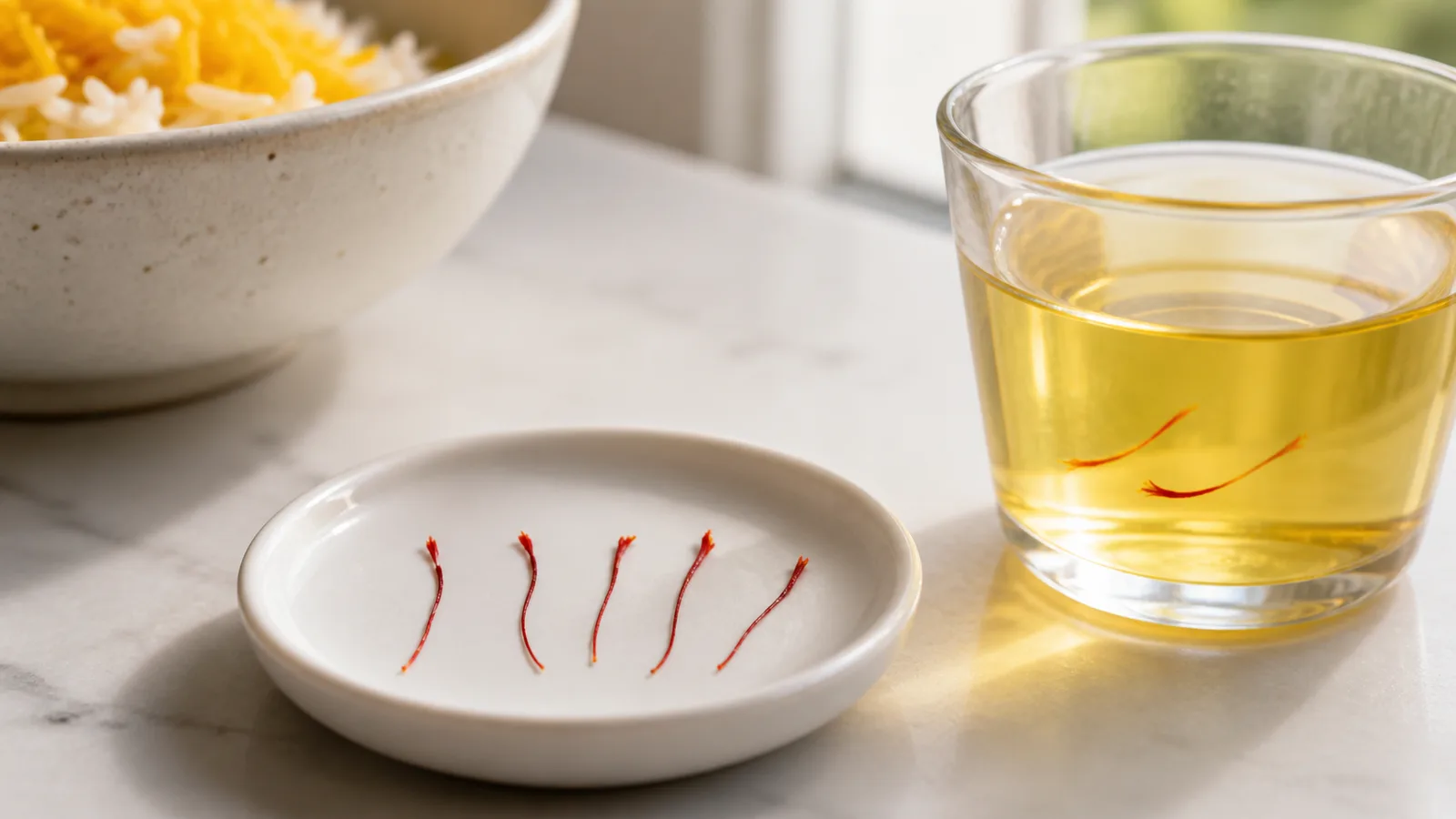
No. At ordinary market prices, saffron is not worth more than gold by weight. “Red gold” is a useful nickname for a rare, labour-intensive spice, but it is not a literal price comparison. In a like-for-like calculation using the same currency, date and unit, investment gold generally costs far more per gram than even premium saffron.
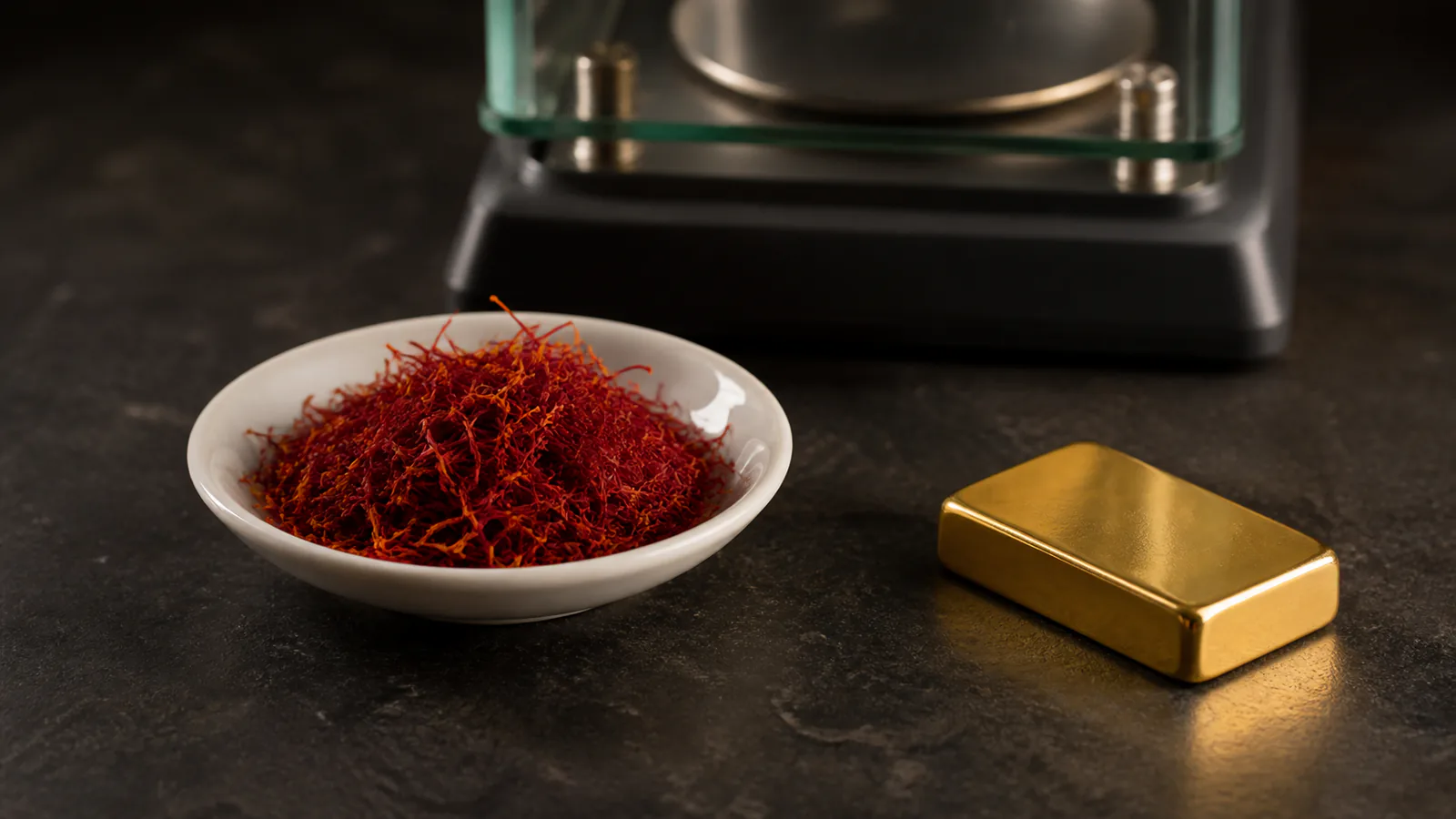
The confusion survives because older articles compare a high retail saffron price with an old gold quote, switch between grams and kilograms, or repeat an exceptional saffron figure as though it represented the whole market. Saffron price vs gold only makes sense when the products and units are stated clearly.
Saffron price vs gold in 2026
The World Gold Council reported an LBMA Gold Price PM of US$4,072.05 per troy ounce on 26 June 2026. Since one troy ounce is 31.1035 grams, that equals about US$130.92 per gram, or approximately US$130,919 per kilogram. The Council’s mid-year outlook discussed a second-half reference level around US$4,100 per ounce, while stressing that the market can move.
Now apply the same units to the saffron figures in the original version of this article:
- US$5,000 per kilogram of saffron is US$5 per gram.
- US$10,000 per kilogram is US$10 per gram.
- Even the retired source article’s exceptional US$65-per-gram claim would still be about half the June 2026 gold reference.
On those figures, gold is roughly 13 to 26 times more expensive per gram than saffron in the US$5–10 range. This is an illustrative comparison, not a current saffron quotation or investment advice. Saffron prices depend on grade, origin, harvest, quantity, packaging, laboratory evidence and delivery terms. Gold changes throughout the trading day.
How to compare the two correctly
A reliable comparison takes only a few steps:
- Use prices from the same date and currency.
- Convert the gold quote from a troy ounce to grams by dividing by 31.1035.
- Convert a saffron quote per kilogram to grams by dividing by 1,000.
- State whether the saffron price is wholesale, retail or an unusually small gift package.
- Compare like with like: physical product price before tax and delivery, not a futures quote against a retail jar.
The World Gold Council’s price methodology also distinguishes troy ounces, grams and kilograms. That small unit check prevents the most common error in “more expensive than gold” stories.
Why is saffron called red gold?
The phrase describes value, scarcity and cultural importance, not a standing exchange rate. Each Crocus sativus flower produces only three stigmas. They are picked during a short harvest window, separated carefully and dried under controlled conditions. A large number of flowers and many hours of skilled work are needed for one kilogram of finished spice.
Quality also changes the price. Thread cut, proportion of red stigma, moisture, cleanliness, aroma, colour strength, harvest age, origin evidence, packaging and order size all matter. A one-gram consumer jar cannot be compared directly with a bulk export lot because packaging, testing, distribution and retail margins are different.
Gold’s value works differently. It is a durable, globally traded asset held by investors and central banks, with deep bullion and derivatives markets. Saffron is a perishable agricultural product bought for flavour, colour, fragrance and specialist uses. A high price does not turn it into a stable store of wealth.
Was saffron historically more valuable than gold?
Saffron has been prized for centuries and sometimes reserved for wealthy households, courts, dyes, perfumes or medicines. That history supports the “red gold” metaphor. It does not provide a universal historical price ratio.
Comparisons across centuries are difficult because coin purity, local weights, crop failures, trade routes and the quality of the saffron all changed. A claim that saffron was “worth more than gold” needs a specific place, date, unit and primary price record. Without those details, it is better understood as a statement about prestige than as financial data.
Iran’s place in the red-gold story
Iran is central to the comparison because it has long supplied most of the world’s saffron. A UNIDO diagnostic study published a historical production table for 2010 that attributed 239 tonnes, or 90.7% of the listed world total, to Iran’s Khorasan region. The same table listed India, Greece, Morocco, Spain, Italy, Afghanistan, China and Azerbaijan at much smaller volumes, while warning that exact data were not available for every producing country.
This corrects a date problem in the retired article. Its 239-tonne figure belongs to the older production table, not to 2013–2014. An official Iranian submission to the FAO/WHO Codex Committee reported 311.073 tonnes for the 2013–2014 crop year and 280.323 tonnes for 2014–2015.
Khorasan’s concentration
The same Codex paper, citing Iran’s Ministry of Agriculture-Jahad, recorded 218.348 tonnes in Razavi Khorasan and 48.019 tonnes in South Khorasan for 2014–2015. Those figures show why Khorasan is described as the heart of Iranian saffron. They are more useful than repeating the source’s unexplained “more than 70%” line without a year or geographical definition.
What the 2014 export record actually shows
The retired source said Iranian saffron exports rose 36% in 2014 and reached about US$2,000 per kilogram. The Iran Customs figures reproduced in the Codex paper do not support that exact statement. They show:
- 2013: 137.253 tonnes, valued at US$200.30 million;
- 2014: 158.794 tonnes, valued at US$227.63 million; and
- 2015: 121.573 tonnes, valued at US$165.30 million.
From 2013 to 2014, that is an increase of about 15.7% by weight and 13.6% by declared value, not 36%. Dividing the 2014 totals gives an average declared export value near US$1,434 per kilogram. That average is not a quality-specific selling price, but it is a firmer historical reference than the unsourced number.
Sanctions, intermediaries and re-export markets
The 2015 source described Iranian traders adapting to sanctions and banking restrictions through barter and intermediaries in the UAE, India and China. That account belongs to its period and should not be read as a description of every transaction or today’s legal position.
Official 2015 customs data do confirm the importance of intermediary markets: the Codex paper lists the UAE as 35.5% of Iranian saffron exports by weight, Spain at 23.9% and China at 9.5%. It also lists Saudi Arabia, Afghanistan, Italy, Hong Kong, France, Qatar, Sweden, the Netherlands, Germany and Kuwait.
Spain’s role is often misstated. The UNIDO historical table estimated Spanish production at 2.3 tonnes, about 0.8% of its listed world total in 2010. That supports the point that Spain could trade and package much more saffron than it grew. It does not prove the older article’s different claim that only 1% of all “Spanish saffron” was grown in Spain. Origin, processing location and seller location must be kept separate.
For a buyer, the practical lesson is to ask for country of harvest, lot identity, grade or specification, laboratory evidence and packing location. A national brand on the front of a box is not enough to establish origin.
Why saffron still has exceptional value
Saffron does not need to beat gold to be remarkable. Its value comes from a concentrated sensory effect: a small amount can colour and flavour a large dish. Its cultivation supports specialist farming communities, and its uses extend across food, fragrance, cosmetics and research into standardized extracts.
The older Iranian story also mentioned efforts to develop products such as saffron gum and pharmaceutical or cosmetic applications. These are examples of value-added processing, not reasons to price raw saffron like bullion. The more useful economic question is how much origin, testing, branding and finished-product work remains with the producing community.
Getting a meaningful saffron price
Because a real quote depends on the lot and transaction, ask for:
- thread style and the exact grade or specification;
- country and region of harvest;
- harvest date and storage history;
- order quantity and packaging format;
- available laboratory or ISO 3632 test results; and
- currency, delivery term, destination and quote-validity date.
Our saffron price inquiry page asks for the details needed to prepare a current bulk or retail quote rather than publishing a number that may already be stale.
So, is saffron worth more than gold?
Not in a normal 2026 price-per-gram comparison. Gold was about US$130.92 per gram at the cited 26 June reference, far above the US$5–10 per gram saffron examples in the original article. Even its exceptional US$65 saffron claim did not exceed that gold price.
Saffron is “red gold” because it is scarce, painstaking to produce and culturally valuable. Use the phrase as a metaphor. For a real comparison, date both quotes, convert them to the same unit, identify the saffron grade and distinguish wholesale, retail and investment markets.