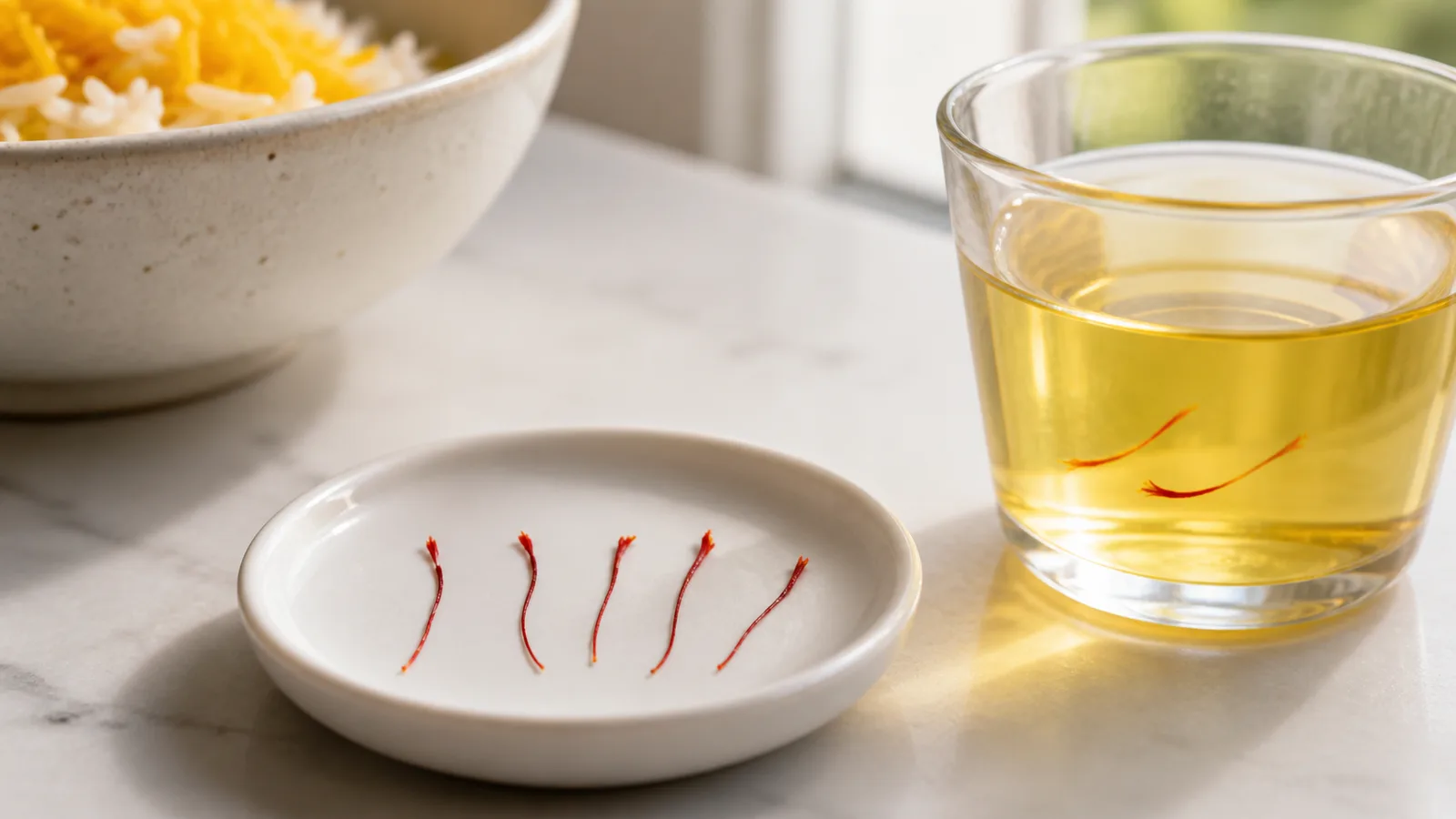
Is saffron still rare? It is often called one of the world’s most expensive spices, and in one sense it is still scarce: each flower produces only three stigmas. In another sense, no—genuine saffron is traded worldwide and can be bought throughout the year from established sellers. The rarity of saffron is best understood as costly, concentrated production rather than complete unavailability.
How rare is saffron today?
Is saffron rare in the way an endangered wild plant is rare? No. Culinary saffron comes from cultivated Crocus sativus, a sterile plant maintained and multiplied through corms. Farmers grow it commercially in several countries, and modern distribution makes small packs available far beyond the harvest regions.
What remains scarce is the amount of finished spice obtained from each field and each hour of harvest work. Availability can look plentiful on a shop shelf because saffron is sold by the gram, sometimes in fractions of a gram. Producing those small packs still takes a very large number of flowers.
Three stigmas keep the yield naturally small
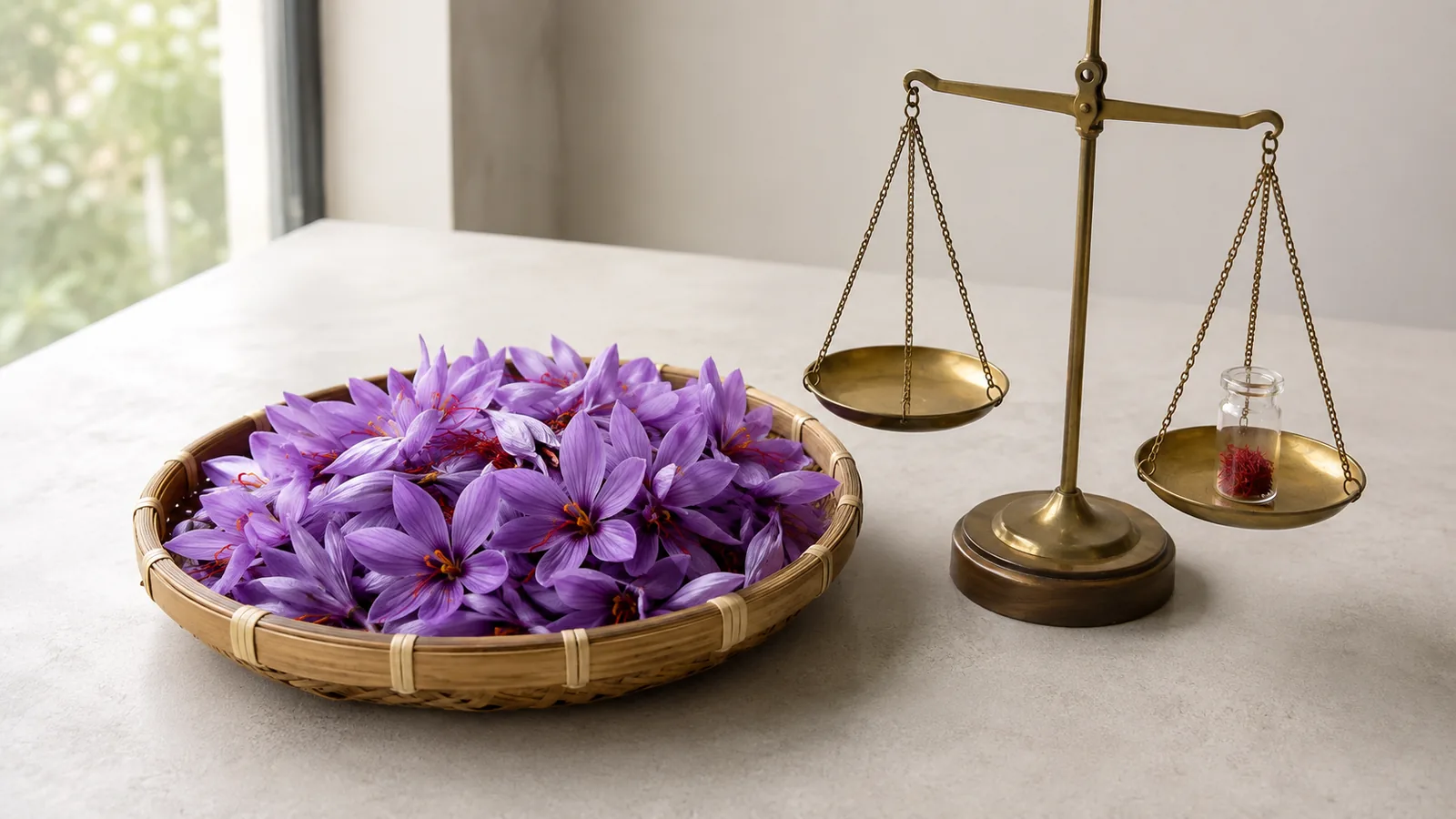
Each saffron flower has three red stigmas, the only parts collected for the spice. The often-repeated figure of 150,000 flowers for one kilogram is a useful scale illustration, not a fixed biological conversion. Stigma size, trimming, moisture and field conditions change the result.
The University of Vermont’s Saffron by the Numbers guide estimates about 167 flowers for one gram of dry saffron under its reference conditions. That would be roughly 167,000 flowers for a kilogram, but another crop can differ. Either figure makes the important point: a flower produces milligrams, not spoonfuls.
The harvest window is short and labour stays intensive
The flowers open over a concentrated autumn period. Growers must pick them while they are fresh, separate the delicate stigmas and dry the material correctly. Field preparation can be mechanised, and controlled dryers can improve consistency, but flower handling and stigma separation still require substantial care and labour.
A large workforce may be needed for a few peak days rather than spread evenly across the year. If flowers wait too long, rain arrives or drying is poorly controlled, some of the already small crop can lose value. That combination of seasonal urgency and manual handling helps keep saffron both expensive and relatively scarce.
Production is possible in more places than the old article suggested
Saffron does not grow only in three narrowly defined regions. Iran is the leading producer, with deep production knowledge and established trade, while India and Spain have important and distinctive saffron traditions. Afghanistan, Greece, Morocco, Italy and other countries also produce it.
The FAO’s account of Iran’s qanat-based saffron system shows how cultivation is tied to local water management, community knowledge and arid-land farming. Those systems cannot be replicated simply by placing corms in any dry field.
Research and commercial trials have also expanded production in places such as the United States. This matters because it disproves the claim that saffron can grow in only a tiny handful of countries. It does not make every new region a large or reliable supplier: growers still have to solve climate, soil drainage, corm health, labour, drying, quality control and market access.
Climate affects supply without making every shortage permanent
Temperature, rainfall, irrigation timing and disease pressure influence flowering and corm development. Drought can reduce output in some production systems, while excess moisture and poor drainage can damage corms elsewhere. “Perfect climate” is therefore too simple an explanation.
Climate change can increase production risk through heat, water stress and less predictable seasons, but it should not be used as a vague explanation for every price rise. A claim about a particular shortage needs a place, harvest year and source. One region can have a poor crop while another has an ordinary season.
Demand changes the price more quickly than the plant can respond
Saffron appears in Persian, Indian, Mediterranean and other cuisines, and it is also marketed for cosmetics, traditional uses and research-related products. These are different markets with different specifications. A statement about medicinal interest is not evidence that culinary saffron treats a condition, and health marketing should never substitute for clinical evidence.
When demand rises, producers cannot instantly expand supply. New corms and fields need time, trained seasonal workers must be available and post-harvest capacity has to grow with the crop. Dealers and retailers also carry inventory between harvests, so exchange rates, packaging, freight and trade conditions can change the shelf price even when the physical harvest has not suddenly become rarer.
Price is not a direct measurement of rarity
A high price can reflect low yield and labour, but it can also reflect grade, thread form, testing, packaging, brand, origin documentation and small retail pack sizes. Conversely, a low price can come from a different trade level—or from old, diluted, mislabelled or underweight material.
This is why an average price needs a date, currency, unit, country and sales level. Our saffron price page provides dated market context, while the explanation of why saffron is so costly follows the expense from flower to retail pack.
Can greater production make saffron common?
More acreage, better corm selection, improved drying and careful mechanisation can increase saleable output. Producers in newer regions may also shorten supply chains for local buyers. Those gains can make saffron easier to obtain without changing the flower’s basic biology.
There are limits. Expanding area without enough harvest labour can leave flowers unpicked. Increasing yield without matching drying and testing capacity can reduce quality. Crowded corms eventually need management, and a successful trial plot does not automatically prove profitable production at commercial scale.
For those reasons, innovation is more likely to broaden the supply base than turn saffron into a cheap bulk spice. Small packs can become widely available while high-quality, fresh and traceable lots remain comparatively scarce.
What “rare” should mean when buying saffron
A seller should not use the word rare as proof of quality. Look for an identifiable business, clear net weight, thread or powder form, origin wording that is not misleading, sensible batch information and secure packaging. Whole threads are easier to inspect than powder, although appearance alone cannot verify every quality or purity question.
Be cautious with permanent “last harvest” stories, unsupported claims that one country is the only genuine source, or luxury pricing with no product information. Rarity is a reason to ask for better evidence, not a reason to stop comparing offers.
So, is saffron still rare?
Yes, if rare means that each harvest produces a small amount of spice through concentrated, skilled work. No, if it means saffron is almost impossible to find or can grow only in Iran, India and Spain. Cultivation has spread and global trade has improved availability, but three stigmas per flower, a short harvest and demanding post-harvest handling still constrain supply.
That more precise answer explains why genuine saffron can be readily for sale and still deserve its reputation as an unusually scarce spice by weight.