


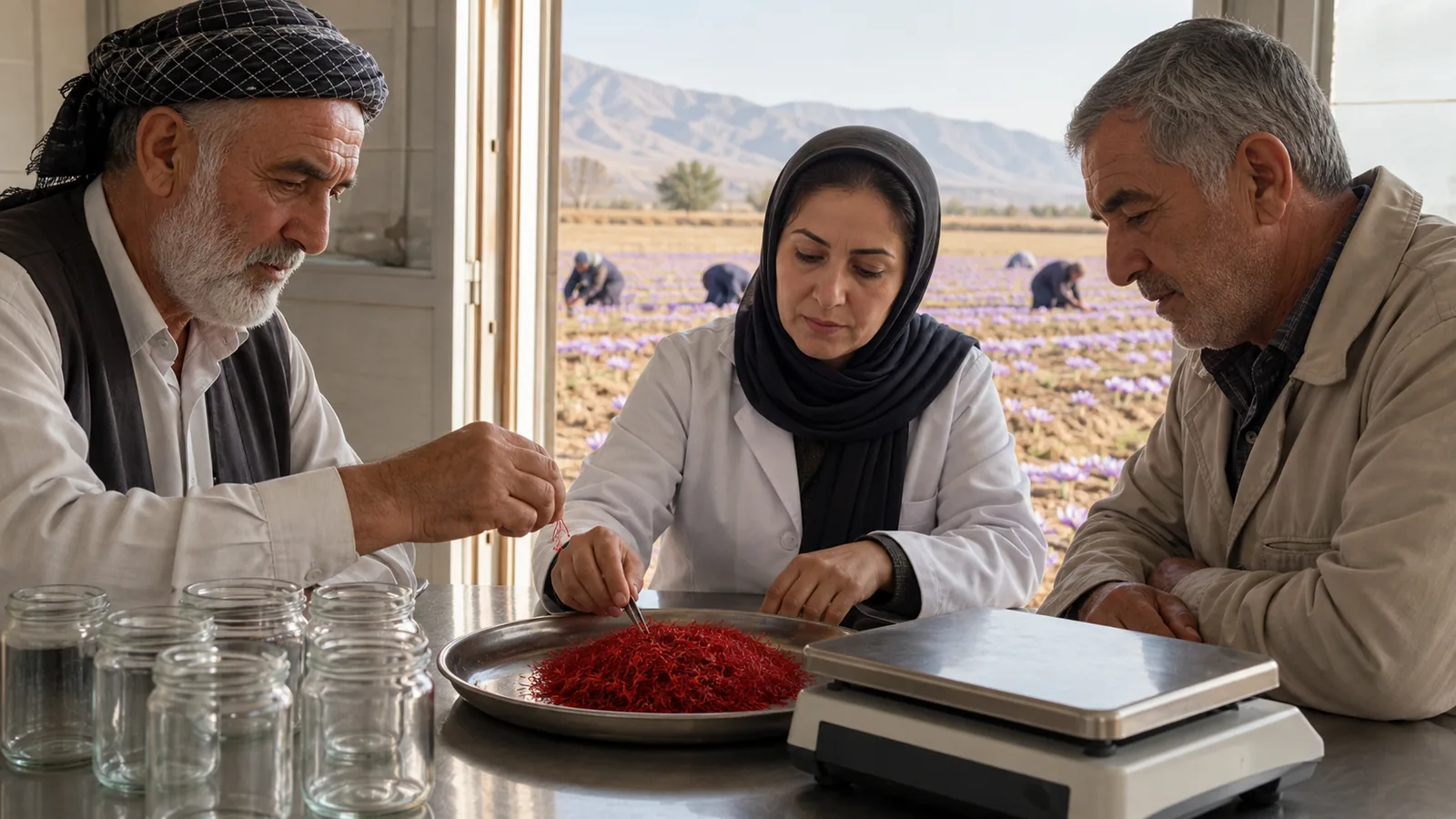
Iranian saffron producers from having the world is a damaged 2016 headline attached to a report about a large harvest, grower yields and the risks of speculative buying. Its central figure was more than 300 tonnes of Iranian saffron from over 80,000 hectares, described at the time as roughly 10% above estimated world demand.
Those numbers are historical estimates, not a current production forecast. They are still useful because they show the problem producer representatives were trying to explain: growing more saffron does not automatically help farmers when storage, quality and market behaviour are poorly controlled.
Which country produces the most saffron?
For readers asking “saffron from which country?”, the short answer is Iran. Saffron is grown in several countries, but recent FAO material places Iran’s share of global production at about 85–90%, while another FAO announcement says the country produces more than 90%. Different years and methods can produce different percentages, so a range is more honest than a timeless fixed number.
Most Iranian production is associated with the Khorasan provinces. A Codex project document using 2014–2015 Iranian data recorded 218.348 tonnes in Razavi Khorasan and 48.019 tonnes in South Khorasan, with smaller quantities in several other provinces. That contemporary evidence makes the old report’s national total of more than 300 tonnes plausible as an attributed estimate, but it does not turn it into today’s figure.
The 2016 harvest estimate
Ali Hosseini, identified in the report as a member of Iran’s National Saffron Council, told ISNA that the season had produced a good crop. He cited more than 80,000 hectares under saffron and more than 300 tonnes harvested. Dividing those rounded figures gives an average close to four kilograms per hectare, matching the yield quoted in the report.
The translation then says average yield could rise to “10 kilograms per square meter.” That unit is impossible for dried saffron and conflicts with the surrounding hectare figures. The intended claim was almost certainly up to 10 kilograms per hectare under stronger management, but the Persian original is needed before that wording can be restored as a direct quotation.
Yield is only one part of a producer’s result. Corm quality, planting density, irrigation timing, soil, flower picking, stigma separation and drying all influence the final amount and grade. Higher output is valuable only when the harvest can be processed, tested, stored and sold without weakening quality.
Why speculative buying worried producers
Hosseini’s sharper warning concerned people entering the saffron market without product knowledge. The report describes buyers purchasing from many growers, storing saffron in their homes and waiting for an artificial shortage to lift prices. He argued that this could harm both farmers and consumers while damaging confidence in Iranian saffron.
His reasoning was practical. A speculator may profit during a brief price rise, but storage capacity and demand are finite. If too much product is held back, owners eventually have to sell. Once prices stop climbing, a rush to release stock can reverse the market and leave both inexperienced buyers and producers exposed.
The article does not supply transaction records that prove how widespread this behaviour was. It should therefore be read as a producer representative’s warning, not as a measured estimate of national hoarding.
Low-grade buying and Iran’s reputation
The report also says some foreign traders, including buyers described as Chinese, were visiting provincial markets in search of cheaper “semi-mixed” saffron. The English phrase is unclear. It may refer to lower-grade, mixed or otherwise non-standard material; it should not be converted into an accusation of adulteration without the original source and laboratory evidence.
The reputational risk is easier to understand. When product with inconsistent colour, aroma, moisture or purity is sold simply as Iranian saffron, a distant buyer may judge an entire origin by one weak shipment. Traceable lots, representative sampling and recognised laboratory methods protect growers as well as customers. They also make price comparisons meaningful: two consignments described only by weight may not be the same grade.
What the old price figures can and cannot tell us
One surviving line gives an international price of about US$1,400 per kilogram. It then lists domestic figures around 4.5 million, 5 million and 5.5 million, but the currency labels and sentence order are corrupt. These were likely local-currency prices discussed against an exchange rate, not millions of US dollars.
Because the report does not preserve a reliable unit, date range, grade or exchange rate, those domestic figures cannot support a current saffron-price claim. They remain here as part of the historical record, with their limitation made explicit. A valid comparison would need the same grade, packaging level, transaction date, currency and trade stage.
Nicosia saffron production: why this page appeared for the query
This page has appeared in searches for “Nicosia saffron production,” although the report is about Iran and never presents Nicosia as a production centre. The likely connection was old image metadata that named Cyprus among a list of importer markets. That metadata did not prove cultivation in Nicosia.
Cyprus does have native crocus species. The Republic of Cyprus biodiversity material lists Crocus cyprius, for example, but a native crocus is not automatically the cultivated saffron crocus, Crocus sativus. Cyprus trade records also contain saffron commodity entries. Neither fact is enough to establish a meaningful Nicosia production volume. Without an official crop-area or harvest series specifically for saffron in Nicosia, that number should be marked unavailable.
What matters to saffron producers now
The old interview drew a useful line between production and market health. A resilient sector needs more than a large harvest:
- field records that make yield figures comparable;
- rapid, hygienic separation and drying after flowers are picked;
- moisture-safe storage rather than informal household stockpiles;
- testing that supports grade and authenticity claims;
- traceability from grower or cooperative to shipment; and
- prices tied to verified quality instead of rumours of shortage.
Our saffron production statistics guide separates dated estimates from current evidence. For the regional and global-share context, see Iranian saffron suppliers and world production.
Iranian saffron producers remain central to the world market, but scale alone is not the measure of success. The strongest outcome is a crop whose origin, handling and grade can be trusted—and a market in which growers are not forced to carry the cost of speculation.
Sources and further reading
- The immutable 2016 Rowhani Saffron backup, preserving Hosseini’s attributed harvest, area, yield, storage, buyer and price statements.
- FAO and Iran saffron value-chain initiative, including the 85–90% production range.
- FAO–Mashhad University saffron authenticity work, describing Iran as producing more than 90% of the world’s saffron.
- Codex saffron project document, with 2014–2015 Iranian province area, yield and production data.
- Republic of Cyprus biodiversity information, distinguishing native Crocus cyprius from evidence of cultivated saffron output.

![Exporting Saffron to Turkey + Price Guide [Complete 0 to 100]](https://img.rowhanisaffron.com/20260827003933/saffron-export-turkey-quality-inspection.webp)



