


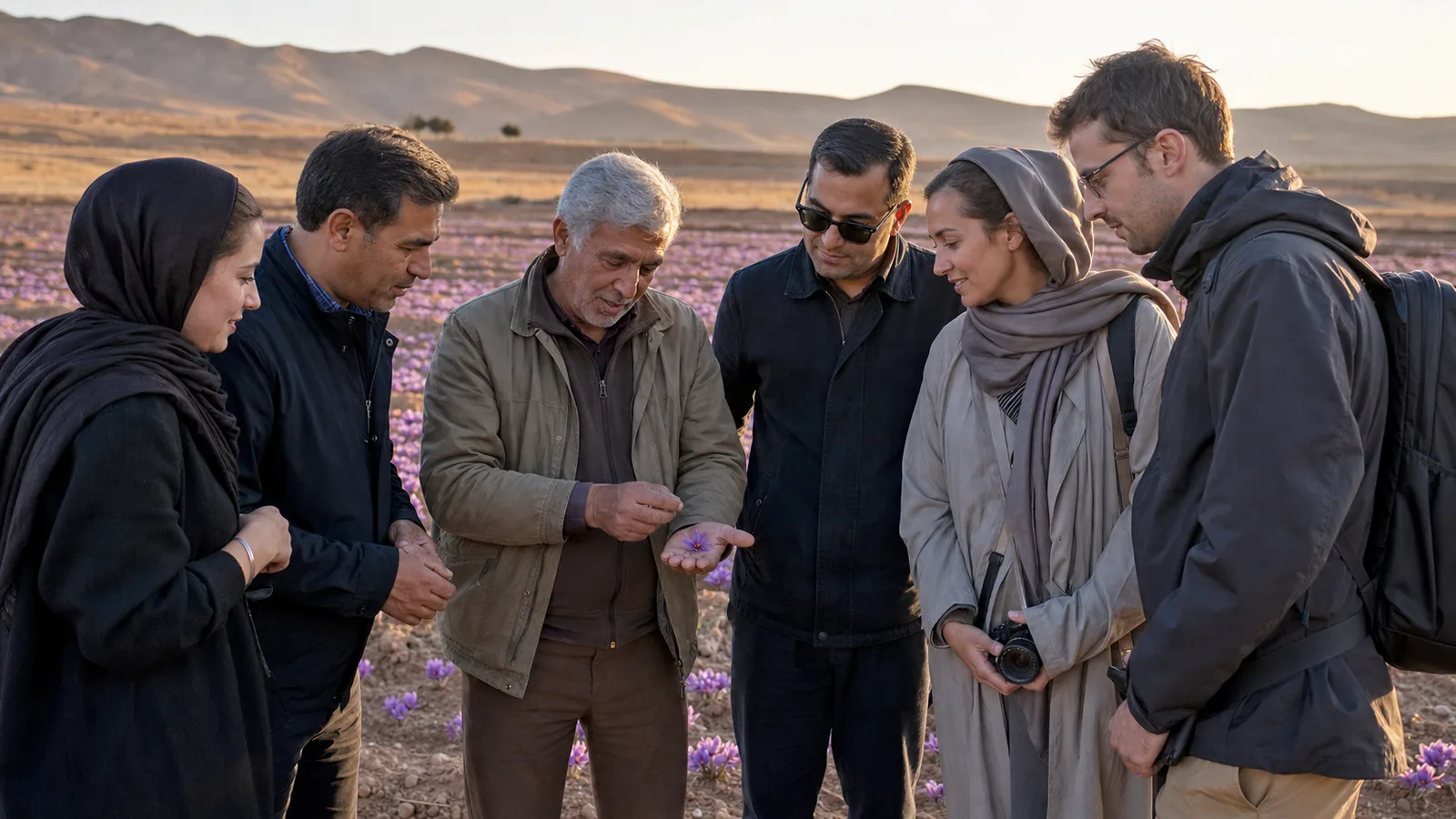
“Flowers” symbol of World Tourism Day in Iran refers to a domestic tourism campaign, not to a new national flower. In the announcement preserved here, Iran’s tourism authorities chose a stylised flower—and described it as a saffron flower—to represent solidarity, growth and cooperation across the country’s tourism sector.
The surviving English version is badly translated, but its main point is clear. Tourism was being presented as work that depends on many parts of society: public agencies, private businesses, local communities and the services that connect visitors with a place. The flower was meant to give that shared effort one simple visual identity.
What the flower represented
Morteza Rahmani Movahed, then Tourism Deputy at Iran’s Cultural Heritage, Handicrafts and Tourism Organization, discussed the campaign at a meeting of government and private-sector representatives. An official UN Tourism participant list from 2016 confirms his name and role; the original machine translation rendered both incorrectly.
According to the announcement, the flower carried several connected ideas:
- different organisations working together rather than promoting tourism separately;
- growth and development that involve local communities;
- friendship between visitors, hosts and institutions;
- the energy and enjoyment associated with travel; and
- a recognisable symbol that participating organisations could use in their own publicity.
Saffron made sense within that visual language. Its purple flower is closely associated with eastern Iran, especially the saffron-growing provinces of Khorasan, and it connects agriculture, food, craft, trade and travel. That does not prove the campaign was intended as a permanent tourism brand. The report describes a World Tourism Day emblem, used for a particular programme.
The campaign’s community message
The announcement linked the Iranian campaign to the World Tourism Organization’s focus on local communities. UN Tourism records the official 2014 World Tourism Day theme as “Tourism and Community Development.” Its explanation centred on tourism’s ability to give people skills and opportunities to create change in their own communities.
That context helps recover the meaning of the broken English. Rahmani Movahed was arguing for a move away from an inward-looking, single-agency approach. Tourism promotion, in his account, should involve the institutions that shape transport, culture, education, commerce, security, media and local life. Cooperation at home would help Iran present itself more clearly abroad.
The old text also gives the campaign phrase as “like tourists, like tomorrow.” This is almost certainly a damaged translation of the Iranian slogan, not the official English theme issued by UN Tourism. Without the Persian source, it should not be silently rewritten into a more polished quotation. What can safely be said is that the slogan connected tourism, tomorrow and a shared national effort.
Why the dates appear to conflict
World Tourism Day is observed internationally on 27 September each year. The Rowhani report says the Iranian celebration connected with this campaign would take place on 5 October. Those dates need not describe the same event: a country can schedule its own ceremony after the international observance. The surviving report does not explain the interval, so it would be misleading to replace one date with the other.
The community-development language points to the 2014 international theme, while this page itself was published in 2016. That suggests the post may preserve an older report republished later. It is a historical record, not an announcement for a future World Tourism Day.
Who was represented at the meeting
The breadth of the attendee list shows what “multi-sectoral” meant in practice. The report names senior representatives connected with:
- the Ministry of Culture and Islamic Guidance;
- the Ministry of Industry, Mine and Trade;
- the Ministry of Education;
- the Ministry of Youth and Sports;
- Iran’s police force and Ministry of Foreign Affairs;
- the Islamic Republic of Iran Broadcasting organisation;
- free zones;
- road transport and toll services; and
- other public and private organisations involved in tourism.
The original final sentence is too damaged to identify every body confidently. Its underlying meaning is stronger than its grammar: tourism touches the whole visitor journey, so the campaign wanted the organisations along that journey to use a common message.
Was the saffron flower declared Iran’s national flower?
No such declaration appears in this report. Choosing a saffron-flower logo for one tourism campaign did not make saffron the official national flower of Iran, and it did not establish a shared national flower of Iran and Turkey. Those are different questions from the one this historical announcement answers.
“Persian flower symbol” can also mean several things, depending on the period and setting. Scholarly references document the rose and nightingale as a major theme in Persian poetry and decorative art. Lotus imagery appears in Achaemenid art, while tulips carry other historical and modern associations. Saffron flowers have a particularly strong regional connection with Khorasan. Treating any one of these meanings as a universal legal designation would flatten a much richer cultural history.
For this event, the relevant symbol was the campaign flower. Its job was to communicate participation, unity and development at a glance.
What the announcement tells us about tourism
The most useful part of the old report is not the logo by itself. It is the idea behind it: a destination is experienced through many hands. A visitor notices roads, information, public spaces, hospitality, local food, heritage protection and the confidence of the people who receive them. A campaign cannot compensate for weak coordination between those services.
Saffron offers a practical example. A field visit can connect growers with travellers, but only when the experience respects farm work, explains the crop accurately and gives local communities a fair role. Our article on agricultural tourism in Khorasan Razavi looks at that relationship more closely. The background to saffron as part of local identity is explored in red gold in traditional culture.
Seen in that light, the flower was a compact invitation to cooperate. The artwork belonged to a particular World Tourism Day campaign, while the underlying message—tourism works best when host communities and institutions shape it together—remains easy to understand.
Sources and further reading
- The immutable Rowhani Saffron backup, preserving the original Iranian campaign report, its dates, slogan translation, symbolism and attendee list.
- UN Tourism: World Tourism Day 2014, confirming the 27 September observance and “Tourism and Community Development” theme.
- UN Tourism: Sixth Silk Road Task Force participant list, identifying Morteza Rahmani Movahed as Tourism Deputy at ICHTO.
- Encyclopaedia Iranica: Gol o Bolbol, on the rose-and-nightingale tradition in Persian art and literature.
- Encyclopaedia Iranica: Achaemenid visual representations of women, discussing lotus imagery and the limits of assigning it one fixed meaning.

![Exporting Saffron to Turkey + Price Guide [Complete 0 to 100]](https://img.rowhanisaffron.com/20260827003933/saffron-export-turkey-quality-inspection.webp)



