


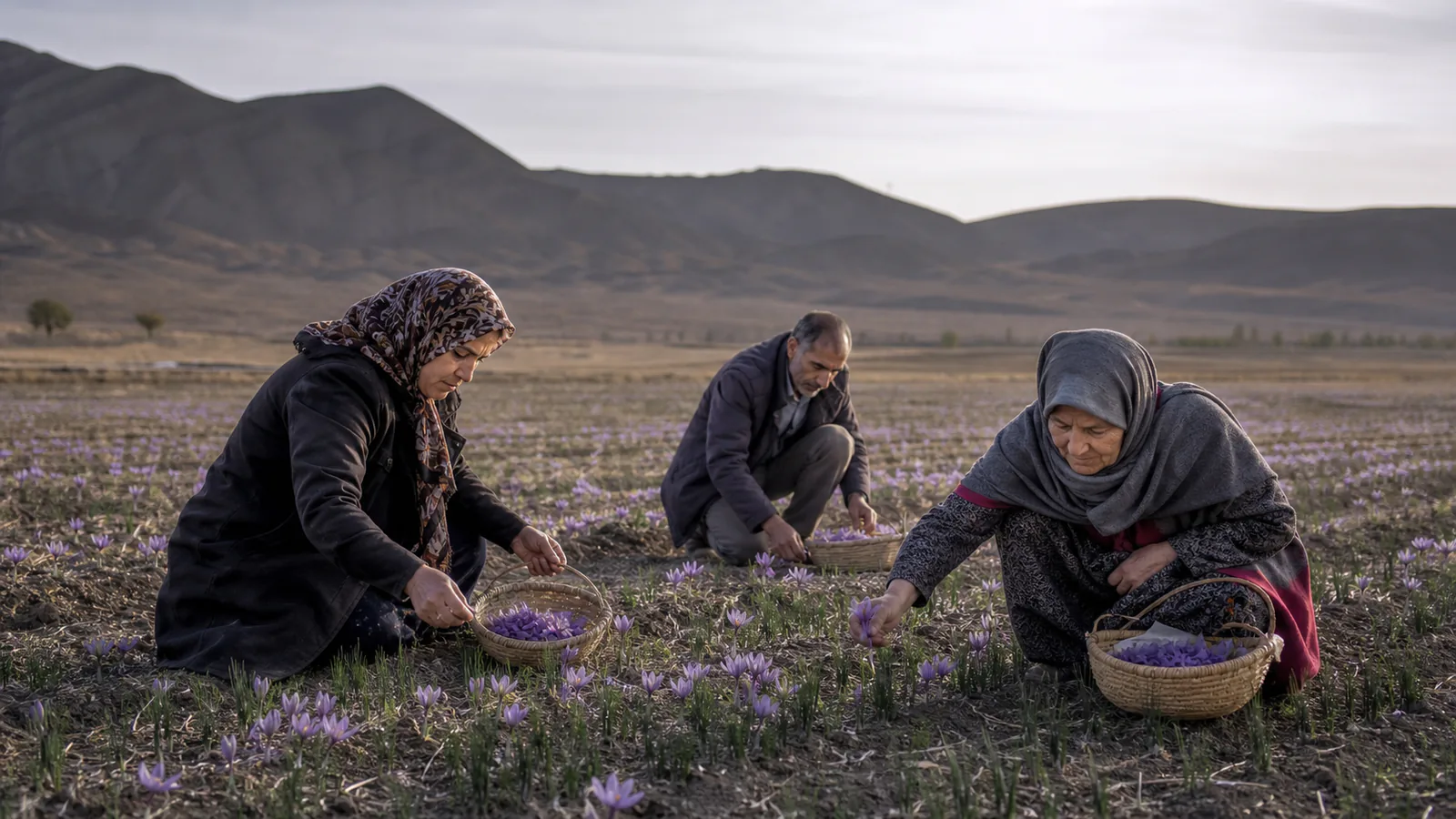
Saffron is called red gold—and sometimes desert gold—in Khorasan because a tiny harvest carries exceptional value. The name also reflects something less visible: generations of field knowledge, family labour and regional identity concentrated in each handful of red stigmas.
In South Khorasan, traditional culture does not sit apart from production. It determines when families enter the field, how flowers are opened, how stigmas are dried and how the crop reaches a buyer. Modern quality control can strengthen that tradition, but it cannot replace the human judgement on which the harvest still depends.
Why saffron became the desert gold of Khorasan
Crocus sativus grows through the cool season and becomes dormant during the hot, dry summer. Its calendar fits the arid and semi-arid landscapes of eastern Iran better than many water-intensive summer crops. The UN Food and Agriculture Organization describes the qanat-based saffron system of Gonabad as an example of farming adapted to severe water scarcity and sustained by local knowledge.
Value comes from scarcity and labour. Every flower yields only three red stigmas. Flowers are picked during a short autumn window, then opened by hand. The fresh stigmas must be dried promptly and cleanly. A mistake at any stage can weaken colour, aroma or food safety.
South Khorasan’s association with saffron is centuries old. Historical reports have described roughly 700 years of cultivation in the province, while Iran’s wider saffron tradition extends much further back. Exact origin dates differ between accounts, so the durable point is cultural continuity rather than a single anniversary.
A 2015 portrait of South Khorasan saffron
The original report behind this article was published in 2015 and quoted provincial agriculture and trade officials. It described South Khorasan as Iran’s second-largest producing province and presented its saffron as a leading-quality crop. It also reported around 35,830 growers.
The surviving English version is damaged by machine translation. It appears to cite approximately 14,141 hectares and a production forecast of 53 tonnes, but those two numbers should be treated as historical reported estimates, not a current statistical series. Later agricultural reporting shows that acreage and production continued to change: a 2021 provincial report cited 17,152 hectares in the previous year and about 70 tonnes harvested.
The 2015 account placed harvest from the second half of October into early December. Timing varies by altitude, first irrigation and weather, but the basic sequence remains familiar: flowers emerge, the field is picked in repeated passes and the stigmas are separated before drying.
Qaen and the county-level harvest
Qaen is one of the names most closely associated with South Khorasan saffron. The 2015 report attributed 4,346 hectares and about 13.7 tonnes of production to Qaen County. Those figures belong to that reporting period, but they illustrate the scale behind the place name found on so many saffron packages.
A second county example in the report described 2,700 hectares, an average dry-stigma yield of roughly 3.5–4 kilograms per hectare and a forecast harvest close to 10 tonnes. It also recalled a previous season of 2,000 hectares and eight tonnes. The county name is garbled in the surviving English text, so it would be misleading to attach those figures to a place without the original Persian record.
What matters across both examples is the variation hidden by provincial totals. Altitude, field age, corm density, water timing, frost and post-harvest practice can produce very different outcomes between farms.
What traditional production gets right
Harvesting at the cool start of the day
Families often begin before full daylight. Cool, closed flowers are easier to handle, and early collection shortens the time between field and separation. This is practical quality protection, not ceremony for its own sake.
Recognising a healthy field
Experienced growers read leaf growth, soil moisture, flowering density and signs of corm disease. The 2015 officials emphasised large healthy corms, organic and biological fertilisers, timely irrigation, micronutrient management where justified, weed control and attention to pests and disease.
Modern agronomy adds an important qualification: inputs should follow soil and field evidence. More fertiliser or more irrigation is not automatically better. A soil test, clean planting material and careful field records make traditional observation more useful.
Separating and drying without delay
The red stigmas must be separated from the rest of the flower in clean conditions. Standard food-grade containers, clean hands and surfaces, protection from dust and controlled drying reduce microbial and physical contamination. The 2015 report specifically urged better harvest hygiene and drying.
Where the value is lost
Price volatility at harvest
Flowers arrive within a compressed season, while many small growers need cash immediately. That can weaken their bargaining position. The report described prices as determined by agreement between buyer and seller and identified sharp price changes as a central concern.
Weak local processing and packaging
The province had plans for processing and packaging facilities. The 2015 figures cited 29 establishment permits with a stated total capacity of 150 tonnes and five operating licences with a stated 60-tonne capacity. Capacity on paper is not the same as active throughput, and the article did not document utilisation.
Local cleaning, grading, laboratory testing, traceable packaging and direct market access can keep more value near the farm. A decorative box alone is not enough; the buyer also needs reliable identity, lot information and quality evidence.
Drought and declining water quality
Officials cited a long drought, falling well discharge and poorer water quality. Saffron is adapted to dry conditions, but it is not immune to water stress or salinity. The timing and quality of limited irrigation determine how well corms grow and flower in later seasons.
From regional name to verifiable quality
The 2015 trade discussion considered regional and national recognition for South Khorasan saffron. Regional identity can help a product, but a place name should lead to evidence rather than substitute for it.
A credible lot should be traceable to a producer or processor, protected from contamination and tested against the specification promised to the buyer. Chemical markers such as crocin-related colour strength, picrocrocin-related taste and safranal-related aroma are useful quality dimensions. They should be measured by an appropriate laboratory method rather than converted into unsupported claims that one entire province is always superior.
The report said South Khorasan saffron reached European, Persian Gulf and Central Asian markets. Later reporting has noted that some exports move through neighbouring provinces, which makes a distinction between where saffron is grown, where it is packed and where it is formally exported essential.
Keeping the culture while improving the system
South Khorasan does not need to choose between heritage and modern practice. The strongest future joins them:
- healthy, traceable corms and field-level soil and water decisions;
- family knowledge supported by practical extension training;
- clean flower collection, rapid separation and controlled drying;
- lot-level testing and records that a buyer can verify;
- processing and packaging sized to real throughput;
- cooperative marketing where it improves small growers’ bargaining position; and
- regional storytelling that never outruns product evidence.
That is why red gold remains within traditional culture. The tradition is not merely the age of the crop. It is a working system of land, water, labour and judgement. When better hygiene, testing and market transparency are added to it, the desert gold of Khorasan can carry both its history and its quality honestly.

![Exporting Saffron to Turkey + Price Guide [Complete 0 to 100]](https://img.rowhanisaffron.com/20260827003933/saffron-export-turkey-quality-inspection.webp)



