


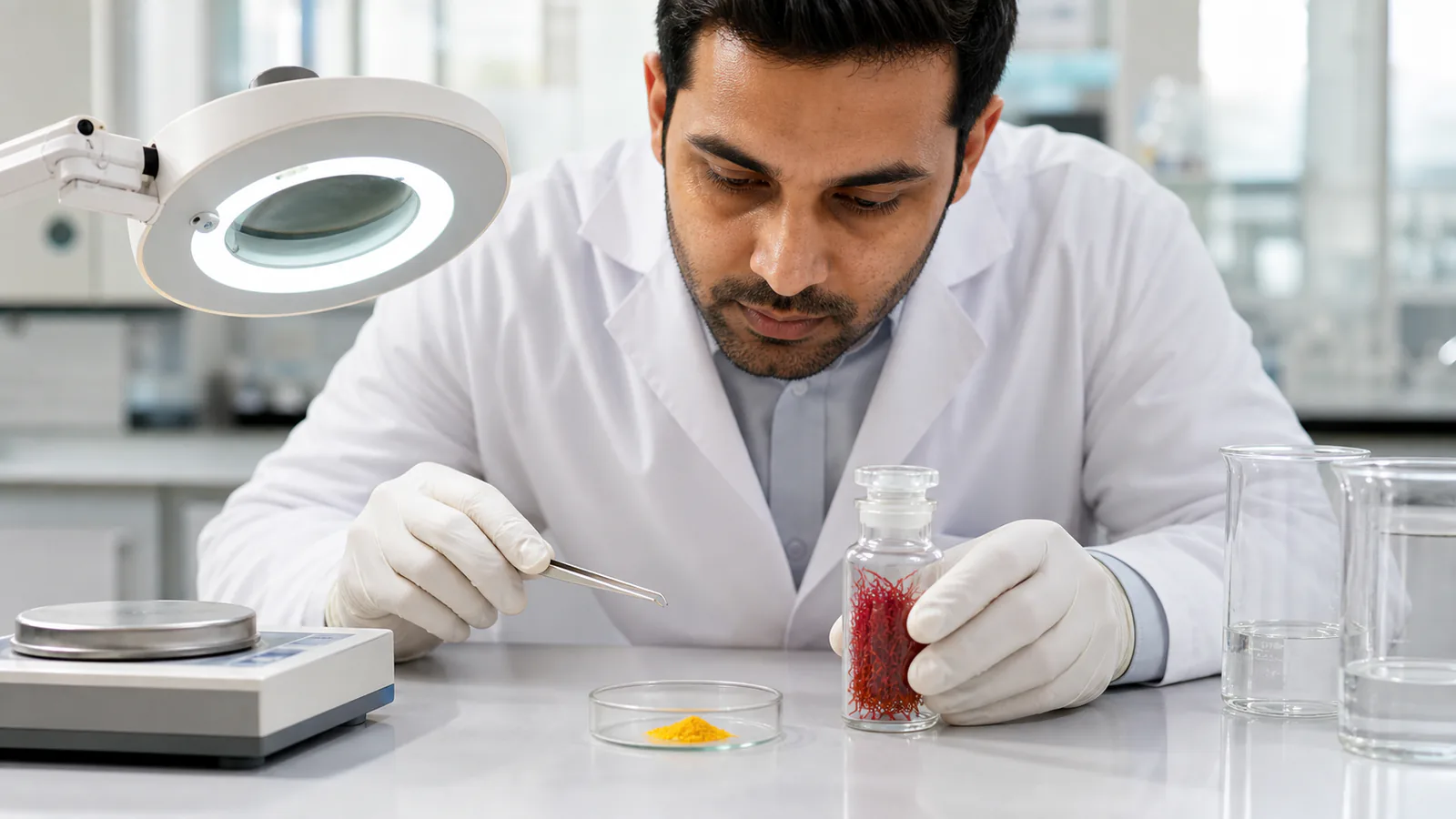
Fake saffron color may be an unlabelled, adulterated product and should not be used in food. But the old headline “Fake Saffron color carcinogenic” went further than the evidence supports. Tartrazine, the yellow colour additive named in the original 2016 report, is regulated for food use in many countries; authoritative safety reviews do not classify every permitted use of tartrazine as carcinogenic.
That correction does not make a jar sold as “saffron colour” trustworthy. If its manufacturer, ingredients, food approval and batch cannot be identified, there is no reliable way for a consumer to know what the powder contains or whether it was produced for food use.
What the original Iranian warning said
Dr Hossein Rastegar, then director of Iran’s Food and Drug Administration reference control laboratories, warned about inexpensive powders brought into Iran as souvenirs, particularly by travellers returning from Saudi Arabia. The January 2016 account said some were presented as saffron colour or saffron extract even though they were not saffron.
Rastegar referred to tartrazine and advised travellers not to buy these products as gifts. He also warned about low-priced “saffron powder” sold by street vendors, including sellers in the Tehran Metro. One adulteration example in the report was dried corn silk that had been coloured and sold as saffron. Another involved adding an aroma or essential oil to make a substitute smell more convincing.
The practical advice remains sound: do not eat an unidentified powder simply because its colour resembles saffron. The report’s claim that tartrazine itself was wholly carcinogenic, however, needs to be separated from the risk of an unregulated and possibly mislabelled product.
Tartrazine, tartarazin and saffron are different things
Tartrazine is a synthetic yellow food colour also known as E102, INS 102 or, in its certified US form, FD&C Yellow No. 5. The search spelling tartarazin is a common misspelling of the same name. Tartrazine is an additive; it is not saffron, saffron extract or a substitute that can legally be passed off as the spice.
Real saffron consists of dried parts of the pistil of Crocus sativus flowers. Its colour, aroma and flavour arise from the spice’s natural chemical profile. A colouring powder can make rice yellow, but colour alone does not give it the identity, composition or sensory character of saffron.
There are therefore three separate questions:
- Is tartrazine permitted for a particular food, at a permitted level, under the rules where that food is sold?
- Does a labelled product actually contain the approved food-grade colour and nothing undeclared?
- Is someone deceptively selling a colour, dyed plant material or flavoured powder as genuine saffron?
An answer to the first question cannot answer the other two. Regulatory permission for a specified use does not validate an anonymous souvenir jar or make ingredient fraud acceptable.
What official safety reviews say about tartrazine
The Joint FAO/WHO Expert Committee on Food Additives reviewed tartrazine in 2016. Its JECFA evaluation established an acceptable daily intake of 0–10 milligrams per kilogram of body weight. The committee concluded that estimated dietary exposure for the general population, including children, did not present a health concern.
In the United States, the Food and Drug Administration lists the certified form as FD&C Yellow No. 5 and regulates its use and labelling. The FDA explains that certified colour batches are analysed for identity, purity and specified contaminants before certification. Its current consumer guidance on food colour additives includes tartrazine among colours subject to this system.
These findings do not mean that any amount, any grade or any use is safe. Permission depends on the jurisdiction, food category, purity, dose and labelling requirements. Some people may also be sensitive to particular colour additives. A named, compliant food additive is still very different from an unknown powder with no traceable producer.
Why an anonymous “saffron colour” is risky
The main problem is uncertainty. A loose or poorly labelled product may contain a permitted food colour at an unknown concentration, a non-food-grade dye, undeclared flavouring, contaminated plant material or an entirely different substance. Its appearance cannot tell you which possibility is true.
A low price is another warning, though not proof of fraud by itself. Genuine saffron requires flower harvesting, stigma separation, drying, grading and careful storage. A cheap powder that promises the same colour with no ingredient list is not an economical form of saffron; it is a different product whose composition needs to be declared.
Powdered material is especially difficult to assess by sight because grinding removes the thread structure. Even whole-looking material can be made from dyed corn silk, safflower or other fibres. Household water tests and aroma checks may reveal an obvious problem, but they cannot certify purity or identify every dye. Laboratory analysis is the reliable route when authenticity matters.
How to buy saffron with traceability
Choose a sealed product from a seller that can identify the producer or responsible importer. The package should provide the product name, net quantity, batch or lot information, ingredients where required, and the food-approval or licence details used in that market. Do not rely on a logo by itself; it must be possible to trace the business behind it.
For saffron threads, look for a product sold as saffron rather than “saffron colour,” “saffron flavour” or an unexplained extract. The current ISO 3632-1:2025 saffron specification applies to dried saffron in filament, cut-filament and powder forms and provides a recognised basis for product requirements. A consumer package may not display every laboratory result, but a responsible supplier should understand its specification and testing.
Our guide to telling real saffron from fake saffron explains useful visual and sensory checks, along with their limits. These checks help with purchasing decisions; they are not a replacement for accredited testing.
If you already used an unknown product
Stop using it and keep the container, receipt and remaining product. If anyone develops symptoms, contact a local poison-information service or medical professional and provide the package details. Do not try to diagnose the ingredient from the colour of the food or from an online photograph.
If there is no immediate illness but the product appears falsely labelled, report it to the food-safety authority or consumer-protection body where it was purchased. Traceable reporting is more useful than repeating a broad cancer claim: it gives regulators a product, seller and batch they can investigate.
The accurate conclusion
Unlabelled fake saffron colour is not worth the risk, and a coloured or scented substitute should never be sold as saffron. That was the useful core of the 2016 warning. The precise modern conclusion is that tartrazine is a regulated food colour with defined conditions of use, not proof that a powder is saffron and not, by its mere presence, evidence that the product is carcinogenic.
Buy saffron for its verified identity and quality, not simply for the yellow colour it releases.

![Exporting Saffron to Turkey + Price Guide [Complete 0 to 100]](https://img.rowhanisaffron.com/20260827003933/saffron-export-turkey-quality-inspection.webp)



