


Thirteen tons of bulk export saffron went from Iran to Spain during the first six months covered by a 2015 customs report. Spain was the largest buyer in the report’s over-30-gram category, while the United Arab Emirates led purchases of saffron packed for retail. The figures offer a useful snapshot of how two quite different parts of the export market were moving at the time.
This is a dated trade report, not a current price sheet. Its value lies in the detail: it separates larger consignments from 10-to-30-gram packs and shows that the two categories were travelling in opposite directions. Larger-pack exports rose sharply, while retail-ready shipments fell.
What the six-month customs figures reported
Iran exported saffron to about 35 countries in the period, with total declared sales of approximately $78 million. The report divided that value into just under $36 million for consignments packed in quantities above 30 grams and just under $42 million for retail-ready packs. Those figures are rounded, so they should be read as a summary rather than used to reconstruct an exact customs ledger.
Compared with the same six months a year earlier, exports in packages above 30 grams increased by more than 60% by weight and about 85% by value. Shipments in 10-to-30-gram packages moved the other way, falling by more than 30% in both weight and value.
The surviving version of the report also referred to changes of about $200 for the larger-pack category and about $20 for the 30-gram category. Its wording does not make the underlying unit or calculation sufficiently clear. We have therefore retained the substance of that observation without presenting either number as a reliable current price. Anyone pricing a shipment should work from a dated quotation that states the grade, crop year, quantity, Incoterm, laboratory specification and currency.
Why Spain accounted for 13 tons of bulk saffron
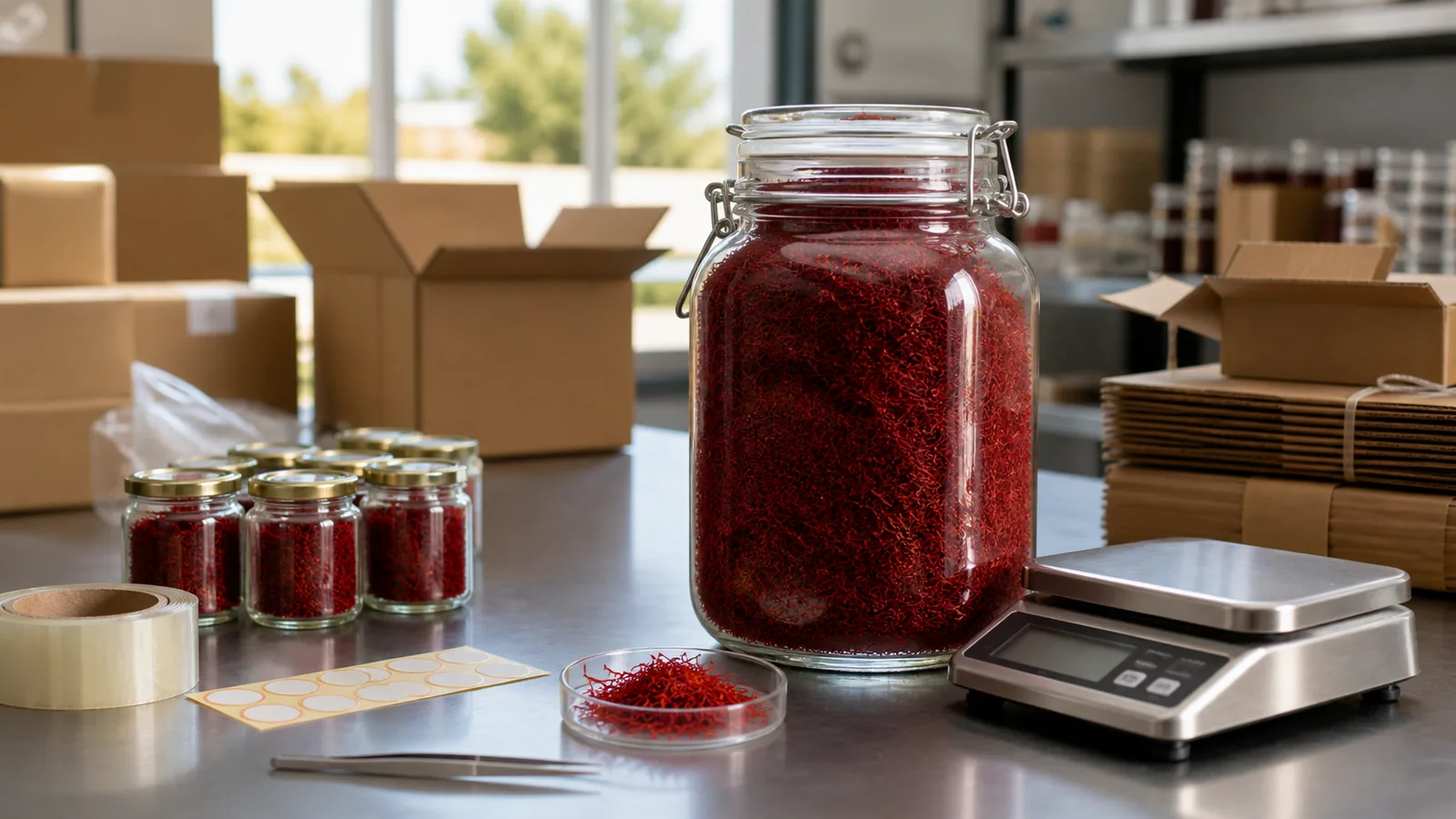
Spain bought 13 tons of Iranian saffron in packages above 30 grams, making it the leading destination in that customs category. The United Arab Emirates, Afghanistan, China and Italy followed. The number describes the size and packing class recorded at export; it does not, by itself, say that the saffron was inferior or unbranded.
That distinction matters. In everyday language, “bulk saffron” can suggest an anonymous sack of spice. In this report it meant a package weighing more than 30 grams. A sealed commercial container prepared for a food manufacturer, distributor or repacker could therefore sit in the same statistical category as a much larger wholesale lot.
Buyers choose larger formats for practical reasons. A processor may need saffron for a production run, while a distributor may divide an authenticated lot into smaller packs for local sale. The appropriate format depends on the customer and end use. Packaging size alone tells us nothing conclusive about purity, aroma, colouring strength or traceability.
Retail-ready saffron followed a different pattern
Among buyers of retail-ready saffron, the United Arab Emirates purchased more than 18 tons during the same six-month period. China and Saudi Arabia each bought about four tons. These figures help explain why the overall value of small packs could remain substantial even while the category declined year over year.
The full destination list in the report included Pakistan, China, Japan, Argentina, Germany, Spain, Australia, Afghanistan, the United Arab Emirates, the United Kingdom, the United States, Italy, Bahrain, Belgium, Thailand, Taiwan, Turkey, Singapore, Sweden, Switzerland, Saudi Arabia, Oman, France, Qatar, Canada, Kuwait, Poland, Malaysia, Hungary, Mauritius, the Netherlands, Hong Kong, India, South Africa and Greece.
These were markets recorded in one historical reporting period. They should not be read as a promise that every route remains open today, or that demand is unchanged. Import rules, sanctions, banking arrangements, food-labelling requirements and customer preferences can all change. Exporters need to verify the current rules in both Iran and the destination market before accepting an order.
Bulk and retail packs answer different buyer needs
The contrast between the two categories is more useful than a simple argument that small packs are always better. Consumer packaging can retain more of the presentation and branding value at origin. Larger formats, however, may be exactly what an industrial kitchen, food producer or specialist importer requires. Forcing those customers into dozens or hundreds of small units would add packaging and handling without improving the spice.
A sensible export saffron offer begins with the buyer’s use, then specifies the product clearly. At minimum, a commercial agreement should identify:
- the form of the saffron, such as whole filaments, cut filaments or powder;
- the agreed quality specification and test method;
- net weight, container type and the number of containers;
- crop or production information and batch traceability;
- storage conditions, seal integrity and shelf-life information;
- the required certificates, destination labels and customs documents.
For quality, the current ISO 3632-1 specification for saffron applies to filaments, cut filaments and powder. Laboratory evidence and an intact chain of custody are more informative than the visual size of the export package. Retail customers can also use our guide to buying high-quality saffron when assessing threads sold in smaller packs.
How the Spain trade relationship looks in newer data
The 13-ton figure belongs to the first half of the historical reporting year. It should not be compared directly with a full-year total without noting the different dates and definitions. Nevertheless, newer reporter data confirms that Spain remains an important market for Iranian saffron.
According to the World Bank’s WITS presentation of UN Comtrade data, Spain reported importing 39,649 kilograms of saffron from Iran in 2024, valued at about $50.74 million. That dataset uses HS code 091020 for saffron and does not reproduce the old report’s split between packs above 30 grams and packs of 10 to 30 grams. It is therefore context, not a like-for-like continuation of the six-month series.
The comparison still tells us something important. Spain’s role was not confined to one 13-ton shipment window, and larger commercial flows between the two markets continued years later. What cannot be inferred from the import total is how much product was sold directly to consumers, used in Spanish food production, repacked, or later traded elsewhere.
What exporters and buyers should take from the report
For exporters, the figures are a reminder to separate market strategy from package-size slogans. A strong offer can include both protected consumer packs and carefully documented wholesale formats. The commercial question is whether the chosen pack suits the buyer while preserving quality, traceability and a truthful statement of origin.
For buyers, the headline “13 tons of bulk export saffron to Spain” is only the beginning of due diligence. Ask who produced and packed the lot, which laboratory tested it, what specification was used, and whether the documents identify the same batch that will arrive. When the saffron will be repacked, storage conditions and contamination controls matter at every handover.
The historical report captured a clear change in direction: over-30-gram exports were growing while 10-to-30-gram exports were shrinking. It did not prove that one format was inherently good and the other bad. The durable lesson is to match the format to a real customer, document the product properly and judge Iranian saffron by verified quality rather than by package size alone.

![Exporting Saffron to Turkey + Price Guide [Complete 0 to 100]](https://img.rowhanisaffron.com/20260827003933/saffron-export-turkey-quality-inspection.webp)



