


Saffron exporters expect government support when public policy affects finance, customs, quality control and access to overseas markets. That concern was set out in a December 2015 interview with Gholamreza Miri, then head of the Khorasan Razavi Saffron Exporters Union. His comments were about the conditions exporters faced at that time; they are not a description of every rule or market condition in force today.
The original English article had been badly damaged in translation. Its central argument was still clear: exporters were not asking for a slogan or a one-off concession. They wanted public bodies to work in the same direction, avoid sudden obstacles and make legitimate trade easier to plan.
What exporters were asking for in 2015
Miri told the Iranian Students News Agency’s Khorasan bureau that saffron companies had met repeated export barriers during Iran’s ninth and tenth administrations. In his view, the absence of coordinated support contributed to two practical problems: limited working capital and difficulty developing stable markets.
That distinction is important. An exporter normally pays for product, testing, packaging and shipment before receiving the final proceeds from a foreign buyer. A profitable order can still be difficult to complete if the business cannot finance the period between purchase and payment. At the same time, market development requires samples, documentation, customer checks and repeat deliveries. Neither task is solved by a short-lived announcement.
Miri said the administration in office at the time appeared interested in easing saffron exports, but he saw poor coordination among ministries. He described the Ministry of Industry, Mine and Trade and the Ministry of Agriculture as trying to improve exports, while criticising actions by the Ministry of Economic Affairs and Finance that exporters regarded as obstructive.
These were the union president’s views in a dated interview, not an independent finding about the conduct of each ministry. Preserving that attribution keeps the historical record useful without turning an industry complaint into an unqualified fact.
Why stable rules matter to a saffron contract
Miri also connected domestic price volatility with the uncertainty created by directives and export-permit decisions. A buyer and seller may agree on a specification, quantity, currency and delivery date weeks before a shipment leaves Iran. If the cost base or export procedure changes suddenly, the exporter must either absorb the difference, renegotiate or risk losing the order.
Useful government support therefore does not have to mean direct financial aid. In practice, exporters benefit from:
- clear, published customs and documentation requirements;
- reasonable notice before material rule changes;
- coordination among agriculture, trade, finance and food-safety authorities;
- access to compliant laboratory testing and recognised certificates;
- banking and settlement routes that a legitimate business can actually use; and
- trade-promotion work tied to qualified buyers rather than headline numbers.
Predictability does not remove commercial risk, nor should it excuse weak quality. It allows a business to price that risk honestly and meet an agreed delivery instead of discovering a new administrative requirement after the product is ready.
Bulk packs are not automatically a branding failure
The 2015 interview addressed a familiar criticism: Iranian saffron was sometimes exported in larger packs and later sold under another company’s brand. Miri said about 80% of Khorasan Razavi’s saffron was exported at that time. He estimated that only 20% to 25% of Iranian saffron shipped abroad was repacked for retail sale, while much of the remainder went to industrial users.
He compared saffron with products such as rice, tea, coffee and other spices that a country may import in bulk and pack locally. A food manufacturer buying saffron for a production line does not need thousands of consumer jars. For that customer, a sealed 500-gram pack may be the correct commercial format.
This does not make origin and brand development unimportant. Retail-ready packs can preserve a visible connection to the producer and may capture more value when the buyer, regulations and distribution channel support them. The point is narrower: package size should follow the customer’s use. Industrial ingredients and finished retail products are different offers, and it is misleading to label every larger export pack as a lost branding opportunity.
The modern trade record still shows several kinds of buyer
Current trade data should not be substituted for the interview’s historical percentages, but it does show that Iranian saffron continues to reach distinct markets. In the World Bank WITS presentation of 2024 reporter data, the European Union recorded 53,530 kilograms of saffron imports from Iran. Spain reported 39,649 kilograms, China 42,390 kilograms and Italy 5,217 kilograms.
Those figures are importing reporters’ records under HS 091020. They should not be added indiscriminately to create an Iranian export total because the European Union aggregate overlaps with member-country reports. They also do not reveal how much was sold at retail, used by food manufacturers or re-exported. What they do demonstrate is that “the export market” is not one customer with one preferred package.
Our account of Iran’s place in the saffron world market explains why production leadership, trade routes and brand ownership need to be considered separately.
Quality support begins before the product reaches customs
Miri placed particular emphasis on hygiene during harvest. The old translation said a farmer had only 24 hours “from flowering to harvest.” The useful meaning is that saffron flowers are highly perishable and must move quickly through picking and stigma separation. Twenty-four hours should be read as the urgency expressed in the interview, not as a universal shelf-life guarantee.
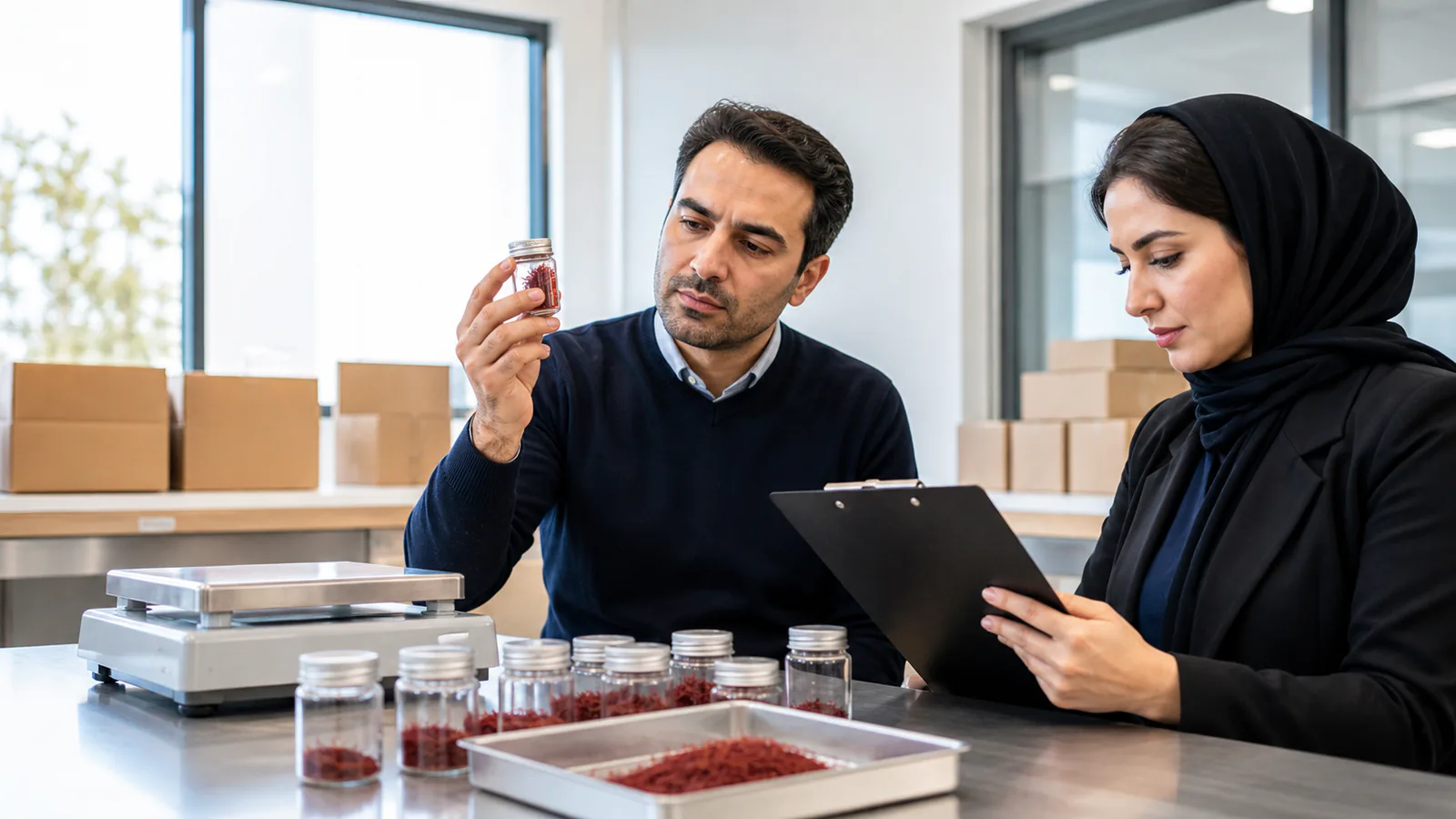
The quality chain begins with clean hands, clean collection containers and protection from soil, dust, heat and compression. Flowers need prompt handling; separated stigmas then need controlled drying, protection from moisture and hygienic storage. A shipment cannot recover aroma, colour or cleanliness that was lost during those early hours.
Miri said many farmers still harvested and processed saffron traditionally and that exporters were asking suppliers to meet hygiene requirements. Traditional hand work is not inherently poor practice. The risk comes from uncontrolled handling: dirty sacks, piled flowers, delayed separation, uneven drying or storage that allows moisture and foreign matter into the product.
International specifications provide a common language for buyers and sellers. ISO 3632-1:2025 sets requirements for dried saffron in filament, cut-filament and powder forms and includes storage and transport recommendations. The Codex Alimentarius also lists CXS 351-2022 for dried floral parts, including saffron. The exact certificate a shipment needs still depends on its destination, buyer and intended use.
What meaningful support would accomplish
The strongest public support protects the reliability of the whole transaction. A farmer receives clear guidance on hygienic handling. A processor can test and document a consistent lot. An exporter knows the current rules before quoting. The overseas buyer receives the specified product on time, in a package suited to its use.
That sequence is less dramatic than a new directive, but it is how trust is built. Reliable testing, stable procedures, workable finance and honest product claims give saffron exporters something they can carry from one order to the next. They also help more of the value return to the people who grow, process and trade the crop.

![Exporting Saffron to Turkey + Price Guide [Complete 0 to 100]](https://img.rowhanisaffron.com/20260827003933/saffron-export-turkey-quality-inspection.webp)



