


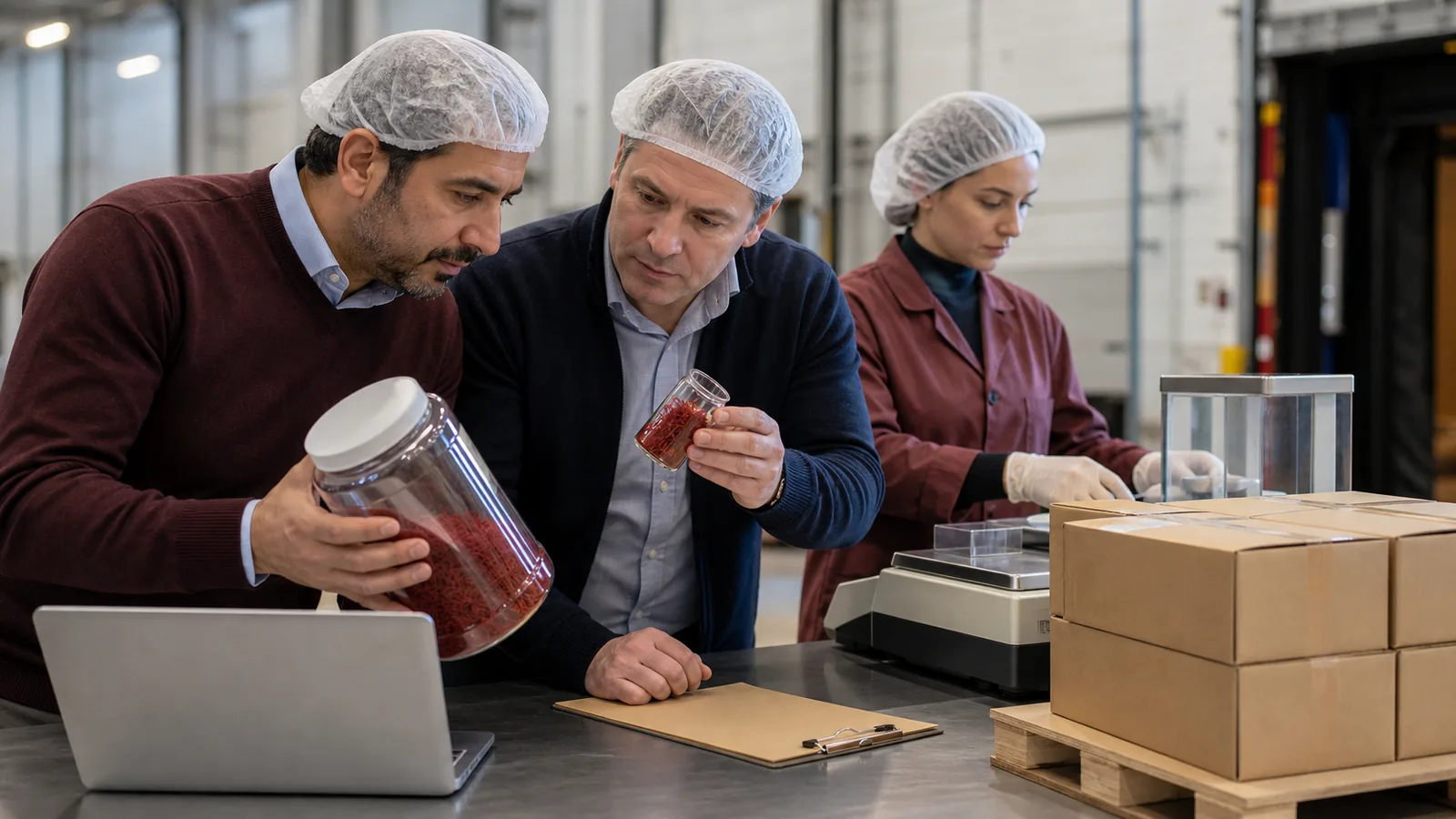
The statement that 92% of the world’s saffron production was in Iran came from a 2015 interview with Gholamreza Miri, then chairman of the Saffron Exporters Union. It was an industry estimate tied to that period, not a permanent market share. Miri’s larger point was that producing most of a crop does not automatically give a country the strongest customer relationships, contracts, distribution network or brand.
He described a saffron world market in which Iran supplied the volume while Spanish businesses were often better placed to serve international buyers. “Management” did not mean that Spain set one global price or controlled every transaction. It meant influence gained through dependable supply arrangements, processing, market access, finance and presentation.
Four reasons Spain was said to manage the saffron world market
The original article carried a second headline: “4 reasons Spain manages the world saffron market.” Miri’s interview was long, but its commercial argument can be organised into four connected reasons.
1. Reliable contracts and steadier pricing
Miri said Spanish suppliers could agree one-year contracts and offer a consistent price through the contract period. Iranian exporters, in his account, faced exchange-rate and domestic price swings that made the same commitment difficult. A buyer planning a year of food production values delivery certainty, agreed specifications and a predictable price, even when another origin grows more saffron.
His comparison was deliberately stark. He put Iranian production at about 300 tonnes and Spanish production at about 700 kilograms in that period, yet called Spain the more dependable supplier for some customers. Both numbers are historical claims from the interview. The important distinction is between production capacity and commercial supply reliability.
2. Trade access and established buyer trust
According to Miri, Iran lost access to many customers after the 1979 Islamic Revolution as financial and trade relationships became harder to maintain. Spain bought a substantial part of Iranian exports and built a familiar route to customers. He also argued that European-made packaged goods encountered greater buyer confidence in some markets and that Spain benefited from lower tariff barriers in trade with other countries.
These points were the speaker’s explanation of the 2015 market, not a statement that every destination applied the same tariff or rejected Iranian packaging. Customs duties depend on the importing country, trade agreement, product form and date. Buyer trust can also be earned directly through documented quality, traceable lots and reliable service.
3. Finance, freight and packaging infrastructure
Miri contrasted borrowing costs of 25 percent for Iranian exporters with financing at 2.5 percent in Spain. He also cited a shortage of suitable domestically made containers for small export packs. Those figures were offered as contemporary industry conditions and should not be reused as current loan rates.
The old English translation turned his freight comparison into “1.5 to 1.6 million dollars” per kilogram and US$30 from Spain. The Persian report actually used 1.5 to 1.6 million tomans for transport and packaging from Iran, compared with 30,000 tomans for air transport from Spain. They were 2015-era quoted costs, not directly comparable prices today, but correcting the currency changes the claim from impossible to intelligible.
4. Products and pack sizes designed for the customer
Packaging was part of the problem, but Miri rejected the idea that every export should go into a tiny retail jar. Industrial customers use saffron as an ingredient and may find one-gram packs wasteful. He said some Iranian saffron therefore left in half-kilogram packages. Bulk or business-to-business supply is not inherently a failure when the lot is clean, tested, traceable and sold on good terms.
Spain’s advantage, as he described it, was the ability to combine Iranian material with processing, specifications, suitable pack formats and customer service. A consumer brand captures one kind of value. A trusted industrial supplier captures another. Iran needed both routes rather than decorative packaging without distribution.
How Iran’s production expanded
Miri looked back roughly 40 years from the interview. He said Iran had produced only five to seven tonnes of saffron a year, concentrated in Khorasan and the areas of Qaen, Birjand, Gonabad and Bajestan. Spain, he said, had produced around 40 tonnes at that earlier point.
Over the following decades, Iranian cultivation and exports expanded. The interview put production near 300 tonnes, up from about seven. It also said saffron reached more industries and was used in a wider range of products. At the same time, lower-priced Iranian supply made it harder for Spanish-grown saffron to compete on production cost, so Spanish businesses concentrated more heavily on trade and market relationships.
The interview’s 92-percent figure belongs to this historical comparison. There is no reason to treat 92 as a fixed biological constant: harvests change, new origins enter the market and estimates may use different country data and years. A current percentage should be calculated from a stated production dataset for the same season, not copied from a decade-old headline.
What current trade data shows
World Bank WITS data, drawn from UN Comtrade, confirms that Spain remains an important trade hub. In 2024 Spain reported importing 45,351 kilograms of saffron from all origins, worth US$56.34 million. Iran accounted for 39,649 kilograms and US$50.74 million of those imports.
Spain also reported saffron exports worth US$56.22 million in 2024, spread across a long list of destinations. The United States, Sweden, Italy, France and the United Arab Emirates were the five highest-value destinations shown. This is strong evidence of a broad Spanish sales network.
It is not batch-level proof that every exported kilogram came from Iran or was relabelled as Spanish. Gross customs tables report flows by country and commodity code. They do not connect an imported lot to a later export entry, reveal processing losses, or show the origin statement on a retail package. Those questions require company, batch and label records.
Our current guide to Iranian saffron exports to Spain examines those trade records in more detail. The South Khorasan article on saffron, Spain, Morocco and traceable origin explains why national customs data cannot identify a particular province or farm.
The rest of Miri’s 2015 figures
Several numbers in the interview describe the Iranian industry at that moment. They are worth preserving, but only with their date and attribution:
- private exporters were handling an export task of about 170 tonnes a year;
- domestic saffron consumption was estimated at about 50 tonnes;
- 78 percent of Iranian saffron was said to come from 69,000 hectares across Khorasan Razavi and South Khorasan;
- average yield was put at 3.5 kilograms per hectare;
- Iranian exporter finance was quoted at 25 percent, compared with 2.5 percent for Spanish exporters; and
- Spain’s annual domestic production was estimated at about 700 kilograms.
These figures do not all share a published statistical table in the surviving article; they were statements by an industry representative. Acreage, yield, output, consumption, rates and exports should each be updated from its own source before being used in a current business plan.
Was small packaging the answer?
Only sometimes. Retail-ready packs can preserve brand identity and present origin directly to the consumer. They also require food-compliant materials, accurate labelling, small-weight filling equipment, market-specific regulatory work, inventory and a distributor willing to place them.
An industrial buyer may have no use for that format. It may buy a larger pack for extraction, food manufacture or repacking under a contract. Miri’s half-kilogram example was a reminder that pack size should follow the customer’s operation. The more important questions are whether the seller retains a fair margin, whether the origin is represented accurately, and whether the batch remains traceable.
For buyers evaluating a direct supplier, our Iranian saffron exporter guide covers grades, laboratory documents, sample approval and shipment terms. Those controls do more for trust than a box alone.
Price volatility reached the farm
Miri also discussed domestic price behaviour. He said saffron prices had risen artificially in the preceding months and warned that an excessive rise could reduce exports and ultimately hurt production. At harvest, he objected to a familiar imbalance: traders could defend high prices while holding stock, but calls for a “balanced” price appeared when farmers needed to sell.
The closing example concerned fresh saffron flowers, not dried threads. The report said the flower price fell from 90,000 tomans to 30,000 tomans—one third—around the start of harvest. The unit or transaction basis was not specified in the surviving copy, so the figures cannot be converted into a reliable per-kilogram comparison. Their role in the interview was to illustrate growers’ exposure during a short selling window.
Price stability helps exporters sign contracts, but stability cannot be achieved by transferring all risk to the farmer. Storage finance, transparent grading, credible market information and contracts that define quality and delivery can spread that risk more fairly.
What “market leadership” really requires
Iran’s production scale is a major advantage. It supports larger lots, specialist knowledge and a deep cultivation base. Yet a buyer does not purchase a national production percentage. The buyer purchases a defined grade, quantity and delivery promise from a supplier that can answer when something goes wrong.
That is why the four issues in Miri’s interview still form a useful checklist: dependable contracts, practical access to markets, affordable finance and logistics, and products built for the customer’s actual use. Branding matters, but it works best when those operating systems sit behind it.
Sources and data notes
- Archived Persian reproduction of the Fars News interview with Gholamreza Miri, including the original toman amounts and the 92-percent claim.
- World Bank WITS: Spain saffron imports by origin, 2024.
- World Bank WITS: Spain saffron exports by destination, 2024.
- World Bank WITS: reported saffron imports from Iran, 2024.
Production, finance, freight, consumption, acreage, yield and flower-price figures attributed to Miri describe the 2015 interview and are not presented as current. WITS figures use HS 091020 and gross reported trade. Sources were reviewed on 29 August 2026.

![Exporting Saffron to Turkey + Price Guide [Complete 0 to 100]](https://img.rowhanisaffron.com/20260827003933/saffron-export-turkey-quality-inspection.webp)



