


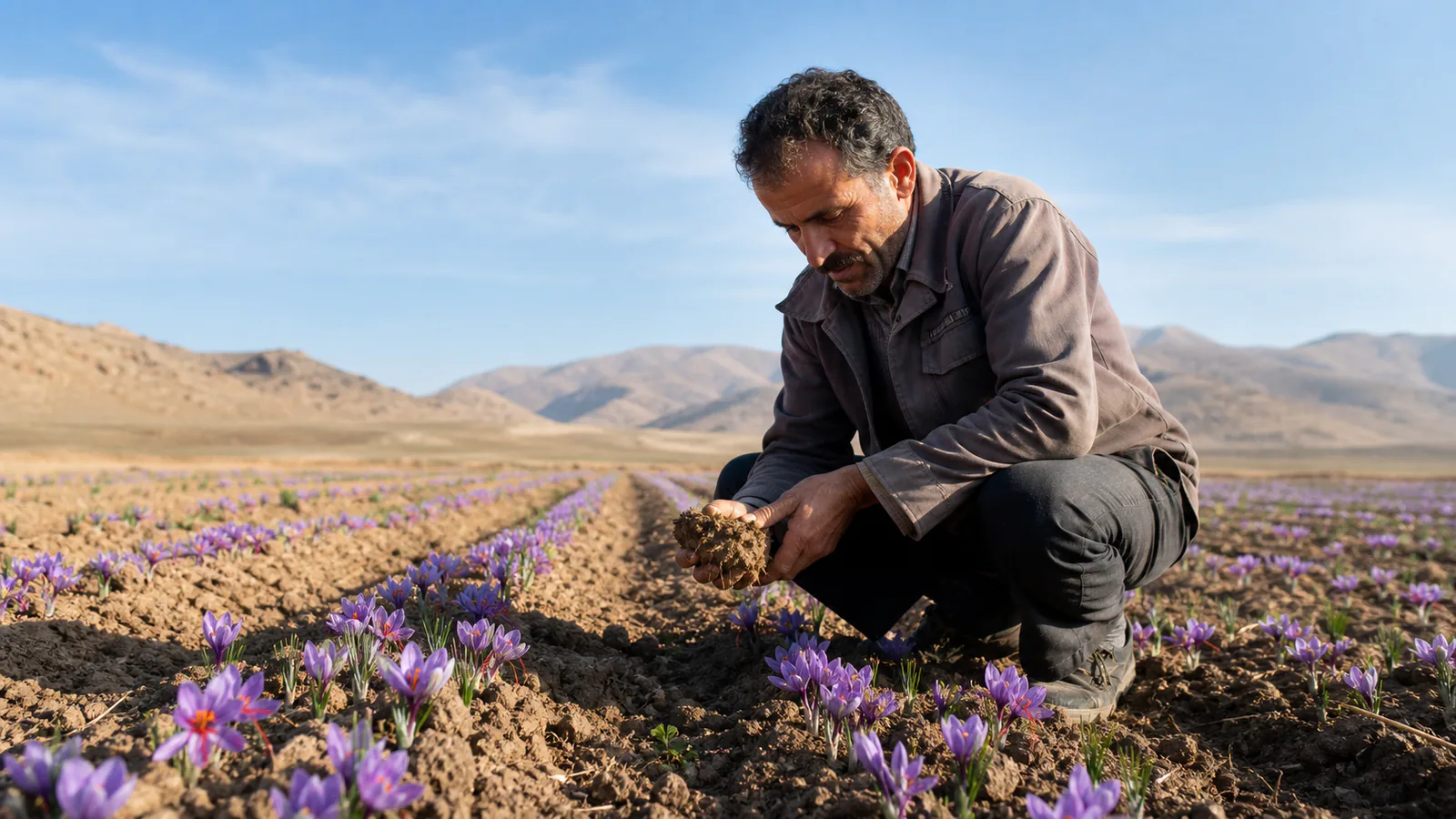
Ijrud can be suitable for the cultivation of saffron, but suitability is not a blanket guarantee for every farm. The county’s dry climate and cold season fit important parts of the crop’s annual cycle. A grower still needs to test the soil, confirm drainage and water quality, select healthy corms and check the local frost pattern before investing.
The case for Ijrud first attracted attention in a 2015 agricultural report from Zanjan Province. At that time, the county’s agriculture director described three hectares in production, six active growers and a harvest of about six kilograms. Those figures are a historical snapshot, not current statistics, but they show that saffron was already being tested commercially outside Iran’s best-known Khorasan production belt.
Where Ijrud fits in Iran’s saffron geography
Ijrud County lies in Zanjan Province in north-western Iran. Its highland setting produces cold winters and relatively dry conditions. Saffron’s leaves grow through the cooler months, while its corms become dormant in the dry summer. That reversed calendar is one reason the crop can work in places where many summer crops face water pressure.
Research catalogued by the UN Food and Agriculture Organization has identified climatically capable saffron areas in neighbouring Hamedan Province using temperature, precipitation, sunshine, frost, slope and soil data. The finding supports the regional logic, but it does not replace an assessment of a particular plot in Ijrud.
Why Ijrud may suit saffron cultivation
A dry summer matches corm dormancy
Saffron corms rest during summer. Dry soil during dormancy can limit rot, provided the field is well drained and irrigation is not excessive. This characteristic makes the crop attractive in semi-arid farming systems.
Cold is part of the normal crop cycle
Saffron is not a tropical crop. It grows actively in cool weather and can tolerate winter cold, although the exact risk depends on soil depth, snow cover, corm depth and the timing of severe frost. A county-level climate description is therefore only a starting point.
Its irrigation calendar differs from many crops
The main irrigation periods normally fall around autumn growth and flowering and during spring development, rather than at the hottest point of summer. FAO’s description of Iran’s qanat-based saffron system notes the crop’s value in water-scarce areas. “Low water requirement,” however, should not be read as “no water requirement.” Timely irrigation and the quality of the available water still matter.
High value per unit of harvested weight
Dry saffron is compact and valuable, which can make it attractive where land is fragmented or transport is costly. The economics are demanding at the beginning: corms, land preparation, labour and clean drying equipment all require capital before the field reaches mature production.
What the 2015 Ijrud report actually said
The agriculture director quoted in the report expected cultivation to expand by about 20 hectares over the following years. He described saffron development as a local management priority and said that the existing growers produced roughly two kilograms per hectare across their first three hectares.
The report also identified finance as a constraint. Establishing a saffron field requires a substantial initial outlay, while the corms remain in the ground for several seasons. Low-interest credit was therefore presented as a way to help growers manage the start-up period. Tehran was mentioned as a consumer market for Ijrud’s crop.
These statements record an official plan and local expectations in 2015. They do not prove that the projected area was planted, that the same six growers remain active, or that the reported yield represents today’s farms. Current acreage, yield and financing would need current data from Zanjan’s agricultural authorities.
Six checks before planting saffron in Ijrud
1. Soil texture and drainage
Saffron needs soil that drains freely. Waterlogged ground increases the risk of corm disease and loss. A field inspection and soil test should establish texture, salinity, pH, organic matter and nutrient status before planting.
2. Water availability and salinity
A grower needs enough water at the right stages, not simply a low annual total. Water quality matters too. Iranian field research indexed by FAO AGRIS shows that irrigation salinity, manure rate and planting method can all affect saffron growth and yield in semi-arid conditions.
3. Microclimate and frost exposure
Elevation, slope and cold-air pooling can create large differences between nearby plots. Temperature records from the nearest station should be combined with the farmer’s knowledge of the site, especially for flowering time and early autumn frost.
4. Healthy planting material
Large, firm, disease-free corms give a field a better start. A cheap lot contaminated by fungal disease can turn a multi-year planting into an expensive failure. Traceable planting material and careful inspection are worth more than an optimistic yield forecast.
5. Harvest labour and drying capacity
Flowers must be collected promptly and the stigmas separated without delay. The harvest window is short, so labour availability can limit the area a family can manage. Clean, controlled drying is equally important because poor handling can damage aroma, colour and food safety.
6. A realistic market route
A distant consumer market is useful only when grading, packaging, traceability and transport are organised. Before expanding acreage, growers need to know who will buy the crop, which quality specification applies and how payment risk will be managed.
Start with evidence, then expand
The safest development path is a representative pilot plot followed over several seasons. Record corm source, planting density, irrigation dates, labour hours, dry stigma yield and quality results. Compare those records with the actual sale price and all establishment costs.
Ijrud’s climate gives saffron cultivation a credible basis, and the small 2015 plantings showed local interest. The final decision belongs at field level. Soil, water, corm health, labour and market access determine whether “suitable” becomes a durable farm business.

![Exporting Saffron to Turkey + Price Guide [Complete 0 to 100]](https://img.rowhanisaffron.com/20260827003933/saffron-export-turkey-quality-inspection.webp)



