


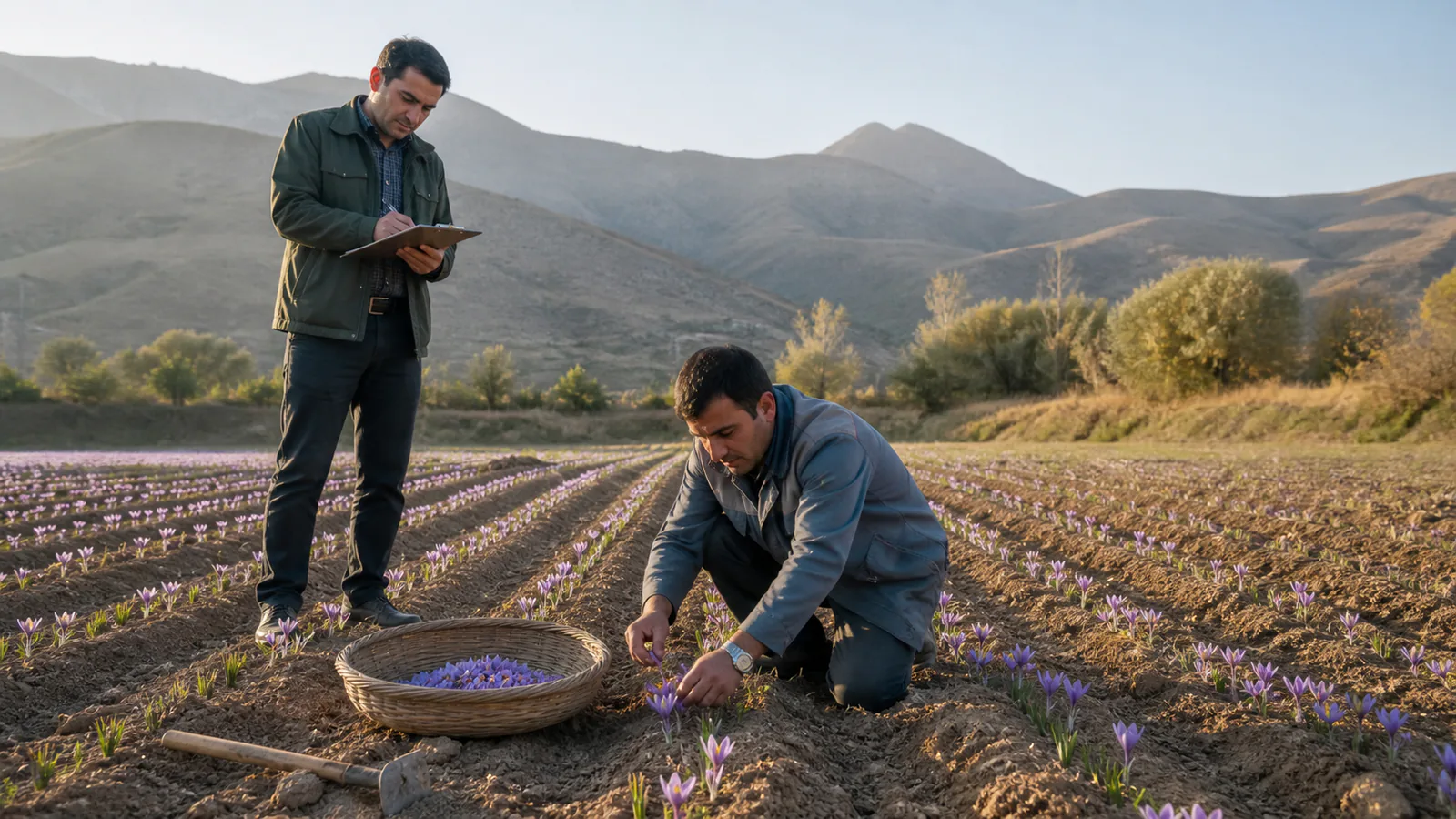
Agriculture supports the development of saffron in Ardebil, according to a December 2015 provincial agriculture report that described saffron as a promising crop for suitable parts of Ardabil Province. The announcement focused on practical support for growers, the crop’s relatively modest water demand, and the possibility of adding a higher-value product to the province’s farming mix.
The original English version of this report had been damaged by machine translation. This revised account keeps its names, places, figures and historical meaning, while making clear that the announcement is an archival record rather than a description of today’s programme.
What Ardabil’s agriculture authority announced
Adil Sarvi, then head of the Agricultural Jihad Organization of Ardabil Province, said the organisation intended to support saffron cultivation in areas where local conditions and farm economics justified it. He also said saffron produced in the province had shown encouraging quality.
The report placed that support within a broader discussion about crop planning. Provincial officials wanted researchers, agricultural specialists and growers to identify which crops suited each district instead of promoting a single crop everywhere. Saffron was considered alongside pistachios, jujubes and peanuts as one of several higher-value options for appropriate land.
That distinction matters. Ardabil contains cold uplands, valleys and the warmer Mughan plain; a crop that performs well in one part of the province may be a poor choice in another. Support for saffron development was therefore a proposal for selective, evidence-led expansion, not a claim that every Ardabil farm should replace its existing crops.
Why saffron attracted attention in Ardabil
Two qualities were central to the 2015 proposal: saffron can require less irrigation than many conventional field crops, and a small quantity of dried spice can carry substantial value. For growers facing water constraints, those characteristics make the crop worth investigating. They do not, by themselves, guarantee profit.
A saffron field also represents a multi-year commitment. The underground corms remain in the soil and produce successive crops, so site selection, drainage and healthy planting material affect more than one harvest. Flower picking and stigma separation are concentrated into a short period and require careful labour planning. Drying, storage, grading and access to a dependable buyer matter just as much as successful flowering.
Research published through the FAO AGRIS research catalogue supports the need for location-specific decisions. A 2014 study mapped Ardabil’s agroclimatic suitability for saffron by combining climatic and physical land factors. Its purpose was to identify suitable zones, which is a more useful approach than treating the province as one uniform growing area.
Field visits and planting-material support
Sarvi said officials had visited saffron farms in Namin and Meshgin Shahr. The results encouraged the provincial organisation to continue working with growers, particularly because of the quality seen in local production and the crop’s potential contribution to farm income and rural employment.
The report also stated that roughly 72 tonnes of saffron planting material had been distributed during the previous year. In this context, “seed” means saffron corms: Crocus sativus is propagated vegetatively rather than grown from ordinary botanical seed. The figure belongs to the 2015 report and should not be read as a current annual distribution total.
Officials said support included helping farmers obtain planting material and seeking the funding needed for cultivation. That can lower the initial barrier to a trial plot, but corm quantity is only one part of a sound establishment plan. Growers also need to know the corms’ health and origin, test their soil, understand drainage and frost conditions, and make a realistic estimate of harvest labour.
Where cultivation was being considered
The announcement said saffron had potential in most of Ardabil Province, while distinguishing Parsabad and Bileh Savar from the general recommendation. Those northern districts sit in the Mughan plain and have conditions that differ from much of the province. The wording did not mean saffron was impossible there; it meant that the provincial plan was not applying one recommendation indiscriminately.
Local trials continued after the report. In 2016, for example, an account from Parsabad described a first three-hectare planting and projected about two kilograms of saffron per hectare under that trial’s conditions. That Parsabad field report is evidence of a specific project, not a yield promise for other farms.
Yield varies with field age, corm size and density, soil, irrigation, weather, disease pressure and harvest handling. A grower evaluating saffron cultivation in Ardabil should use local plot results and current extension advice rather than importing a yield estimate from Khorasan or from a different part of the province.
What responsible support looks like
Planting-material distribution can help a new crop get started, but lasting development needs a longer chain of support. The most useful programme would connect growers with:
- site and soil assessment before planting;
- clean, traceable corms suited to a multi-year field;
- district-specific irrigation and crop-calendar advice;
- training for rapid flower handling and hygienic stigma separation;
- controlled drying and moisture-safe storage;
- quality testing, grading and transparent sales channels; and
- realistic records of labour, yield and net return from trial plots.
Ardabil’s own agricultural extension material has continued to connect saffron and medicinal plants with crop-pattern planning and efficient water use. A report from the Samirin Agricultural Jihad centre, for example, describes discussion between growers and specialists about crop choice, water management and the technical requirements of saffron. That kind of local exchange is more valuable than a general promise that the crop will automatically raise income.
The income opportunity, with the risks included
Saffron can add value to a small area of land, but the price of the finished spice is not the same as a farmer’s profit. Establishment costs arrive before a field reaches mature production. The flower harvest is time-sensitive, and poor separation or drying can reduce quality after a good crop. Market prices also change, while financing costs and access to buyers differ from one farmer to another.
For that reason, a modest pilot area is often more informative than immediate large-scale planting. A trial lets a grower measure flowering, labour hours, dried yield, quality and sales under the farm’s own conditions. It also reveals drainage or disease problems before they are repeated over a larger field.
Anyone planning a crop should begin with a proper land-suitability assessment for saffron, then build a cultivation plan around local evidence. Our detailed guide to saffron cultivation and growing conditions explains the agronomic questions that need answers before corms go into the ground.
How to read the 2015 announcement today
The durable point in this report is not a single tonnage figure or a blanket promise of prosperity. It is the effort to broaden Ardabil’s crop choices while using research, field visits and grower support to decide where saffron belongs.
Some farms may find that saffron fits their soil, climate, water budget and available labour. Others may be better served by a different crop. The strongest version of saffron development in Ardabil is therefore selective: test locally, keep accurate records, protect quality after harvest and expand only when the farm’s own results support the decision.

![Exporting Saffron to Turkey + Price Guide [Complete 0 to 100]](https://img.rowhanisaffron.com/20260827003933/saffron-export-turkey-quality-inspection.webp)



