


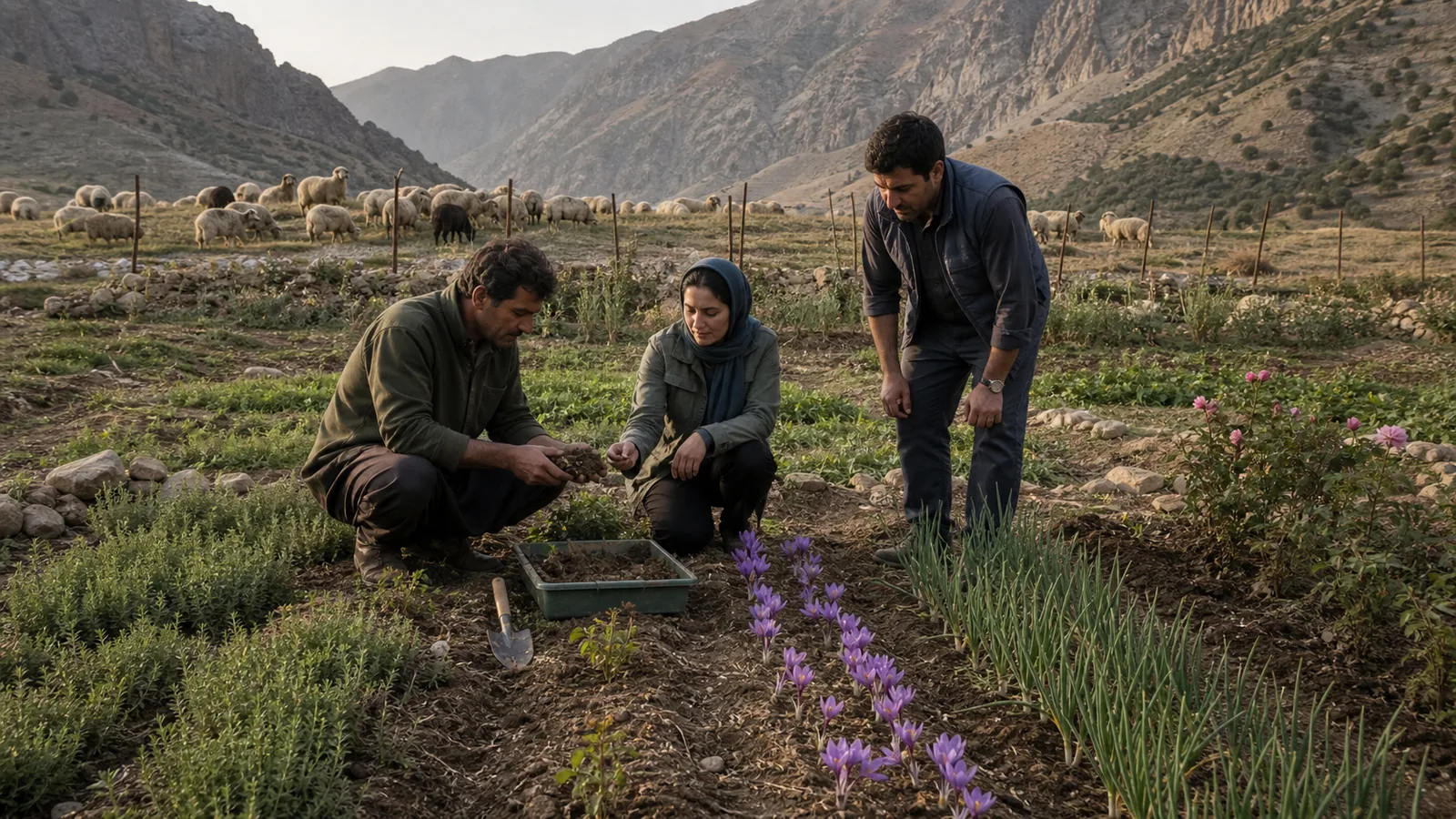
Cultivation of medicinal plants in Chaharmahal and Bakhtiari tribal areas began as a small research-and-training project, not a province-wide change of crops. In late 2015, a one-hectare pilot near Chelgerd in Kuhrang County brought tribal participants and agricultural researchers together to test thyme, saffron, shallot and Damask rose under local conditions.
The purpose reached beyond the harvest from that hectare. Officials wanted to see whether cultivated medicinal and aromatic plants could add a second source of household income, reduce excessive dependence on livestock, and ease some pressure on the rangeland. The pilot belongs to the wider story of agriculture in Chaharmahal and Bakhtiari Province, where crops and livestock share a mountain landscape shaped by seasonal migration.
What began near Chelgerd in 2015
The original account was based on an IRNA interview with Yahya Hosseinpour, then director general of Chaharmahal and Bakhtiari’s Nomadic Affairs office. His name was badly damaged in the old English translation and appeared as “John.” Hosseinpour said the one-hectare plot was carried out through a programme of study, training and extension, with tribal participation at the Chelgerd development centre in Kuhrang.
Four crops were identified in the surviving report:
- thyme, an aromatic herb whose species and management have to match the site;
- saffron, a corm crop with autumn flowers and a concentrated manual harvest;
- shallot, a bulb-forming allium that must not be confused with unsupervised collection from wild stands; and
- Damask rose, a perennial shrub grown for fragrant flowers.
The wording “were killed” in the machine-translated copy was an error; the crops were planted as a pilot. They do not share one production calendar, irrigation need or route to market. Putting them in the same trial allowed researchers and participating families to compare establishment, labour, yield and practical fit rather than assuming that every so-called medicinal plant would perform alike.
Why crops and livestock were considered together
Livestock has long been central to Bakhtiari nomadic livelihoods. Animals convert seasonal pasture into meat, milk and other products, but a household that depends almost entirely on its herd is exposed to drought, high feed costs, animal-health problems and weaker rangeland. The 2015 project therefore linked plant cultivation with a livestock-and-pasture objective.
Hosseinpour described the goals as improving tribal household income, creating a better balance between livestock numbers and available grazing, reducing grazing pressure, and improving rangeland conditions. That did not mean removing livestock from the local economy. The more careful interpretation is diversification: a viable crop or processing activity might earn part of a household’s income, while better livestock productivity could reduce the need to expand herd size simply to maintain earnings.
Cultivated fields and natural pasture must also be kept distinct. A crop trial on suitable agricultural land is not a licence to plough species-rich rangeland. Site selection needs clear land rights, soil and water evidence, erosion safeguards and agreement with the people who use the area along a migration route.
Kuhrang County agriculture is shaped by movement
The old report said tribal communities used about 85 percent of the province’s geographic area. It also distinguished two migration patterns: Kuhrang and Ardal hosted the largest presence associated with migration across provincial boundaries, while Lordegan hosted the largest within-province movement. These historical descriptions explain why a fixed farm project cannot be designed as if every participating family lives beside the plot throughout the year.
Planting, irrigation, weeding and harvest must fit the household’s actual calendar. Saffron, for example, demands concentrated labour when flowers emerge. Damask rose has a different flowering period and remains in the ground for years. A family may need a trusted local partner, shared labour or cooperative arrangement if crop work overlaps with migration or animal care.
Access matters too. A high-value product is still difficult to sell if fresh material cannot reach a processor, dried material cannot be stored safely, or buyers are too far away to inspect a lot. Kuhrang County agriculture is not only about what the soil can grow. Roads, training, collection points, packaging and contracts influence whether a pilot becomes dependable income.
What the four-year cooperation was meant to learn
The 2015 report described a four-year collaboration between the Iran Nomadic Affairs Organization and the provincial agricultural research, education and natural-resources system. The one-hectare plot followed preparatory research and was expected to generate practical evidence for extension work.
A useful multi-year trial would record more than whether plants survived. Each crop needs its own evidence:
- establishment rate and losses after the first winter;
- irrigation volume, timing and water quality;
- labour hours at planting, maintenance and harvest;
- fresh and dry yield by season, not a single best plot;
- drying, storage and processing losses;
- buyer requirements, saleable grade and actual price received; and
- effects on the household’s livestock work and use of pasture.
The surviving article does not provide the pilot’s final four-year dataset. It would be misleading to claim success from the launch announcement alone. Later official activity does show that medicinal-plant training continued in Kuhrang, but it does not substitute for the missing plot results.
Later training in Kuhrang
In January 2022, Iran’s Ministry of Agriculture news service reported practical courses on leafy and bulb-forming medicinal plants in Dasht-e Zarin, Kuhrang. The county agriculture director said close to ten extension and skills courses had been organised that year across the Central, Bazoft and Samsami districts, following increased activity during the previous two years.
That report added an important commercial point: cultivation needed parallel investment in processing and packaging. Many aromatic crops lose value if they are dried poorly, mixed without traceability or sold before a suitable buyer is identified. Saffron faces the same discipline. A clean thread, controlled moisture, a known batch and appropriate food-contact packaging matter more than decorative presentation alone.
For saffron-specific field decisions, our evidence-checked saffron cultivation guide covers corm selection, soil, irrigation, flowering and storage. A separate article examines the risks and trade-offs when saffron cultivation moves beyond Khorasan. Neither replaces local extension advice for a Kuhrang field.
How to judge whether a medicinal crop belongs on a tribal farm
A crop can grow and still be a poor livelihood choice. Before expanding beyond a demonstration plot, the family and advisers need to answer a few practical questions.
Does it suit the exact field?
Province-level climate labels are too broad. Elevation, slope, drainage, frost pocket, irrigation source and soil chemistry can vary over a short distance. The species—or cultivar—must be identified correctly, especially where a cultivated plant has a related wild form.
Who will do the work?
Harvest windows for flowers can be short. The plan should include the family’s migration and livestock calendar, the role and compensation of each worker, and an alternative if weather compresses the harvest into fewer days.
What exactly will be sold?
The customer may want fresh flowers, dried petals, cleaned bulbs, whole dried herbs, saffron threads or a tested ingredient. Each product has a different processor, storage life and regulatory expectation. “Medicinal plant” is an agricultural category here; it is not proof that a homemade preparation is safe or effective for treating illness.
Is there a buyer before acreage expands?
A quoted retail price is not the same as a farm-gate return. The calculation needs the saleable yield, rejected material, drying ratio, packaging, transport, finance and time spent. A written specification and a sample lot are more useful than a general promise of a high-value crop.
The wider livelihood programme
By 2023, the official diversification programme for tribal communities in Chaharmahal and Bakhtiari was described through four connected areas: tourism, handicrafts, cultivation and processing of medicinal plants, and greater productivity in animal husbandry through a more complete red-meat value chain. Officials explicitly said that relying only on livestock and pasture was not sustainable.
This broader plan helps place the Chelgerd hectare in context. The pilot was not meant to turn herders into one-crop farmers. It explored whether another carefully chosen activity could sit beside livestock, spread risk and keep more processing value within tribal households. Success would be measured in durable income and healthier land use, not merely in hectares planted.
What the 2015 launch can—and cannot—tell us
The launch established who participated, where the test took place, which four crops were planted and what the public goals were. It also preserved a valuable connection between Chaharmahal and Bakhtiari Province agriculture, crops, livestock and the reality of migration through Kuhrang, Ardal and Lordegan.
It did not publish final yields, profit, household-level income change or measured rangeland recovery. Those outcomes should remain open questions unless the four-year records become available. The responsible lesson is the design of the experiment: research first, train participants, test several crops on a limited area, measure the effect on the whole livelihood, and expand only where the field and the market both work.
Sources and reporting notes
- Iran Ministry of Agriculture news service: medicinal-plant skills courses in Dasht-e Zarin, Kuhrang.
- Iran Ministry of Agriculture news service: diversification of tribal livelihoods.
- Iran Ministry of Agriculture news service: Yahya Hosseinpour on education and services for tribal communities.
The one-hectare pilot, crop list, four-year cooperation and migration geography are retained from the December 2015 IRNA report. Later official pages establish that related training and diversification work continued; they do not prove the original plot’s final performance. Sources were reviewed on 29 August 2026.

![Exporting Saffron to Turkey + Price Guide [Complete 0 to 100]](https://img.rowhanisaffron.com/20260827003933/saffron-export-turkey-quality-inspection.webp)



