


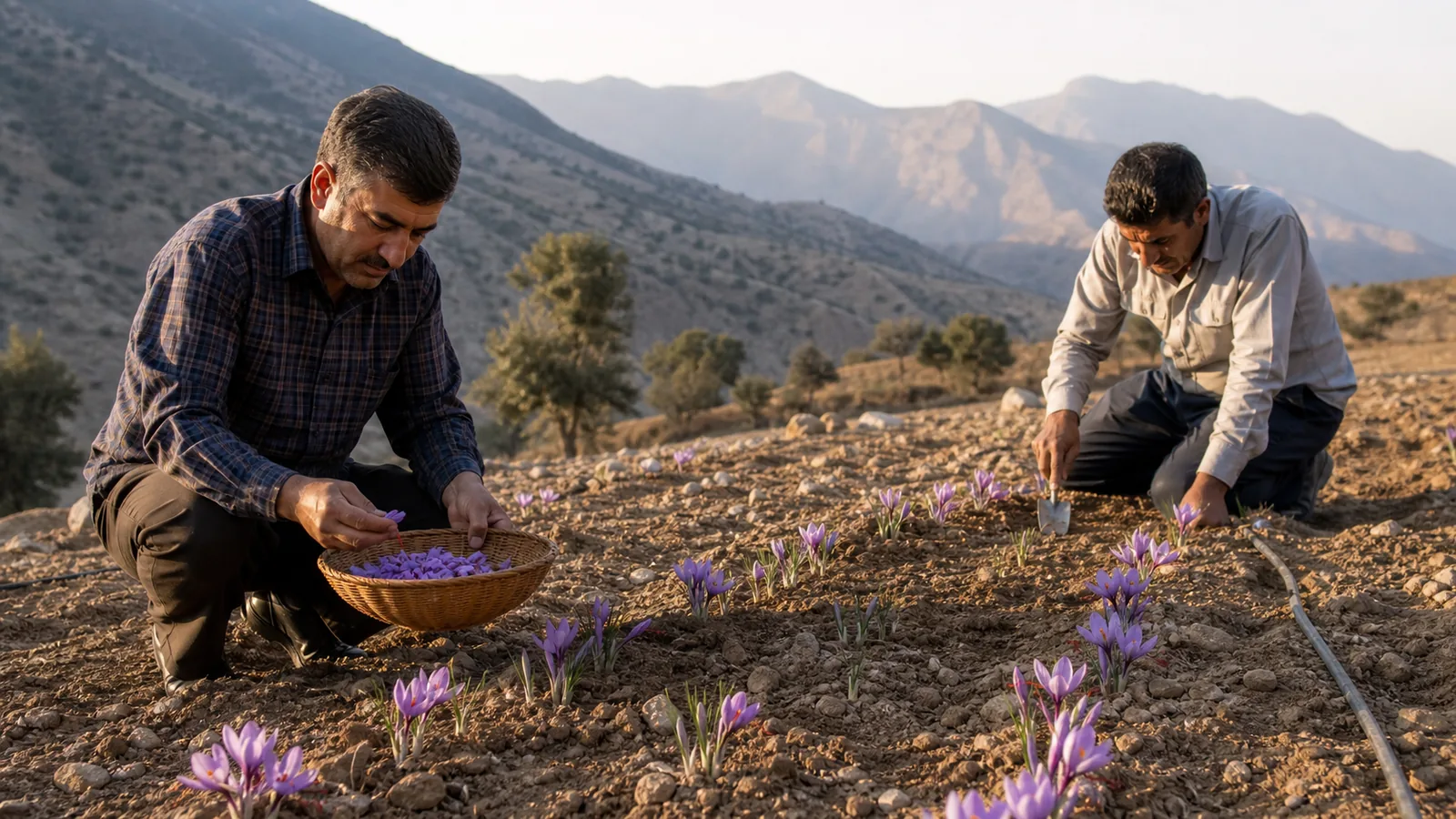
“Rose gold” in this article’s original headline means saffron—the spice more commonly called red gold in Iran. The “roof of Khuzestan” is Dehdez, a high, cool part of the Zagros landscape in the province’s northeast. In 2015, two farmers in the nearby Qaleh Sard area were trying something that was still unusual locally: saffron cultivation in Dehdez.
Their plot was small and the harvest was mainly for personal use. Even so, the experiment was more than a curiosity. It showed that Khuzestan is not one uniform hot plain. Around Dehdez and the village cluster that includes Deh Kian, elevation and winter cold create very different growing conditions. Later provincial projects would build on that same idea.
Two farmers, a small plot and a ten-year trial
The surviving report came from a PANA interview in December 2015. One farmer, identified in its English translation only as H. Kayani, said the two residents had been growing saffron for nearly ten years. They treated the first two years as a trial, watched how the plants responded and then increased the planted area gradually.
They sourced corms from Khorasan and Yazd. Kayani said they planted at the beginning of October and expected flowers in December under their local conditions. That is a record of what these farmers did, not a planting calendar for every field. Saffron timing changes with climate, elevation, corm dormancy, soil temperature and the date of the first irrigation. A farmer elsewhere in Khuzestan should not copy the month without local advice and a soil-and-water assessment.
At the time, only the two villagers were involved and the crop was not yet a meaningful commercial supply. Kayani said a good early yield encouraged them, but they had received no specific support to expand. He believed a larger, properly supported project might create income and seasonal work for other residents. The cautious words matter: this was a promising farm trial, not proof that every nearby hectare would be profitable.
Where the experiment took place
The old machine translation folded several place names together. Deh Kian is one of the settlements associated with the Qaleh Sard village area near Dehdez. In 2015, Dehdez was administered as a district of Izeh County. It later became the centre of Dezpart County, so current reports use “Dezpart” for projects in the same broader area.
Dehdez is sometimes called the roof of Khuzestan because of its high position. The description is useful here. Saffron needs a seasonal rhythm: dormant corms through the hot, dry part of the year, autumn growth and flowering, then leaf development through the cooler months. Local elevation can provide that rhythm even inside a province better known for heat.
Elevation alone does not make a site suitable. A cold mountain plot may still fail if the soil remains waterlogged, the corms carry disease, irrigation water is too saline, or flowering collides with damaging weather. The two farmers’ decision to begin on a small scale was therefore sound. A pilot reveals more than a province-wide climate label.
What happened to Khuzestan saffron after 2015
The Dehdez story did not remain an isolated two-person experiment. A 2024 report from Iran’s Ministry of Agriculture news service described a provincial programme distributing 44 tonnes of saffron corms, accompanied by practical training for growers. New fields were being developed in Dezpart, while educational pilot plots were planned or planted in Izeh, Andika, Lali, Baghmalek and Seydon.
The same official report put Khuzestan’s saffron area at 28 hectares before that expansion and expected it to reach 36 hectares. Harvest was forecast from late Aban to late Azar—the period running roughly from mid-November to late December—and the provincial forecast was 120 kilograms. These were programme and forecast figures, not a final audited harvest.
An earlier provincial account reported 35 hectares and an expected 36-kilogram crop across Izeh, Baghmalek, Behbahan and Shushtar. The different years, districts and forecasts should not be mixed into a single trend line. They do show, however, that saffron cultivation in Khuzestan moved beyond the original Dehdez plot. Our separate report on the 36-kilogram Khuzestan saffron forecast preserves that earlier provincial snapshot.
Why the crop can work in a cooler Khuzestan microclimate
Saffron is a sterile crocus propagated through corms, not seed. The corm stores the reserves needed for the next growth cycle. Its size and health affect flowering potential, which is why reputable, disease-free planting material matters. Moving corms from a successful region does not transfer that region’s outcome automatically; the receiving field still has its own soil, water and management.
Research on Iranian farms has found yield relationships with field age, corm size and irrigation management. The details varied by location. That is the practical point for Dehdez: there is no single watering interval or planting density that is correct across Iran. Even a comparatively low-water crop needs enough moisture at the right stages, while standing water around the corm can invite rot.
Before expanding a trial plot, growers should examine:
- Drainage and soil structure. The bed needs to release excess water and allow roots to develop; “dry climate” does not compensate for a poorly drained field.
- Water quality. Salinity affects growth and flowering, and the safe irrigation plan depends on both water and soil measurements.
- Corm source and condition. Corms should be traceable, appropriately sized for the plan, and checked for wounds, decay and pest damage before planting.
- Local temperature pattern. The timing of dormancy, sprouting, flowering and frost risk should be observed in the actual field, not inferred from the nearest city.
- Labour at flowering. Flowers open over a concentrated period and need prompt, careful collection. A larger plot is only useful if enough trained hands are available.
For a fuller field-to-storage sequence, see our evidence-checked saffron cultivation guide. Local extension advice should take precedence when its recommendations are based on the site’s soil, water and weather.
The work does not end when the flower is picked
The 2015 report listed irrigation, harvest timing, stigma separation, drying and packaging among the factors that shape the finished crop. That remains a useful chain. The valuable part of the flower consists of three red stigmas, which are separated and dried. Rough handling, slow processing, excess heat or moisture can damage aroma, appearance and storage stability.
Drying needs control rather than guesswork. The objective is a stable product, not the fastest possible blast of heat. Once dry, saffron should be protected from moisture, strong light, heat and foreign odours in clean food-contact packaging. A small home harvest and a commercial batch need different records, but both benefit from careful handling.
The old report also repeated a familiar claim that Spain buys Iranian saffron in bulk and sells it in attractive packages. Spain is indeed a major importer of Iranian saffron, but packaging is only one part of the trade. Testing, grading, regulatory compliance, distribution and customer access all add work and cost. Trade totals cannot prove what happened to a particular Dehdez lot or what origin appeared on its final label.
Could saffron create local income?
It can create seasonal and post-harvest work, but acreage alone does not guarantee income. A new grower has the cost of corms, land preparation, irrigation, labour and the years needed to understand the field. Flower picking and stigma separation are labour-intensive. Prices vary by grade, harvest, buyer and evidence of quality.
A sensible expansion begins with a sale route as well as an agronomic plan. Growers need to know who will buy the crop, whether the buyer wants flowers or dried threads, how quality will be assessed, and how each lot will be stored and identified. Cooperatives or shared facilities may help small producers gain access to drying, testing and packaging without each farm buying the same equipment.
The environmental argument also deserves care. Saffron often needs less irrigation than many conventional crops, but “low water” is not “no water.” Expansion should be tied to a realistic water budget and measured yield, especially in a mountain community where households, orchards and livestock depend on the same local resources.
What the Dehdez trial tells us now
The strongest part of the original story is its scale. Two farmers did not announce a new saffron capital. They brought corms from established regions, learned over several seasons and expanded only after seeing a useful result. Nearly a decade later, official reports were describing larger cultivation and training efforts in Dezpart and other parts of Khuzestan.
That does not make the province interchangeable with Khorasan, and it does not turn every upland field into a saffron farm. It shows how a crop can be tested responsibly outside its best-known region: start locally, keep the evidence tied to a season and place, improve the handling after harvest, and scale only when the field and the market both support it.
Sources and reporting notes
- Iran Ministry of Agriculture news service: expansion of saffron cultivation in Khuzestan, dated 2 Mehr 1403.
- Environmental Research: planting date and irrigation-water salinity in saffron cultivation.
- Acta Horticulturae: agronomic attributes of saffron yield on Iranian farms.
The farmers’ statements and early chronology are preserved from the December 2015 PANA report. The official expansion figures refer to the 1403/2024 programme and were reviewed on 29 August 2026. Forecasts are labelled as forecasts; they should not be read as final production totals.

![Exporting Saffron to Turkey + Price Guide [Complete 0 to 100]](https://img.rowhanisaffron.com/20260827003933/saffron-export-turkey-quality-inspection.webp)



