


Agricultural tourism can support saffron production in Khorasan Razavi by giving farms another source of income during the short autumn flowering season. It does not make each field produce more saffron by itself. Its value is in paid visits, local sales, education and the wider rural economy, especially when weather shocks reduce the crop.
This distinction brings two older reports into one useful account. The first proposed saffron-field tourism as an economic opportunity. The second described a reported 30% production loss, a cooperative purchasing program and the importance of the Torbat-e-Heydariyeh–Zaveh growing area. Together, they show why tourism, crop management and market support need to be considered as parts of the same regional system.
Why saffron flowering can attract visitors
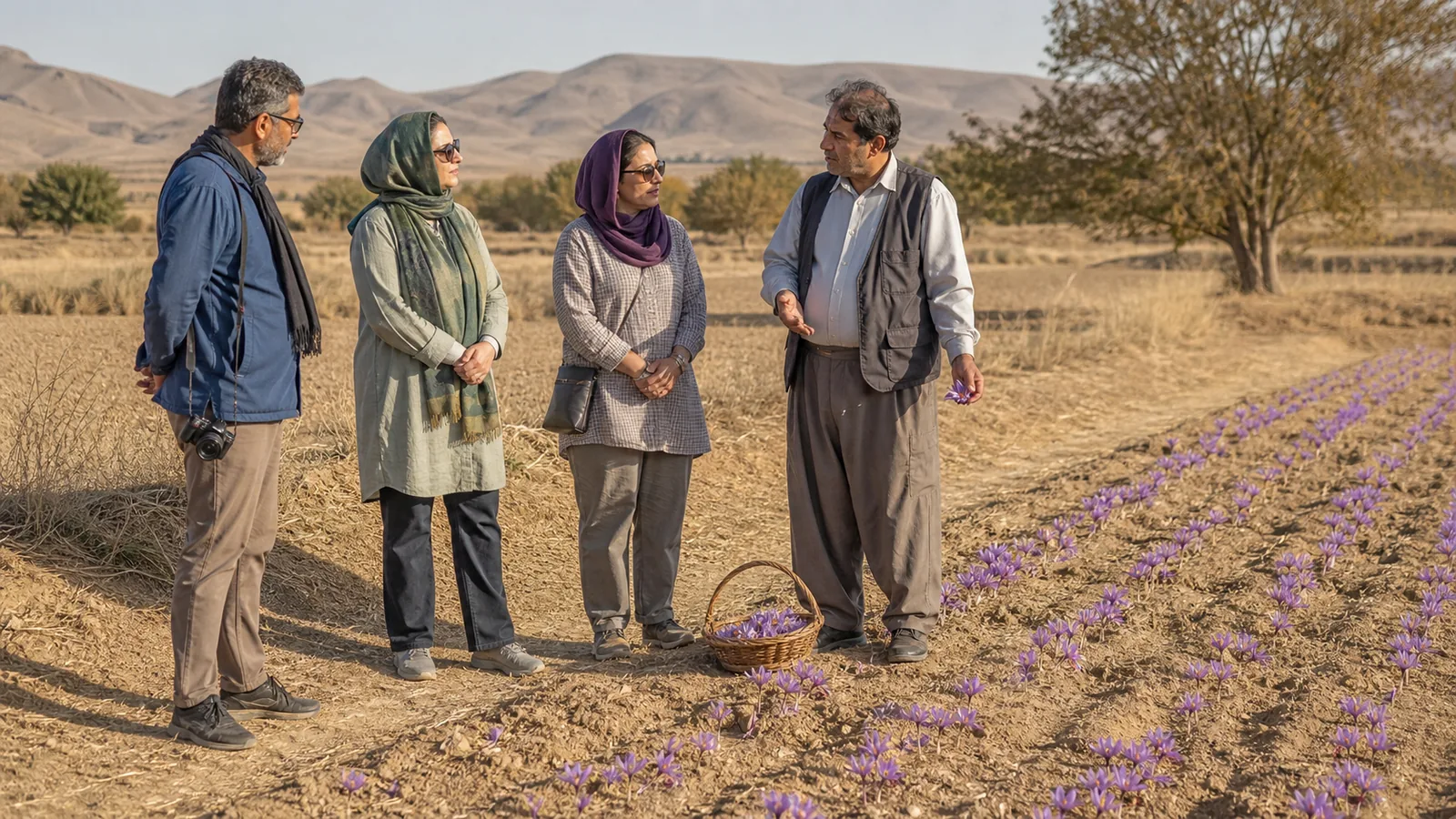
A saffron field changes quickly in autumn. Purple flowers appear close to the ground and must be collected during a concentrated harvest. Visitors can see the crop, meet growers and understand why three small stigmas from each flower require so much manual work.
Sina Farshchin, described in the original destination article as an ecologist and water-resources expert, proposed using this period to attract visitors to Khorasan Razavi. The translated report referred to a flowering and visitor opportunity lasting about a month to a month and a half. The exact bloom is not a fixed festival date: temperature, irrigation, elevation and the season’s weather can move it.
Farshchin argued that branding Iranian saffron and combining agriculture with tourism could make the crop more valuable to the region. His statement that saffron income could remove the country’s need to sell oil was advocacy, not an economic forecast supported by figures in the article. The practical idea underneath it is more modest and credible: a farm can earn from an experience as well as from the harvested spice.
The Food and Agriculture Organization describes agrifood-tourism links as potential sources of farm income, employment and heritage preservation, while stressing the need for coordination among farmers, tourism businesses, destination managers and policymakers. A saffron visit therefore needs planning; attractive flowers alone do not create a safe or profitable tourism product.
What a responsible saffron-farm visit should include
The harvest is working time, not a photo set. A good visit protects the crop and gives the farmer a clear return. Depending on the farm, a small program might include:
- a guided walk on marked paths rather than unrestricted movement through the rows;
- an explanation of the saffron plant, corm and annual growing cycle;
- a supervised demonstration of flower picking and stigma separation;
- a clean tasting or cooking demonstration away from field dirt and processing areas;
- traceable farm products offered without exaggerated purity or health promises; and
- booked group sizes, prices and times that do not delay the commercial harvest.
Hosts also need basic visitor safety, sanitation, parking or transport arrangements, liability planning and a way to protect workers’ privacy. If guests are allowed to handle flowers, the farm should define which flowers, where they go afterward and whether they remain outside the food-production stream.
Tourism revenue is not the same as higher crop yield
The earlier article described average Khorasan yield as about 3.5 kg per hectare and suggested raising it to 4 kg. It then claimed the province could supply total world demand. Those figures were not accompanied by a year, survey method, planted-area denominator or current production dataset, so they should remain historical estimates rather than targets.
Agricultural tourism may help a grower pay for labour, healthy corms, soil improvement, irrigation maintenance, packaging or training. Those investments can support the farm. The visitors themselves do not change the biological yield, and poorly managed foot traffic can damage beds or distract from a time-sensitive harvest.
The original worldwide-consumption estimate of 500 tonnes and its estimate of 350 tonnes from Khorasan also lack a defined year and source. Production, formal exports, informal trade and consumption are different measures. Our article on Iran’s historical share of world saffron production explains why a percentage or tonnage needs its date and definition.
Production shocks in Khorasan Razavi
A separate report attributed a 30% reduction in Khorasan Razavi saffron production to Mojtaba Mazrouei, identified as a director in the provincial Jihad Agriculture Organization. He cited three pressures together: severe cold in the preceding month, low rainfall on provincial farms and summer heat.
The 30% is retained as Mazrouei’s assessment for that harvest, not a permanent decline or a current forecast. The source did not provide a baseline tonnage, field sample, measurement period or calculation. It also repeated the statement without adding evidence.
Even with those limits, the report identifies a real planning problem. A perennial crop can face stress in more than one season: summer heat during dormancy, insufficient moisture at a critical stage, and cold around emergence or flowering. A tourism plan built around one expected bloom date or one expected crop volume needs contingency arrangements for a weak or shifted harvest.
The cooperative purchase and price-support report
Mazrouei spoke while visiting an agreed-purchase operation run by the Rural Cooperative Organization in Torbat-e-Heydariyeh. According to the translated account, the program aimed to support farmers and maintain a minimum market range during the harvest.
The report recorded eight purchasing centres operating in cities across the province, with two more planned for Taybad and Neishabour. It quoted a target price range of 44–55 million rials, without clearly stating the saffron grade, unit weight or date on which each level applied. Those missing fields make the numbers unsuitable as a present price guide.
The payment process was described as laboratory analysis followed by payment of 70% of the purchase value within 48 hours. The source did not explain the laboratory standard, how quality changed the final price, when the remaining balance was due or how much saffron the centres had purchased. Those details would have to be confirmed from the program’s records before assessing how well it worked.
Mazrouei expected reduced supply and steady world demand to move prices back toward prior levels. That was a forecast made during the reported harvest, not a guaranteed outcome. Prices can also respond to grade, stocks, export conditions, currency, buyer demand and the amount traded outside the formal channel.
Torbat-e-Heydariyeh and Zaveh as a production hub
The source described the combined Torbat-e-Heydariyeh and Zaveh area as a major saffron centre, citing approximately 20,000 hectares under cultivation and about 80 tonnes of annual dried output. These are useful historical scale estimates, but the article did not identify the statistical year. They should not be used as today’s official acreage or harvest without a newer provincial dataset.
The area’s concentration of farms makes it a natural place to connect production with carefully managed tourism. A visitor route could link fields, separation rooms, drying and grading demonstrations, local food and direct purchasing. However, each activity needs the grower’s consent, food-hygiene boundaries and honest information about origin and grade.
A more resilient model for saffron production in Khorasan Razavi
The two reports make the most sense when their claims are not pushed too far. Tourism is an additional income channel, not a yield treatment. A cooperative purchase may ease cash pressure, but its success depends on grade rules, timely payment and transparent prices. Weather-loss figures reveal vulnerability, but they need a measured baseline.
A practical regional approach would connect four things:
- farm resilience: locally appropriate water, soil, corm and weather-risk management;
- harvest economics: enough trained labour and prompt, transparent buying and payment;
- visitor management: small booked groups that pay the host and do not interfere with production; and
- credible communication: dated production figures, traceable products and no claim that one province can supply the world without current evidence.
Seen this way, agricultural tourism can help Khorasan Razavi saffron farms diversify income and tell the crop’s story. The stronger claim—that tourism automatically boosts saffron production—would require measured changes in yield, farm investment or retained income. The original reports did not provide that evidence, so the opportunity should be presented honestly: as one useful support around the crop, not a replacement for sound farming and transparent markets.

![Exporting Saffron to Turkey + Price Guide [Complete 0 to 100]](https://img.rowhanisaffron.com/20260827003933/saffron-export-turkey-quality-inspection.webp)



