


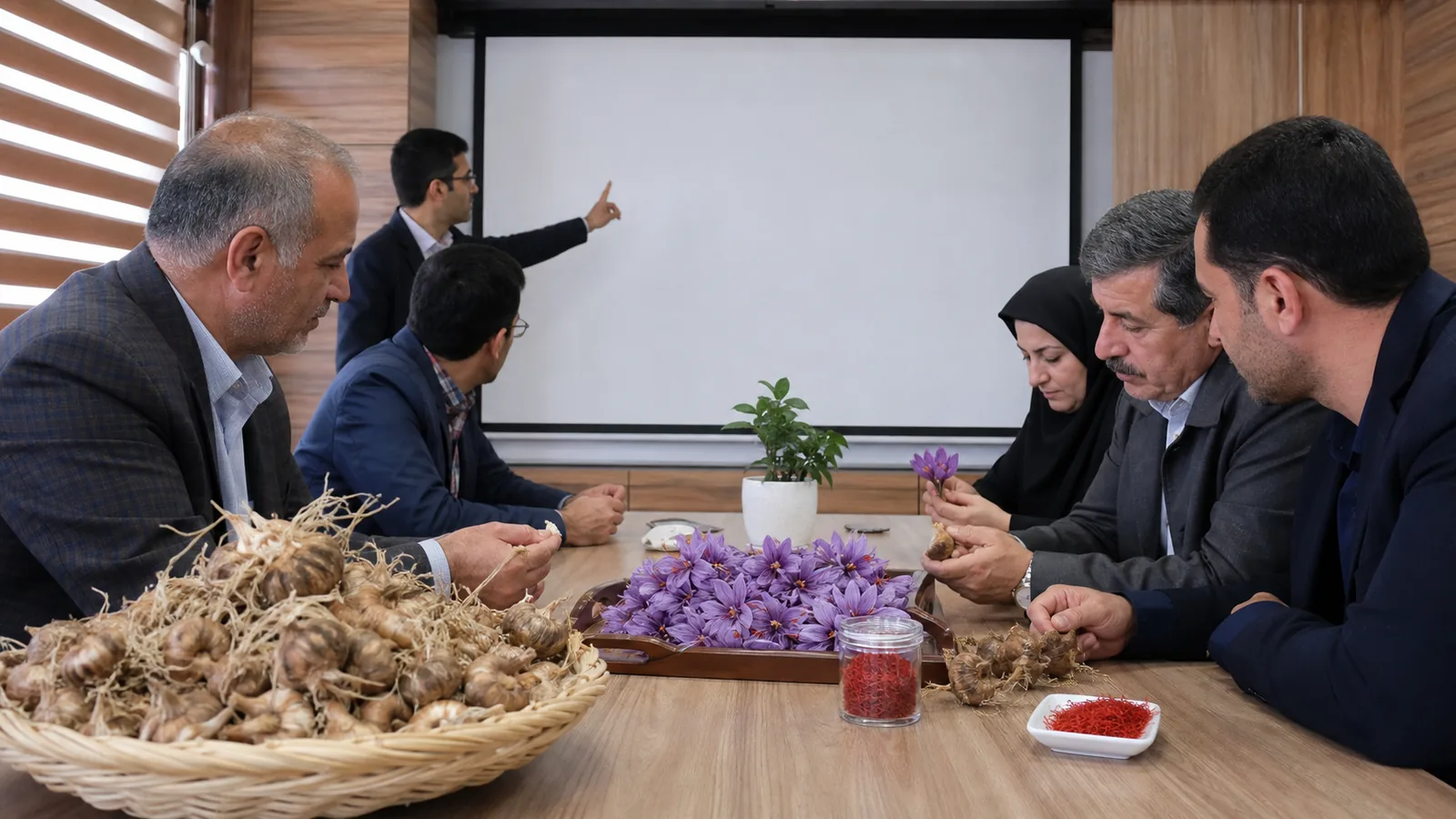
The country was declared saffron production is a 2016 conference report whose headline was damaged in translation. Its central claim was that Iran produced about 200 tonnes of saffron a year, while researchers gathered in Mashhad to discuss the latest scientific work on the crop. The figure belongs to that period; it is not a current national forecast.
The report attributes the remarks to the president of the University of Torbat-e Heydarieh and to the scientific secretary of the conference. Two names are rendered as “Hadi canvas” and “Karbassi.” The Persian source is not present in the backup, so this article records those spellings without guessing a different identity.
A saffron research conference in Mashhad
The event was described as a congress on the latest scientific and research achievements in saffron, held at the Mashhad Chamber of Commerce. Its call for papers had opened six months earlier. Organisers reported receiving 110 articles.
The translation says 80 of those 110 were “special favorites.” That may refer to accepted or selected papers, but the surviving English does not establish the category. It is therefore safer to say that 80 papers received a special selection in the report, rather than converting the phrase into an exact poster or oral-presentation count.
This distinction matters because a submission total measures interest in a conference, not automatically the amount or quality of published research. A useful proceedings record would identify the programme, peer-review process, presentation type and final papers.
The historical 200-tonne production claim
The speaker put Iran’s annual saffron output at about 200 tonnes. Contemporary context makes that scale plausible as a historical estimate: a Codex saffron project document using Iran Ministry of Agriculture-Jahad statistics listed more than 278 tonnes across seven provinces for 2014–2015, including 218.348 tonnes in Razavi Khorasan and 48.019 tonnes in South Khorasan.
Those figures do not “correct” the conference quotation. They may cover a different crop year, statistical method or province set. They show why every production number needs a year and source. Current FAO material describes Iran as producing roughly 85–90%, and in another 2025 update more than 90%, of world saffron; it does not make the old 200-tonne number current.
Was more than 90% produced in Razavi Khorasan?
The translated report says that “over 90 percent” of production belonged to Razavi Khorasan province. The 2014–2015 ministry table does not support that exact province-only share: Razavi Khorasan was dominant, but South and North Khorasan also produced significant amounts.
The intended statement may have referred to the Khorasan region or provinces together. That interpretation would fit the historical concentration better, but it cannot be silently substituted for the surviving wording. The final article therefore preserves the original Razavi Khorasan claim and labels the likely translation or scope problem.
FAO’s current saffron work likewise names Razavi, South and North Khorasan as the main producing provinces. Production concentration and global share are different measures: one asks where Iran grows its crop, the other compares Iran with all producing countries.
Torbat-e Heydarieh, Qaen and European export markets
The source calls European countries target export markets and contains a damaged place phrase rendered as “Torbat Cain.” It appears to combine Torbat-e Heydarieh and Qaen, both recognised saffron centres, but the backup does not prove the intended grammar. Both names remain visible here instead of creating a fictional city.
Research can support exports by improving corm health, cultivation, water management, harvest labour, drying, authenticity testing, grading and traceability. It cannot secure a market merely by increasing tonnage. A buyer still needs consistent specifications, documentation and delivery.
The “East to West” sentence is not usable as fact
One sentence says that, because of “negligence of the East to the West,” production is much lower. It may be criticising weak transfer of science, underinvestment in producing regions or a historical shift in cultivation, but the English does not allow a reliable choice.
The defensible point is narrower: the conference aimed to connect research with production problems. The damaged phrase is preserved as a translation limitation and is not expanded into a claim about a country, institution or culture.
Books, theses and earlier saffron events
The University of Torbat-e Heydarieh president said Iran had authored or translated 50 books and produced 150 theses about saffron. These are attributed 2016 counts, not a current bibliography. The report does not define whether a thesis means master’s work, doctoral work or both, nor how duplicates and translations were counted.
It also referred to recurring festivals and earlier events: the National Conference of Iranian Saffron, an International Saffron Conference and the Red Gold Festival. Their inclusion shows an effort to bring researchers, growers and industry together, but a festival and a scientific congress serve different purposes and should not be counted as equivalent evidence.
Why saffron research still matters
Iran’s scale makes small improvements consequential. Better field sampling, comparable yield records, validated drying, authenticity methods and traceable handling can affect many growers and buyers. FAO’s recent collaboration with Mashhad University of Medical Sciences focuses specifically on saffron authenticity testing and field-ready post-harvest guidance.
The old conference report is therefore most useful as a record of priorities: production measurement, Khorasan’s role, export quality and a growing research base. Its names, paper category and two geographic sentences require the Persian original before they can be stated more precisely.
For a dated explanation of Iran’s global share and regional yield evidence, see Iranian saffron suppliers and world production. Our Iranian saffron standards guide covers the quality measurements that research and trade use.
Sources and further reading
- The immutable 2016 Rowhani Saffron backup, attributing the event, paper, production, publication and festival counts to the conference report.
- Codex saffron project document, including 2014–2015 Iranian province production data.
- FAO–Mashhad University saffron authenticity work, 2025.
- FAO and Iran saffron value-chain quality initiative, including the 85–90% production range.

![Exporting Saffron to Turkey + Price Guide [Complete 0 to 100]](https://img.rowhanisaffron.com/20260827003933/saffron-export-turkey-quality-inspection.webp)



