


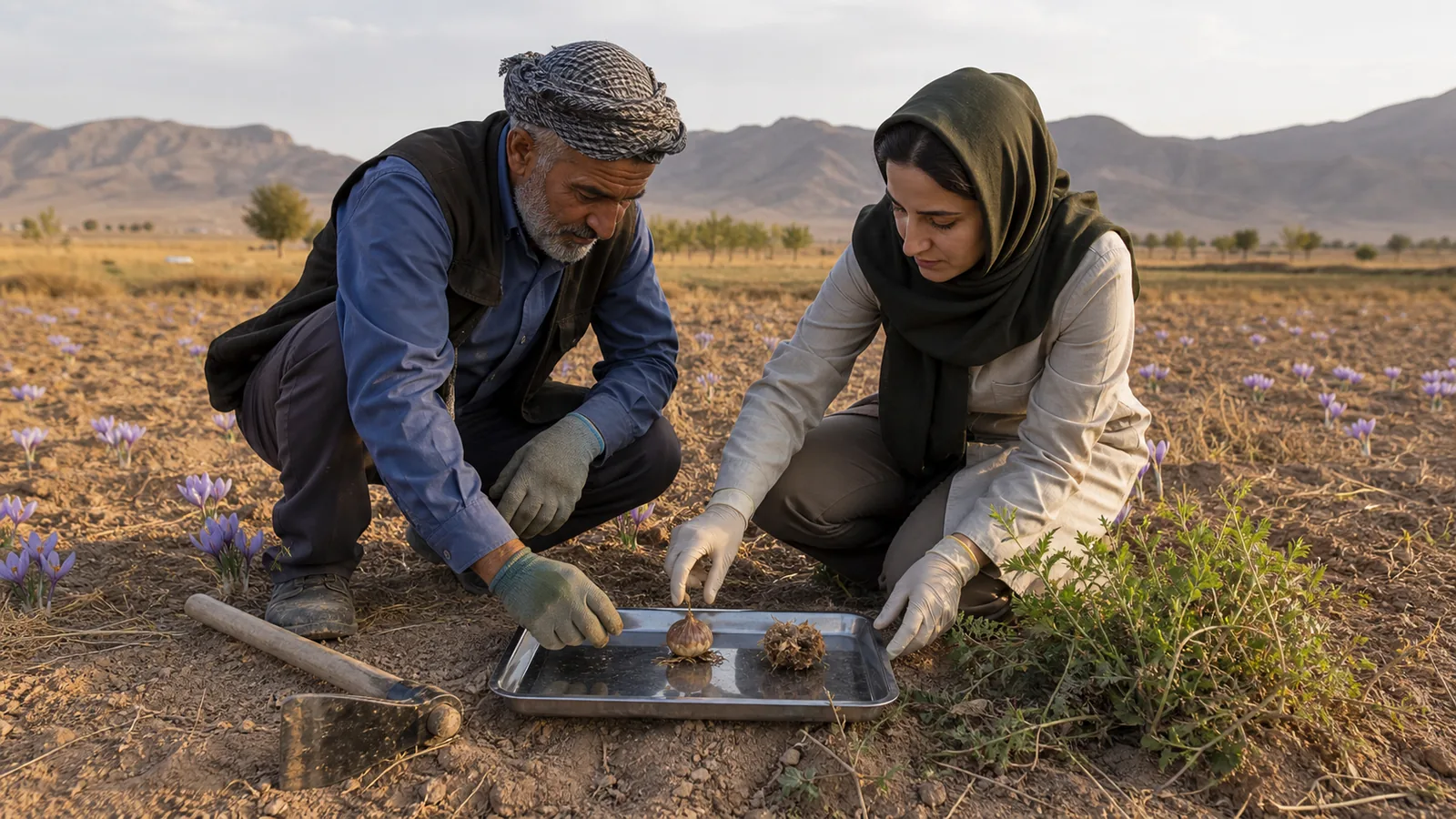
Iranian saffron and pests without toxins is a 2016 report about low-input farming in South Khorasan. Its title should not be read as a guarantee that every Iranian saffron lot is pesticide-free, pest-free or residue-free. The evidence in the article is narrower: a University of Birjand researcher said more than 50% of farmers in the projects he reviewed did not use herbicides for weed control.
That distinction matters for Birjand saffron and for azafrán iraní sold abroad. A farm practice can reduce pesticide use, but only traceability, certification and batch testing can support a claim about the product in a particular package.
Pest, pesticide, toxin and residue are different things
A pest is an organism that damages the crop. In saffron fields this can include weeds, rodents, mites and disease-causing fungi. A pesticide is a product used to manage a pest; herbicides, insecticides, fungicides and rodenticides are different pesticide classes. A residue is a measurable amount remaining in or on a product. “Toxin” is a broader biological term and is not a useful substitute for all of them.
A field may contain pests even when no pesticide is applied. It may also be managed without herbicide but receive a different plant-protection treatment. Conversely, the absence of a detected residue in one laboratory test does not prove that every lot from a country will have the same result.
What the Birjand report actually said
Mohammad Ali Behdani, identified as director of saffron research at the University of Birjand, spoke to ISNA in South Khorasan. He said saffron competes poorly with weeds and that weed control has a direct relationship with field performance. He also reported that more than half of farmers covered by scientific research projects did not use herbicides in their saffron fields.
The translation refers to established or “old” saffron fields being weeded without chemical control. It credits experienced farmers with strong indigenous knowledge and calls for training and incentives so effective low-input methods can spread. Those are valuable observations, but the article does not give a sample size, locations, survey year or laboratory results. The 50% figure must remain an attributed research report rather than a national statistic.
Later residue evidence changes the blanket claim
A 2021 study indexed by FAO AGRIS analysed 88 pesticides in 34 samples from an important Iranian saffron-growing region. Its abstract reports detected residues and says eight samples exceeded the limits it compared against, while the modelled dietary-risk values were low. The abstract also contains a percentage that does not reconcile cleanly with its sample counts, so it should not be reused as a precise national prevalence estimate.
The important conclusion here is modest: later testing does not support saying that all Iranian saffron has no pesticide residues. Nor does one 34-sample study describe every producer. A responsible seller should make lot-specific claims supported by an identified laboratory method, reporting limit, applicable maximum residue limits and a current certificate of analysis.
Managing weeds with fewer chemical inputs
Saffron’s sparse canopy makes it a weak competitor. Weeds can take light, moisture and nutrients while also making flower picking harder. A field experiment reported by the International Society for Horticultural Science found that manual weeding performed well for crop and corm measures, although it was labour-intensive and expensive. Other saffron trials have examined cover crops, mulch and timing, with results that depend on climate and field system.
For a grower, “no herbicide” is not the same as “no weed management.” A practical plan can combine:
- starting with a clean field and avoiding weed-seed spread;
- monitoring which weed species appear and when they compete with saffron;
- hand or mechanical control timed to avoid damaging leaves and corms;
- locally tested mulch, rotation or cover-crop methods where suitable; and
- recording every intervention so a later claim can be checked.
FAO’s integrated pest management principles place prevention, monitoring and cultural, physical or biological measures before routine chemical use. Any treatment still needs a correct diagnosis, local registration, label compliance, worker protection and consideration of the buyer market’s residue rules.
Rodents, rabbits and other saffron pests
The 2016 report names mice and rabbits as threats to saffron corms. Research literature supports the broader point that rodents and rabbits can damage saffron crops, although the original suggestion that this is because of saffron’s particular “flavour” is not demonstrated there. Recent work in northeastern Iran also identifies the saffron bulb mite, Rhizoglyphus robini, as an important pest that feeds on healthy or damaged corms.
Physical exclusion, field-edge management, monitoring and targeted trapping may be appropriate in some systems. The correct response depends on the animal, local law and the damage observed. A grower should not scatter an unidentified poison simply because corms are missing; that creates risks for workers, wildlife, livestock and residue compliance.
Corm disease is not the same as an insect problem
Behdani also recommended crop rotation, removal of infected plants and attention to corms before planting. The old translation says infected plants should be burned and calls corms “onions.” Burning is not a universal instruction: suspected material should be isolated and disposed of under local plant-health and waste rules.
Corm rot can involve Fusarium and other fungi. Research supports using clean, injury-free planting material, good drainage, field hygiene and an appropriate rotation to reduce inoculum and stress. A visible patch of weak plants is not enough to identify the pathogen. Diagnosis should come before any biological or chemical treatment, especially because an injured corm may rot without the assumed organism being the sole cause.
When “organic saffron” is a defensible claim
The original interview described Iran as a leading source of organic saffron and argued that farmer training could create more value. It did not document a certification body, audited land history or a revenue multiplier. Organic is a production and control system, not a synonym for traditional, natural or residue-free.
For regulated markets, an organic claim should be tied to the recognised scheme, certified operator, scope, crop and valid certificate. European Union organic rules, for example, limit artificial fertilisers, herbicides and pesticides but allow only specified substances under defined rules; organic does not literally mean that no pest-control input can ever be used.
Our guide to organic saffron production in Iran explains the certification and traceability distinction. For field identification rather than label claims, see saffron pests and diseases.
What buyers should ask for
A buyer does not need to choose between accepting a sweeping “toxin-free” promise and distrusting an entire origin. Ask for evidence that matches the claim:
- the lot number and traceable producer or packing record;
- the organic certificate if the word organic is used;
- a batch-specific pesticide-residue report from a competent laboratory;
- the tested analyte list, reporting limits and test date;
- the destination market and maximum residue limits used for comparison; and
- quality results kept separate from residue results.
Iranian saffron can come from farms that use very few chemical inputs, and farmer knowledge remains central to that strength. The safe claim is the one the records can prove. Low-input practice, organic certification and a clean residue test are related, but they are not interchangeable.
Sources and further reading
- The immutable 2016 Rowhani Saffron backup, preserving Behdani’s attributed statements about herbicides, weeds, rodents, corm disease, farmer knowledge and organic-production goals.
- FAO AGRIS record: pesticide residues in Iranian saffron, a 2021 analysis of 88 pesticides in 34 samples.
- ISHS: herbicides and manual weed control in saffron, reporting crop and corm outcomes.
- Persian Journal of Acarology: saffron bulb mite in northeastern Iran.
- Corm injury and rot in saffron, supporting clean, injury-free planting material and restrained treatment.
- FAO integrated pest-management principles.
- European Commission organic production rules.

![Exporting Saffron to Turkey + Price Guide [Complete 0 to 100]](https://img.rowhanisaffron.com/20260827003933/saffron-export-turkey-quality-inspection.webp)



