


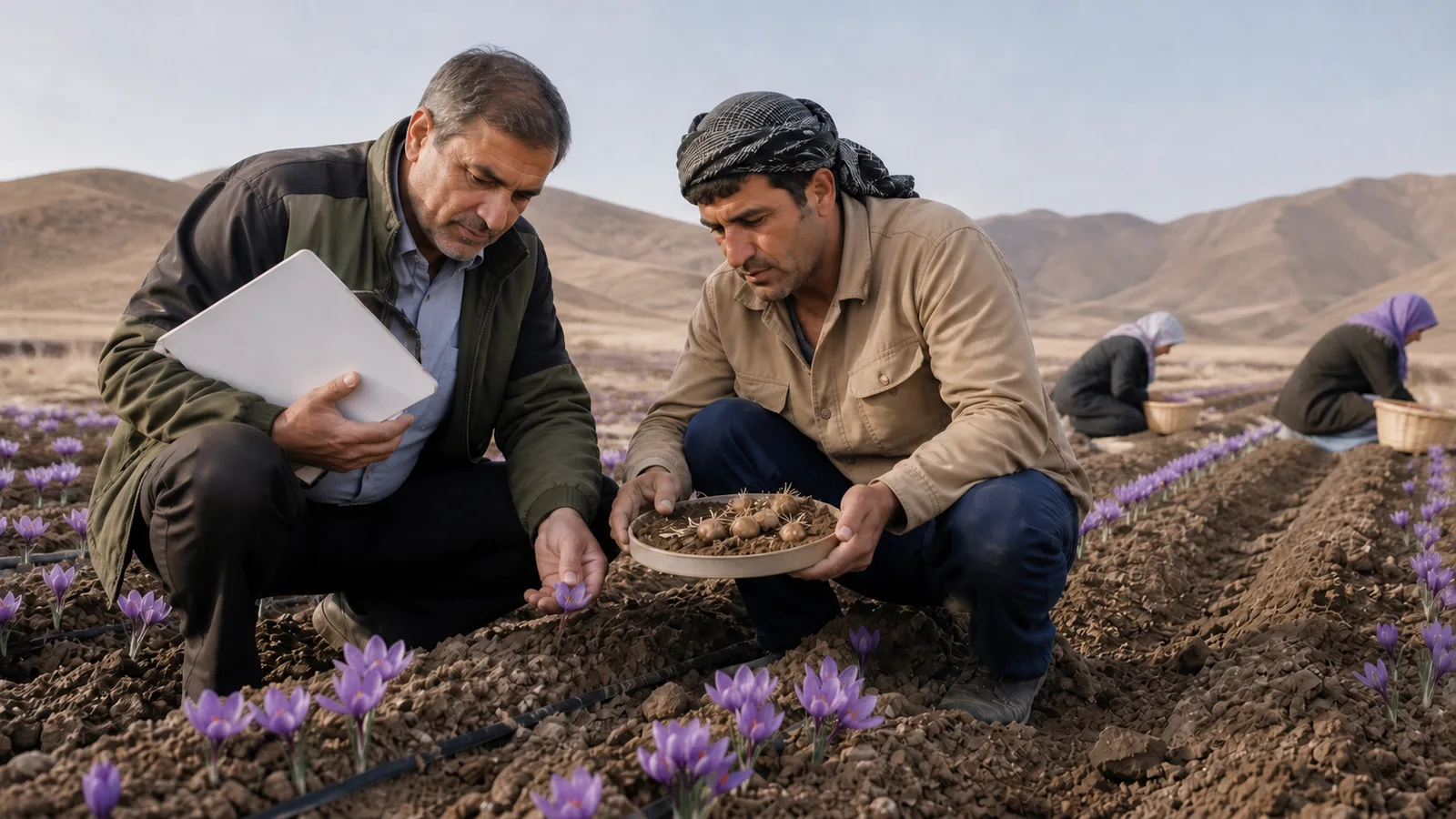
The organic saffron production in Iran is more than growing crocuses without routine synthetic inputs. A credible organic claim depends on a defined standard, an inspected farm and processing chain, records that connect the packaged saffron to the certified operation, and a valid certificate for the market where it will be sold.
Iran is a leading saffron producer, and a 2016 interview highlighted an early organic project in Zaveh, near Torbat-e Heydarieh. The same report raised problems that still matter to organic trade: weak packaging, informal movement of saffron corms, unstable prices, counterfeit powder and the need to create more value in the producing region.
The early organic saffron project in Zaveh
The old English text spells the location “Zavh.” The intended place is Zaveh County in Razavi Khorasan, part of the wider Torbat-e Heydarieh saffron-growing area. The parliamentary representative described saffron from Zaveh as the first organic saffron produced in Iran and said cooperatives should make greater use of the opportunity.
That “first” needs careful attribution. A producer cooperative in the area says it began establishing organic saffron fields in 2008, harvested organic product in 2009 and received certification from the German control body BCS in 2010. In 2016, an Iranian agricultural report described a supervised healthy-and-organic saffron programme planned across 17,000 hectares with 1,400 growers in Zaveh’s Safaiyeh rural district.
Together, those sources establish that Zaveh hosted an early certified project and a larger conversion effort. They do not by themselves prove that no other Iranian farm was certified earlier. The phrase “first organic saffron in Iran” should therefore remain an attributed project claim unless a complete national certification register confirms it.
What “organic saffron” actually means
Organic is a regulated production and labelling claim, not a synonym for natural, traditional, clean or pesticide-free. The exact rules depend on the destination market and certification scheme, but the core process normally includes:
- a documented organic system plan for the farm and handling operation;
- a conversion period during which prohibited inputs are not used;
- approved soil-fertility, weed, pest and disease management;
- inspection by an authorised certification or control body;
- records that trace the crop through harvest, drying, storage and sale; and
- separation from non-organic product to prevent mixing or substitution.
Under USDA rules, land generally must have had no prohibited substances applied for at least three years before an organic crop is harvested. Certification involves application review, an on-site inspection and a certification decision, followed by annual review and inspection. The European Union likewise requires operators marketing food as organic to register with a control body and pass recurring checks. Organic saffron imported into the EU also needs the appropriate electronic certificate of inspection.
A certificate should identify the certified operator, certifier or control body, product scope and current status. A logo or the word “organic” on its own is not enough.
Why packaging is part of the organic chain
The 2016 interview said Iran ranked first in saffron production and was a major exporter, but needed stronger action to introduce the product internationally. It called for the red gold’s packaging industry to be taken seriously and for training, recognised brands and world standards.
Packaging is not merely decoration. Saffron threads need protection from moisture, light, foreign material and odour. For certified organic saffron, the packer must also maintain identity and traceability: incoming lot, processing record, packed quantity, batch code and sales documentation should reconcile. If certified and conventional threads are handled at the same site, separation and cleaning controls become especially important.
Certification does not measure every quality characteristic. Colour strength, aroma-related compounds, moisture and foreign matter require their own specifications and tests. Our guide to Iranian saffron standards explains those quality measures. A lot can meet an organic production standard yet still be poorly dried, weak, old or incorrectly graded.
Organic production, drought and employment
The representative linked saffron to nearly 20 thousand jobs each year in the Torbat area. The surviving report does not explain whether that meant permanent jobs, seasonal workers or worker-days, so the number should be read as an attributed estimate rather than a verified count.
He also connected expansion with drought and water shortages, describing saffron as a crop that “does not require much watering.” Saffron is well suited to dry and semi-arid regions, but it is not water-free. Irrigation timing, soil condition and local water availability still affect flowering and yield. Organic certification does not automatically make a farm water-efficient; water management has to be assessed separately.
Conversion can also carry costs. Farmers need training, records, inspections and approved inputs, while the crop may not be sold as organic during all or part of the conversion period. A cooperative can help smallholders share technical advice, processing facilities, certification administration and market access, but the premium is never guaranteed.
The concern about informal saffron-corm exports
The original interview objected to informal and indiscriminate export of saffron corms to neighbouring countries, including Afghanistan. The concern was framed around protecting Iran’s production position. There is also a practical plant-health issue: moving planting material without proper controls can carry soil-borne pests and diseases.
This article does not claim that all corm trade is unlawful. Export and import requirements depend on the countries involved, current plant-health rules, origin, inspection and documentation. The safe distinction is between regulated, documented movement and informal movement that bypasses those checks.
A corrupted price statement should not become a quotation
The old machine translation says saffron sold at harvest for “4 million USD per kilo.” That figure cannot be accepted literally. Four million US dollars per kilogram is not a credible saffron quotation, and the source almost certainly referred to a local-currency amount. Without the original wording, it is not possible to determine safely whether the unit was rials or tomans.
The underlying point remains: the speaker complained about price fluctuations and insufficient agricultural-market oversight. The number is preserved here as a documented translation problem, not recycled as a historical or current price. Buyers comparing quotations need the date, grade, currency, unit, tax, delivery terms and market level.
Fake saffron powder and organic authenticity
The final lines warned that fake saffron powder threatened public health. A damaged sentence beginning “China enters” appears to allege a country of origin, but the backup supplies no evidence for that accusation, so it is not repeated as fact.
The adulteration concern itself is legitimate. Powder removes the visual clues available in whole threads and can make substitution harder to detect. Organic certification confirms compliance with an organic production system; it does not, by itself, prove botanical identity or exclude every adulterant. Traceable supply, mass-balance records and suitable authenticity testing are still needed.
For a buyer, the practical checks are straightforward: verify the organic certificate with the named control body, confirm that saffron is within its scope and date, match the operator and lot documents, and request quality or authenticity evidence appropriate to the transaction. An “organic Persian saffron” sales phrase is not a substitute for those records.
What the 2016 report gets right
Despite the damaged translation, the report recognised that organic production only creates durable added value when farming, processing, packaging, certification and market access work as one chain. It also recognised that small producers need training and cooperative support rather than a label alone.
Iranian organic saffron can be a credible premium product, but only where the certification is valid, the chain is traceable and the saffron itself meets the buyer’s quality requirements. That is a stronger proposition than an unsupported “natural” claim—and a safer basis for both growers and customers.
Sources and further reading
- The immutable 2016 Rowhani Saffron backup: source of the attributed Zaveh, packaging, employment, drought, corm-export, price and counterfeit-powder statements.
- Zaveh smallholder healthy-and-organic agriculture programme (IANA, 2016).
- How organic certification works and organic crop standards (USDA Agricultural Marketing Service).
- Certification and conversion and organic import documentation (European Commission).

![Exporting Saffron to Turkey + Price Guide [Complete 0 to 100]](https://img.rowhanisaffron.com/20260827003933/saffron-export-turkey-quality-inspection.webp)



