


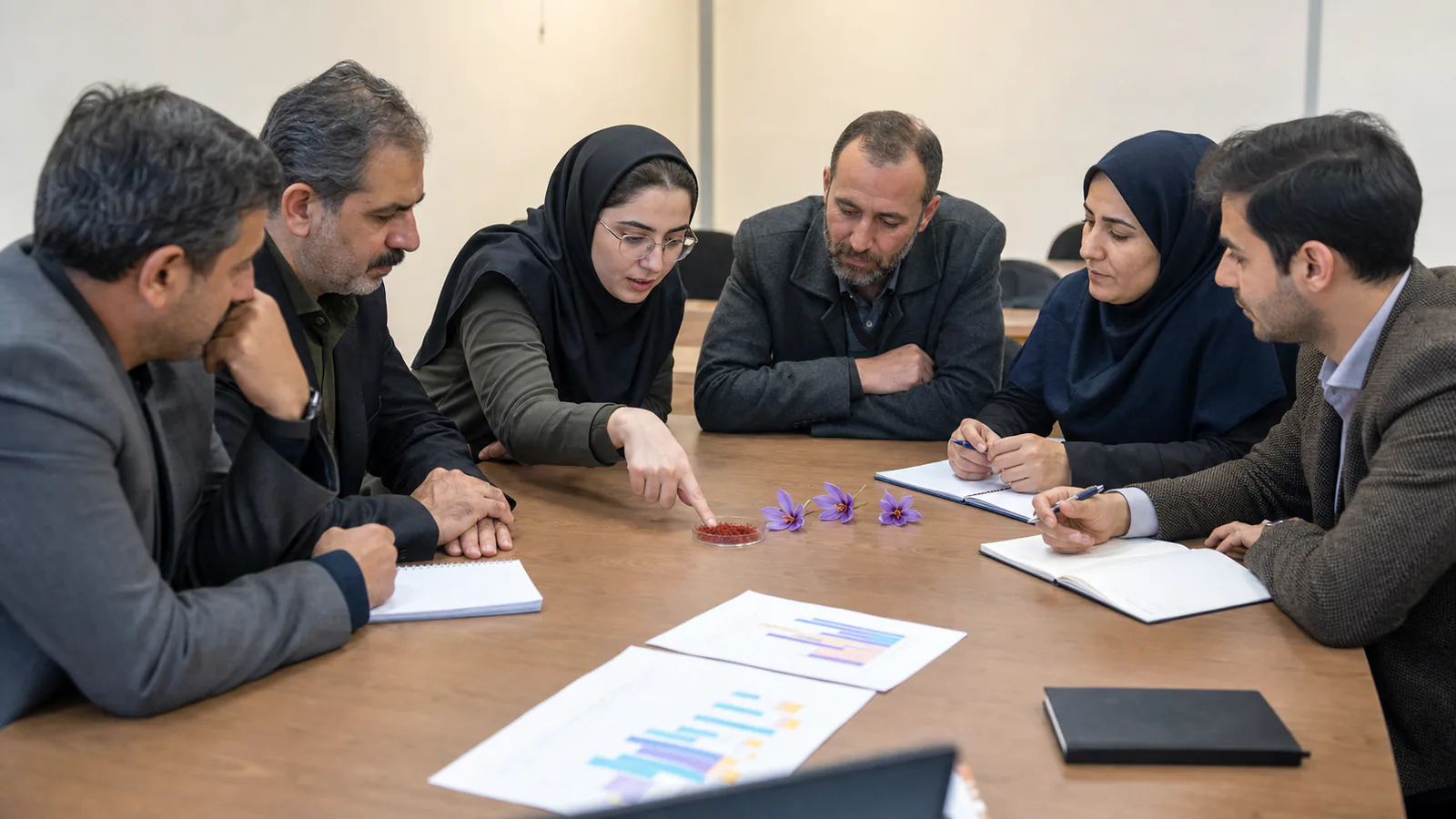
Iran’s Fourth National Saffron Conference was held in Qaen on 4–5 November 2015, led by the University of Bozorgmehr Qaenat. The two-day meeting connected field production with processing, medicine, trade and entrepreneurship in the heart of South Khorasan’s saffron region.
This article is a historical conference record. It does not announce a future event. The original advance report described plans and expected participants; the opening report later confirmed the programme and final paper count.
Why Qaen hosted the conference
Qaenat is one of Iran’s most recognisable saffron-producing areas. At the time, approximately 15,000 hectares of South Khorasan agricultural land were reported under saffron. Hosting the national meeting there placed researchers close to growers, processors and the regional problems their work was meant to address.
The organisers also linked the event with a proposed national identity for Qaenat saffron. A regional name can have commercial value, but it depends on traceability, agreed specifications and consistent enforcement. A conference can frame that work; it cannot establish product origin by declaration alone.
The research programme
Cultivation, physiology and ecology
The field-production theme covered planting and harvest practice, crop physiology and ecological conditions. These questions affect flowering, corm health, water use, labour and the ability of farms to cope with drought and changing temperatures.
Breeding, genetics and tissue culture
Saffron is a sterile triploid plant usually propagated through corms. That makes clean planting material, genetic research and tissue-culture methods especially relevant. Work in this area seeks healthier multiplication systems and a better understanding of the crop’s limited genetic variation.
Processing and related industries
Conference topics extended beyond the field to drying, packaging and processing. The advance report also listed biotechnology and nanotechnology. These labels are useful only when tied to a defined problem—faster clean drying, reliable quality measurement, protected aroma, traceability or a safe product with a real buyer.
Food, pharmaceutical and medical research
Researchers presented work on saffron compounds and possible applications. Such sessions are a place to distinguish laboratory mechanisms, animal studies and human clinical evidence. A conference presentation is not proof that a medical use is effective, and a promising extract is not automatically an approved medicine.
Marketing, trade and entrepreneurship
The commercial programme included marketing, trade development, exports and entrepreneurship. For growers, these subjects connect research with price, grading, packaging, bargaining power and access to buyers. The strongest projects are those that solve a documented value-chain problem rather than merely adding a fashionable product.
How many papers were presented
In the advance interview, conference representative Seyed Hamid Shakib said that 90 scientific papers had been submitted and that 60 were expected to be accepted. An opening-day report gave the final figure as 58 accepted papers: 24 for oral presentation and the remainder as posters.
Both numbers belong in the record because they describe different stages. The first was a pre-event announcement; the second documented the programme after review. Treating them as contradictory totals without timing would create an avoidable error.
Workshops alongside the papers
The confirmed programme included practical workshops on saffron adulteration, organic production, crop nutrition and Comprehensive Meta-Analysis software. Together they show the range of skills the organisers considered important:
- recognising fraud and protecting saffron identity;
- understanding what an organic production claim requires;
- matching crop nutrition to field evidence; and
- combining research results systematically rather than selecting one convenient study.
Those themes remain relevant. Authenticity, field management and evidence quality influence whether research can earn trust beyond the conference room.
Who the organisers expected
The advance report referred to national, provincial and local officials, agricultural experts, saffron practitioners, a Turkish university professor and European business representatives. It also estimated that more than 80 percent of participants would come from Razavi, North and South Khorasan.
The surviving report does not provide a verified final attendance list, so those details should remain described as expectations. Presence at an event also does not prove that a research or commercial partnership followed.
What made the conference useful
Saffron challenges do not fit neatly into one discipline. A crop problem may involve soil and water, corm disease, harvest labour, drying, food safety, laboratory testing, packaging and market incentives at the same time. Bringing those groups together can expose gaps that a single laboratory or trade meeting would miss.
For a grower, a useful conference result should eventually become clearer extension advice, better planting material, safer handling, more reliable grading or a stronger route to market. For researchers, local participation helps turn an interesting question into work that can be tested under real field and processing conditions.
How conference work should be judged afterward
A paper count measures activity, not impact. Longer-term value depends on what can be found and verified later:
- Are abstracts or full papers available with authors and methods?
- Did promising results progress to peer-reviewed publication or larger trials?
- Were field recommendations validated across seasons and locations?
- Did authenticity and quality work become practical testing or traceability?
- Did growers, processors or buyers adopt a method, and was the outcome measured?
That follow-through matters especially for medical claims and new processing technologies, where an early result can be repeated far beyond what the study established.
A historical milestone in Iranian saffron research
The Fourth National Saffron Conference gave Qaenat a national forum for the crop’s full chain, from corm and field to laboratory and export market. Its 58 accepted papers and practical workshops reflected a serious effort to evaluate problems scientifically.
The value of the event lies less in the ceremony than in the questions it brought together. Cultivation, clean processing, genuine product identity, careful health evidence and workable trade all have to advance together if saffron research is to improve the lives of growers and the confidence of buyers.

![Exporting Saffron to Turkey + Price Guide [Complete 0 to 100]](https://img.rowhanisaffron.com/20260827003933/saffron-export-turkey-quality-inspection.webp)



