


Iranian saffron molecular genetics was the subject of a research project reported on 17 July 2016. Scientists were examining genes involved in the formation of saffron’s characteristic compounds, with the aim of building a stronger biochemical reference and supporting higher-value processing rather than relying only on raw spice sales.
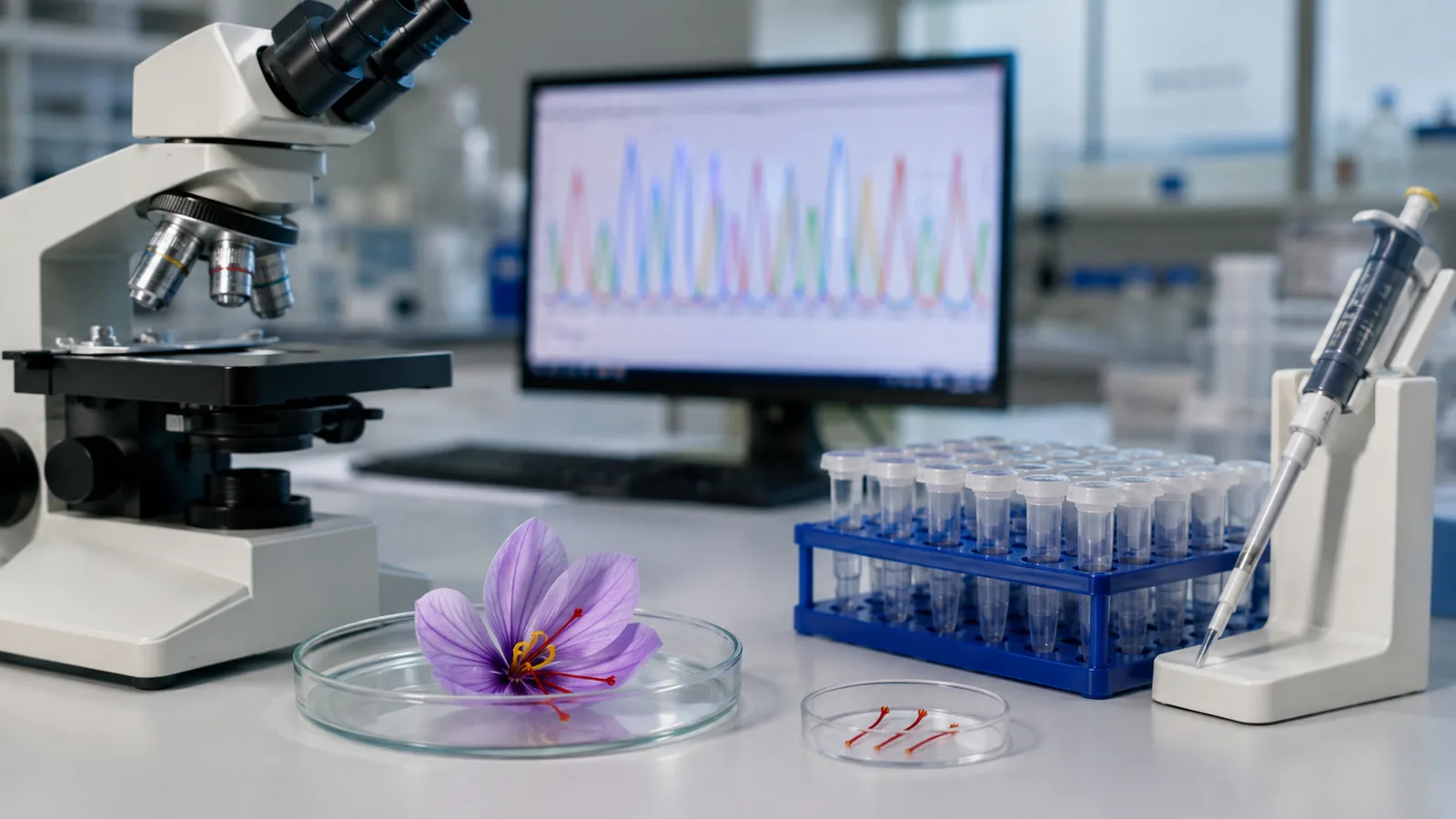
What the 2016 project investigated
The original news report quoted Dr Seyed Mehdi Ziyaratnia of Iran’s Research Institute of Food Science and Technology. He described a project translated as “Molecular and biochemical characterisation of genes involved in the biosynthesis of Iranian saffron.” The work focused particularly on the pathways associated with crocin.
This was not a claim that researchers had discovered a separate species called Iranian saffron. The crop is Crocus sativus. The project was studying molecular activity and biochemical traits in plant material grown in Iran, then trying to document that information systematically.
Why molecular genetics matters to saffron
The valuable part of saffron is the dried stigma. Its colour, bitterness and aroma arise from compounds formed as the flower develops. Researchers can study which genes are active in stigma tissue, how their expression changes during development and how enzymes contribute to the pathway.
A 2015 peer-reviewed saffron transcriptome study used sequencing to identify genes and regulators connected with apocarotenoid biosynthesis. Earlier work on carotenoid biosynthetic genes in Crocus sativus described enzymes involved in forming crocetin glycosides and picrocrocin. These studies show the kind of molecular questions behind the Iranian project; they do not verify every statement in the old news translation.
Crocin, picrocrocin and safranal
Ziyaratnia named three compounds associated with saffron’s familiar sensory qualities:
- Crocin and related crocetin esters contribute strongly to the colour released into water.
- Picrocrocin is associated with saffron’s characteristic bitter taste.
- Safranal is an important part of its aroma.
The 2016 report also attributed anti-tumour, anti-stress and soothing effects to crocin. It supplied no clinical study, dose, population or outcome for those statements, so they are not repeated as health conclusions here. Molecular activity in a plant and evidence that a food treats a person are different levels of proof.
For a food-focused explanation of these compounds, see our guide to the ingredients behind saffron’s colour, taste and aroma.
The production context was historical
The article described Iran as the world’s largest saffron producer and cited an agricultural-year figure of about 300 tonnes for 1392 in the Iranian calendar. That figure belongs to the period discussed and is not a current production total.
Ziyaratnia’s concern was that production and crop-management work had advanced faster than research beyond the farm. In his view, Iran was widely regarded as the centre of the saffron trade but still relied heavily on traditional processing and raw sales.
What Spain represented in the comparison
The report contrasted Iran’s large production with Spain’s smaller crop and longer involvement in molecular research. Its English text is too damaged to support a precise Spanish tonnage, and production, imports and re-exports should not be treated as the same measure.
The useful comparison was about research capacity. A country can grow less saffron yet contribute laboratories, published methods, standards, processing or branded distribution. Production volume alone does not determine who creates the most knowledge or retains the most value.
Three decades of research and a ten-year programme
Ziyaratnia said researchers at the institute had worked in saffron molecular research for more than three decades. He also referred to roughly ten years of work applying newer methods to genetic information. Those time spans were reported in 2016 and describe the institute’s programme at that point.
Long-running work can produce a useful reference only when samples, methods and records are clearly defined. A collection called “Iranian saffron” needs information about where material came from, how it was grown, which tissue was sampled and how the laboratory analysed it.
Could genetics prove that saffron is Iranian?
Not by itself. A genetic or expression profile can help researchers compare plant material and study biological pathways. Geographic origin is a broader traceability question involving the crop, farm records, supply chain and sometimes chemical or isotopic evidence. A molecular study should not be turned into an instant home authenticity test.
It is also important to distinguish stable DNA sequence from gene expression. Expression can change with tissue, developmental stage and conditions. A profile from a stigma at one stage is not interchangeable with a universal national fingerprint.
The proposed gene bank and patent
The 2016 article said the project aimed to preserve molecular and biochemical information in what it called an Iranian saffron gene bank. It also mentioned a patent. The translation does not identify a patent number, filing office or granted claim, so this page records the stated intention without saying that ownership was awarded.
A research gene bank can preserve samples and associated data for comparison. Its scientific value depends on curation, access rules, sample identity and reproducible methods, not on the name alone.
A project still in progress
At the time of the interview, Ziyaratnia said the project had begun about a year and a half earlier and was expected to continue for another year. The report therefore described work in progress, not a final dataset or completed commercial product.
Any assessment of the outcome would need the later publication, repository record or project report. The 2016 article does not provide one, so it cannot establish whether every proposed result was delivered.
From raw saffron to useful research
The project was presented within a wider economic argument: Iran should reduce reliance on raw saffron sales and develop processed products and technical knowledge. Molecular research can contribute by explaining biosynthetic pathways, improving analytical references and identifying questions for crop or process research.
That contribution has limits. A gene result does not automatically create a safe food, cosmetic or medicine, and it does not replace compositional testing of the material being sold. Our compositional analysis of Iranian saffron describes the chemical-measurement side of the subject.
What this report establishes
The 2016 article documents an Iranian project examining genes and biochemistry connected with saffron’s crocin pathway. It preserves the researcher’s production context, criticism of raw selling, comparison with Spain, institutional research history and plans for a reference collection.
It does not prove a national genetic fingerprint, a granted patent or a medical benefit. Read with those boundaries, it captures a serious transition in saffron research: from describing the spice by colour and aroma to studying how the plant produces those qualities at molecular level.

![Exporting Saffron to Turkey + Price Guide [Complete 0 to 100]](https://img.rowhanisaffron.com/20260827003933/saffron-export-turkey-quality-inspection.webp)



