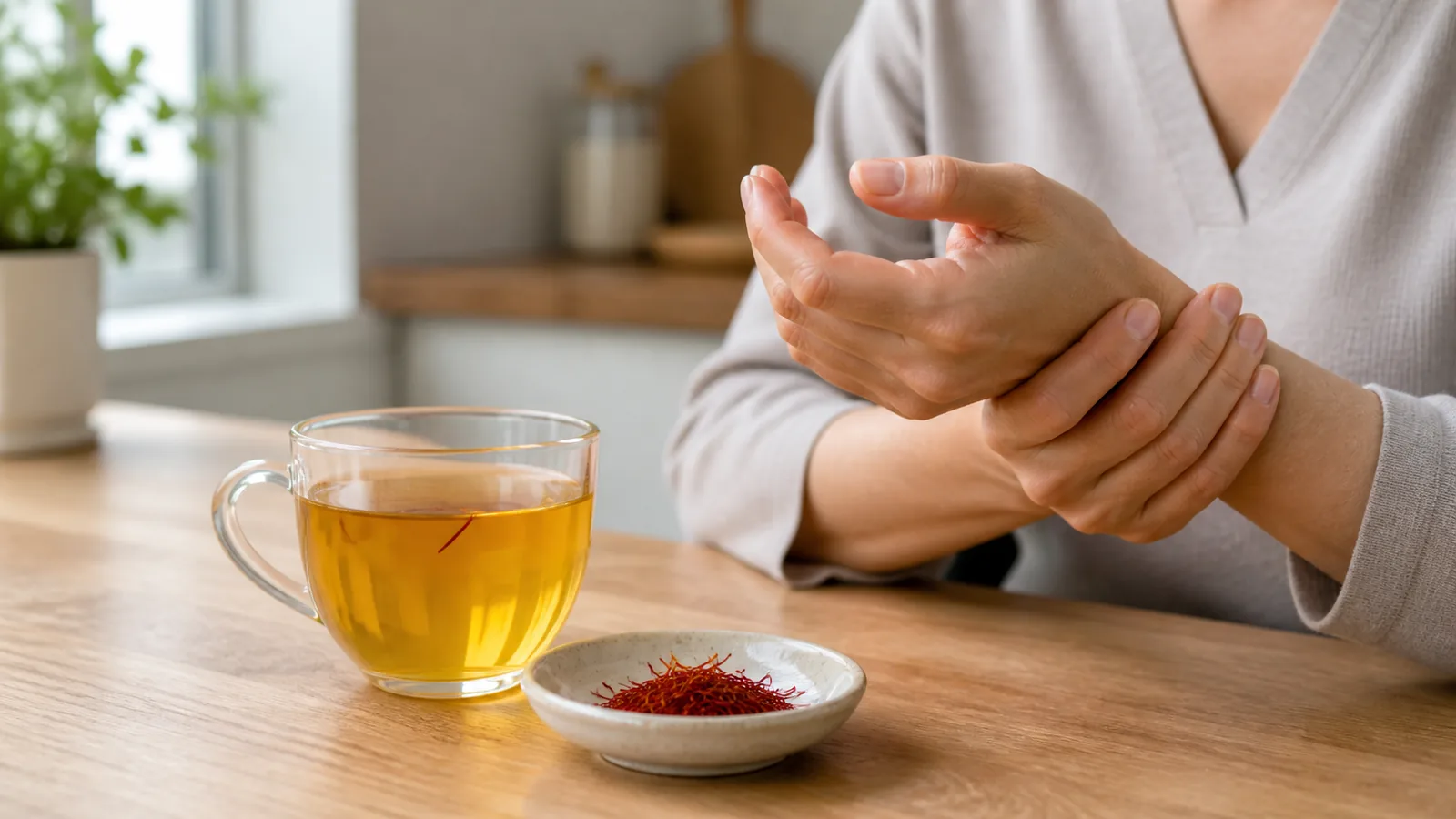
The health benefits of saffron are being studied, but the evidence is not equally strong for every claim. Human trials are most consistent around some measures of depression and anxiety. Smaller or less certain effects have been reported for blood-sugar markers, cognition, vision and a few other outcomes. That does not make saffron a proven treatment, and it does not support claims that a pinch in food boosts immunity, cures anaemia, heals ulcers or wounds, detoxifies the liver, or prevents neurological disease.
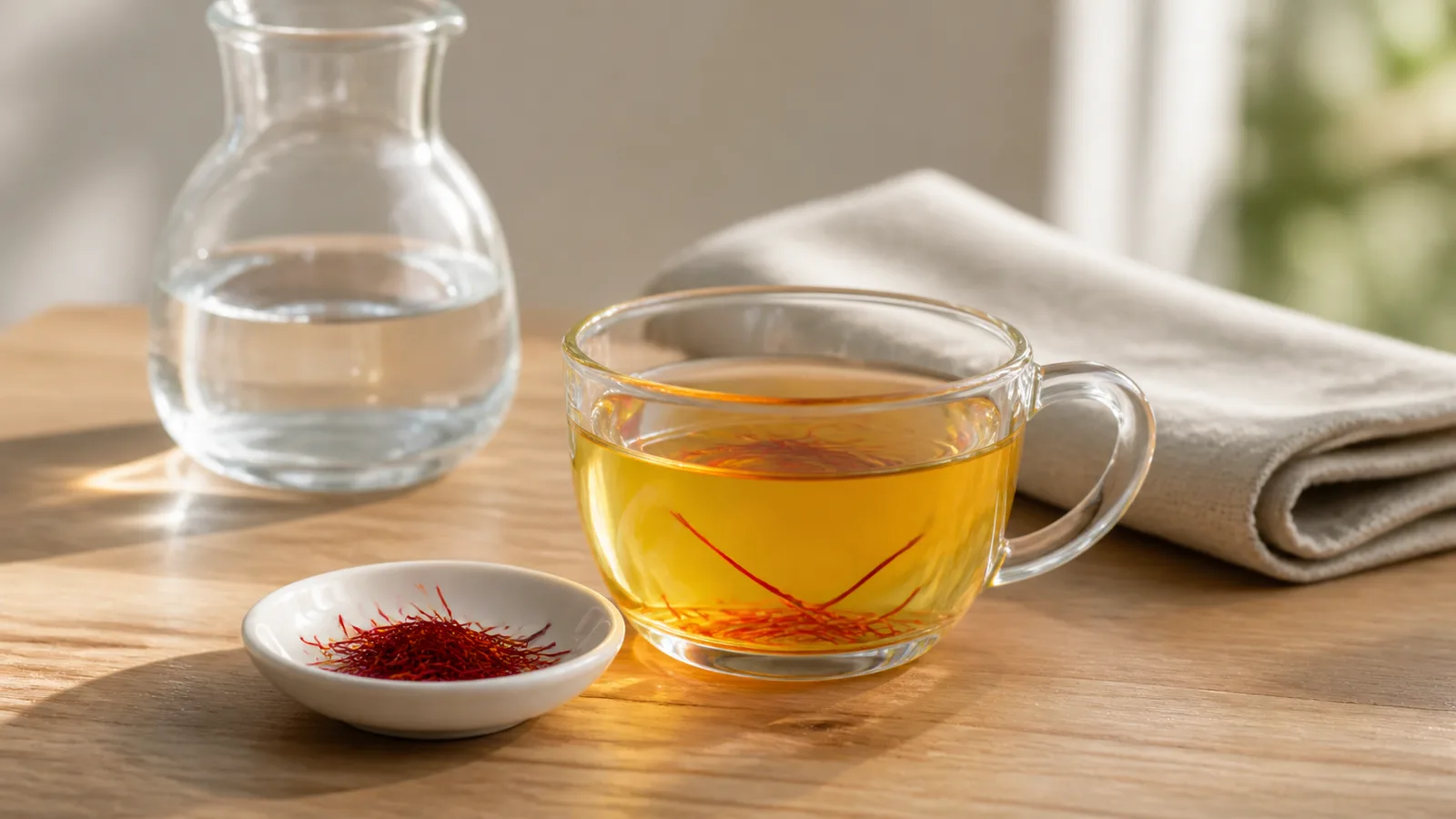
The distinction between food and research products matters. In a recipe, saffron is usually measured in threads or a small pinch. Clinical trials often use a standardised powder, extract or isolated constituent for several weeks. The amount and chemical profile may be very different from a cup of saffron tea or a serving of rice. A result from a supplement trial cannot automatically be promised from ordinary culinary use.
What counts as evidence for a saffron health benefit?
Cell and animal experiments can help researchers identify mechanisms worth testing. They cannot tell us on their own whether saffron prevents or treats a disease in people. An isolated crocin or safranal experiment is also not the same as eating whole saffron.
Randomised controlled trials provide stronger human evidence, but their quality still depends on sample size, duration, product standardisation, blinding and the outcome measured. A 2021 evidence-mapping review found positive signals across several saffron meta-analyses, while also finding that the methodological and reporting quality of those reviews needed improvement. The authors called for larger, higher-quality trials in more countries. That is a useful frame for the claims below: promising does not mean settled.
Mood: the most developed area of human research
Saffron has been studied as a supplement for depressive and anxiety symptoms. A 2026 systematic review pooled 34 randomised trials with 1,769 adults. It found reductions on self-reported Beck depression and anxiety scales, but not on several clinician-rated scales. The results varied substantially across studies, and the overall certainty was rated moderate. Read the GRADE-assessed mood review on PubMed.
This evidence supports further clinical use and research; it does not justify calling saffron a “natural antidepressant” that anyone can self-prescribe. Depression and anxiety can be serious, and stopping prescribed treatment can cause harm. A person interested in using a saffron supplement alongside treatment should discuss the specific product and dose with their clinician. Culinary saffron can still be enjoyed, but a meal is not a substitute for mental-health care.
Blood sugar and diabetes: small changes, not a cure
The old version of this article said saffron’s manganese could prevent or manage diabetes. That explanation is not supported. Human studies test saffron or crocin supplements as interventions; they do not show that the trace minerals in a culinary serving control insulin.
A 2024 meta-analysis included ten randomised trials and 562 people with diabetes. Compared with placebo, saffron supplementation was associated with average reductions of about 8.4 mg/dL in fasting glucose and 0.22 percentage points in HbA1c. It did not significantly change insulin, HOMA-IR or QUICKI, and the authors described the study quality as heterogeneous. The diabetes meta-analysis therefore points to a possible adjunct worth studying, not a replacement for medication, monitoring, diet or medical advice.
Liver health: “detox” is the wrong claim
Saffron does not “clean fat from the liver.” A liver-function meta-analysis of nine randomised trials found a small average reduction in ALT, with high inconsistency among studies, but no significant change in AST or alkaline phosphatase and no clear dose-response relationship. The authors called for larger trials in more diverse populations. See the systematic review of liver-function indicators.
A laboratory marker is not the same as reversal of fatty liver disease, and “detoxification” is not an outcome those trials established. Anyone with abnormal liver tests needs appropriate diagnosis. Adding saffron to food should not delay that assessment.
Does saffron boost immunity or improve circulation?
Saffron contains vitamin C and iron when analysed per 100 grams, but people do not eat it in 100-gram portions. The USDA FoodData Central record for saffron uses 0.7 gram as one teaspoon. Applying its nutrient values to that serving gives only about 0.6 mg vitamin C and 0.08 mg iron. A small culinary pinch contributes even less. The underlying values can be checked in the official USDA FoodData Central saffron record.
That amount cannot reasonably be described as “full of vitamin C” or “high in iron.” There is no sound basis for saying a normal saffron serving makes enough white blood cells to strengthen immunity, raises red-blood-cell production, prevents anaemia or meaningfully increases oxygen delivery. People concerned about iron deficiency or recurrent infection need proper testing rather than a spice-based claim.
Bone strength and nerve function
The assigned source promised stronger bones by increasing calcium absorption and better nerve function because saffron contains vitamin B6. Neither claim has adequate human evidence. From the same USDA data, a 0.7-gram teaspoon provides roughly 0.8 mg calcium and 0.007 mg vitamin B6. Those quantities do not make saffron a practical calcium or B6 source.
No credible trial evidence shows that culinary saffron increases bone mineral density, prevents osteoporosis or protects the nervous system through its vitamin content. Bone health depends on factors such as overall calcium and vitamin D intake, resistance and weight-bearing activity, hormones, age and medical history. Neurological symptoms also require diagnosis; they should not be attributed to a spice deficiency.
Stomach problems, constipation and ulcers
Saffron has a history of traditional use for digestive discomfort, and laboratory research has explored anti-inflammatory and smooth-muscle effects. That is not proof that it treats constipation, bloating, cramps or peptic ulcers in people. The source article grouped all of these conditions together without a clinical citation, even though they can have very different causes.
Persistent pain, bleeding, vomiting, unexplained weight loss or a change in bowel habits deserves medical attention. An ulcer may involve Helicobacter pylori infection or medicines such as NSAIDs and needs evidence-based treatment. Saffron should not be used to mask those warning signs.
Inflammation, pain, wounds and skin
Researchers have measured inflammatory biomarkers in some saffron-supplement trials, and preclinical work has explored antioxidant and wound-related mechanisms. That evidence does not establish saffron as a topical treatment for sports injuries, arthritis, gout, open wounds, acne or wrinkles.
Putting culinary saffron or a homemade mask on broken or inflamed skin introduces an unstandardised product and can cause irritation or allergy. A food spice is not sterile wound care. People can enjoy saffron in food without extending early laboratory findings into medical instructions.
Eyes, memory, Parkinson’s and Alzheimer’s disease
Small human trials have examined saffron preparations for cognition and certain eye conditions, and reviews describe this as an active research area. The products, diagnoses and outcomes differ, and many studies are short. It is not accurate to turn that work into the blanket statement that saffron “improves eyesight” or treats Parkinson’s or Alzheimer’s disease.
A 2024 systematic review of neurological and psychiatric trials reported encouraging signals but also combined varied conditions, products and comparators. Its results are a reason for better disease-specific research, not permission to replace an ophthalmologist’s or neurologist’s treatment. The difference between saffron’s compounds and its nutrient contribution is explained in our guide to saffron ingredients.
Safety: food use is not the same as a supplement
Small culinary amounts are different from concentrated extracts or repeated medicinal doses. A 2026 systematic review of adverse events concluded that clinical monitoring should be considered for higher-dose or prolonged medicinal use. Reported effects across the literature include nausea, headache, dry mouth, appetite changes and allergic reactions, although frequency and product quality vary. See the current adverse-events review.
Pregnancy requires particular caution because dose-specific safety evidence is limited and higher exposures have raised concern. Anyone who is pregnant or breastfeeding, takes prescription medicines, has a medical condition, or plans to use saffron extract regularly should speak with a qualified healthcare professional. Do not use an online article to choose a treatment dose.
A balanced conclusion
Saffron is a valuable culinary spice with distinctive crocins, picrocrocin and safranal. Supplement research has produced a credible but still developing signal for mood symptoms and smaller, condition-specific findings elsewhere. It has not shown that ordinary food portions supply enough vitamins or minerals to boost immunity, correct anaemia, build bone or repair nerves.
The safest way to describe the health benefits of saffron is with the study population, preparation, outcome and uncertainty attached. Enjoying saffron in food and investigating a standardised supplement in a clinical setting are both legitimate. They are not the same claim.