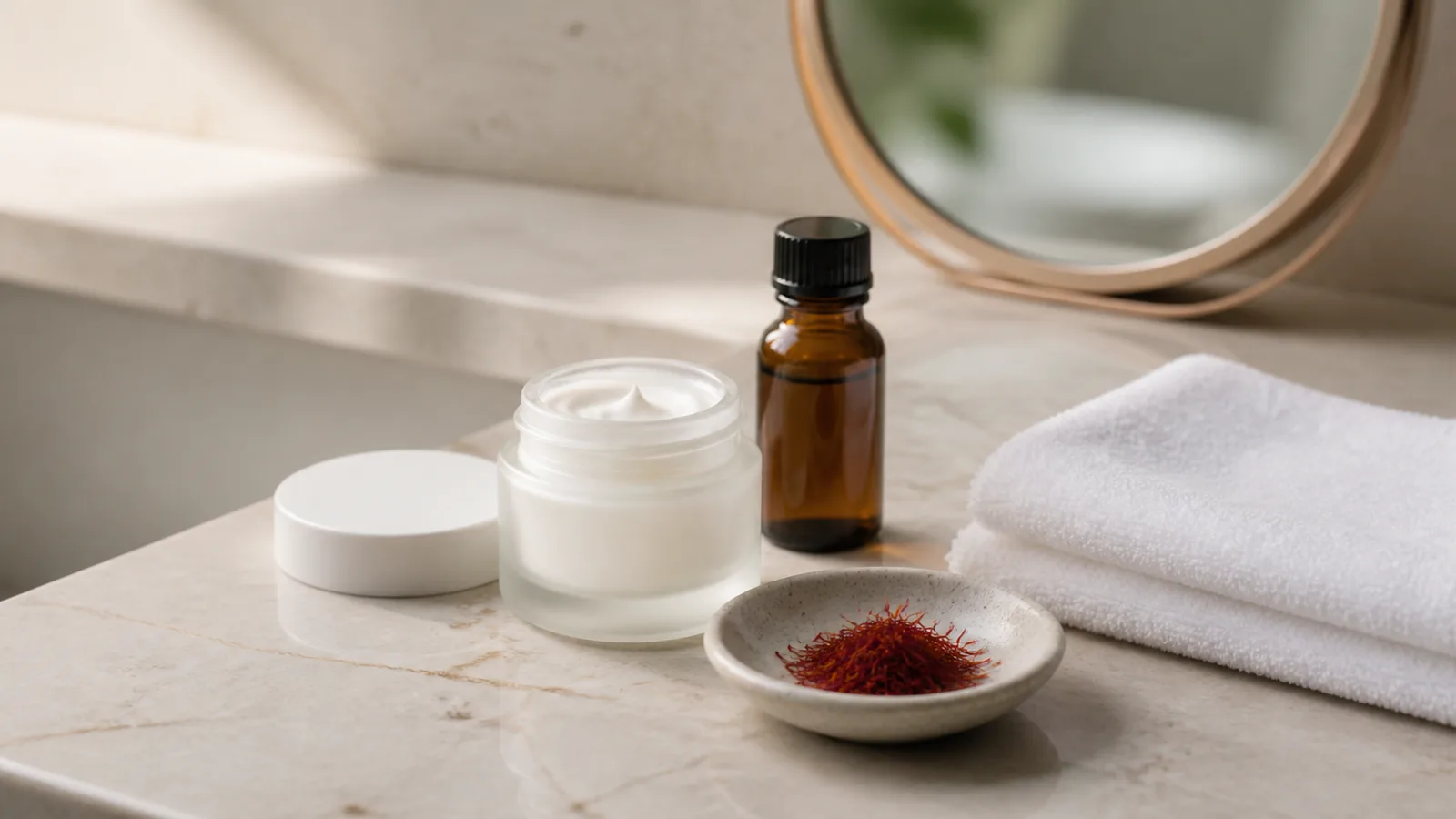
The potential benefits of using saffron for skin care are modest and formulation-specific. Small human studies suggest that professionally formulated creams containing saffron extract may affect skin moisture or the appearance of wrinkles, but that evidence does not prove that raw threads, saffron water, milk masks, honey mixtures, or “saffron oil” will brighten skin, clear acne, remove dark circles, or create an overnight glow.
Saffron for skin care is therefore best approached as a cosmetic ingredient, not a home treatment. Check what the product actually contains, introduce it slowly, and keep the basics—gentle cleansing, moisturizer, and broad-spectrum sun protection—at the center of the routine.
Is saffron good for skin?
The honest answer is possibly in a well-designed topical formula, for a limited cosmetic purpose. The word saffron on a label does not tell you the concentration, extraction method, stability, preservation system, or which other ingredients are doing the work.
Two small studies are relevant:
- A study indexed in PubMed tested a water-in-oil cream containing 3% concentrated Crocus sativus extract against its cream base over eight weeks and reported changes in measured skin moisture. It studied a preserved emulsion, not a kitchen mask.
- A separate small study followed 20 volunteers using a cream that combined saffron extract with avocado oil for 12 weeks and reported changes in wrinkle measurements. Because the formula contained both ingredients and the sample was small, it cannot show that raw saffron alone produces the same result.
These are early signals, not proof of every saffron skin benefit repeated online. Reviews discuss antioxidant, antimicrobial, and pigment-related activity in laboratory models, but activity in a cell or test tube is not the same as a clinically useful effect on a person’s face.
In short, the benefits of saffron for skin supported by direct human research are much narrower than the lists found on many beauty pages.
What saffron skin benefits are actually supported?
Moisturizing
The clearest direct human evidence concerns one 3% extract cream and skin-moisture measurements. Even here, the vehicle matters: a cream base is designed to reduce water loss and soften skin. A consumer cannot recreate that formulation by dropping threads into water or oil.
The appearance of fine lines
The small saffron-and-avocado-oil study is interesting but preliminary. It does not establish an anti-aging dose, prove that saffron was the active component, or replace better-supported habits such as daily sun protection. Treat “erases wrinkles” and “reverses aging” as marketing claims, not conclusions from this evidence.
Saffron for glowing skin or a brighter-looking surface
“Glow” is not a standardized medical outcome. A moisturizer can temporarily make a dry surface look smoother, and saffron’s natural color can tint a mixture, but neither proves a lasting change in skin health or pigment. The old promise that a milk-and-saffron mask produces an immediate brightening effect was not supported by a clinical study.
Saffron for acne, pimples, and blackheads
There is not good human evidence that a paste of saffron and basil treats acne, clears blackheads, or prevents eruptions. Acne has several causes, and an irritated or oily homemade mixture can make a routine harder to assess. The American Academy of Dermatology’s acne guidance discusses established options such as benzoyl peroxide and salicylic acid; persistent, painful, or scarring acne deserves a dermatologist rather than a spice mask.
Dark spots, “fairness,” and skin lightening
No one needs to make their natural skin tone “fairer.” For uneven pigmentation, the cause matters: acne, eczema, irritation, medication, hormones, and sun exposure need different responses. The AAD’s dark-spot guidance notes that effective care begins with sunscreen and that irritation itself can contribute to discoloration, especially in darker skin tones. A DIY blend that stings is not harmless simply because its ingredients are natural.
How to use saffron for skin care more safely
For anyone asking how to apply saffron on the face, the safest general answer is to use a properly labelled finished cosmetic, test it away from the face first, and follow its stated contact time.
Choose a finished cosmetic rather than an improvised treatment
Look for a product with a complete ingredient list, clear directions, a usable date or period-after-opening symbol, and packaging that protects the formula. “Saffron cream,” “saffron gel,” and “saffron oil” can describe very different products. The front label is not enough.
Do not assume a more intense yellow color means more saffron or a better formula. A cosmetic may contain other colors, fragrances, extracts, or active ingredients. If you have fragrance sensitivity, examine the full list and choose a simpler product.
Patch-test before applying it to your face
The American Academy of Dermatology’s home test guidance recommends applying a new product to a small area twice daily for 7–10 days, using it for the same contact time the label specifies. If redness, itching, swelling, burning, or a rash appears, wash it off and stop.
This consumer check is not the same as medical patch testing for contact dermatitis. If reactions recur or the cause is unclear, a dermatologist can test specific allergens.
Introduce one product at a time
Adding saffron cream, an acid toner, a retinoid, and a new cleanser in the same week makes a reaction difficult to trace. Keep the rest of the routine stable for a couple of weeks. Use the new product exactly as labeled rather than increasing the amount to chase faster results.
Keep it away from eyes, lips, broken skin, and active irritation
Food-safe does not automatically mean eye-safe or suitable for damaged skin. Do not apply raw saffron mixtures over cuts, freshly shaved skin, a severe rash, or weeping acne lesions. Wash your hands after handling a strongly colored product so it is not rubbed into the eyes.
Can you apply saffron on the face overnight?
Do not leave a homemade saffron mask on overnight. There is no good evidence that longer contact creates more benefit, and prolonged exposure gives an irritating ingredient more time to cause trouble. Milk, aloe gel, rosewater, or water-based mixtures also need preservation if they are stored; a bedroom or bathroom jar is not a controlled cosmetic formula.
A commercially manufactured leave-on product can be used overnight only when its label says so and the patch test was uneventful. A rinse-off mask should be rinsed off at the stated time. More time is not automatically better skin care.
What about popular DIY saffron face masks?
Saffron and milk for the face
There is no clinical evidence that soaking threads in milk for two hours lightens skin. Milk can spoil, and anyone sensitive to dairy or another component may react. The mixture should not be stored as a toner or left overnight.
Saffron and honey
Honey changes the texture and contact time but does not turn raw saffron into the tested extract cream. It is sticky, difficult to standardize, and can contain material that does not belong near irritated or broken skin. A honey allergy is also possible.
Saffron, sandalwood, basil, sugar, and oils
The old masks combined several variables at once: sandalwood powder, basil leaves, sugar crystals, coconut or olive oil, milk, and saffron. Fragrance, plant proteins, physical scrubbing, and heavy oils can each create irritation or breakouts for some people. If the skin improves or worsens, there is no way to know which ingredient caused it.
Sugar is not a precise facial exfoliant, and rubbing harder does not “improve circulation” in a way that treats dullness or dark circles. Gentle application is preferable to scrubbing.
Saffron toner and gel
Threads left in rosewater for one or two days create an unpreserved botanical mixture. The U.S. Food and Drug Administration’s cosmetic-safety guidance warns that contaminated products can become harmful because of bacteria or fungi. A commercial gel or toner should have a preservation system and directions; a homemade bottle should not be kept for repeated spraying.
Saffron oil, almond oil, and essential-oil claims
“Saffron oil” is not one standardized ingredient. It may mean threads infused into a carrier oil, a fragrance blend, a manufactured extract, or a product using the term loosely. Its expected effect and risk depend on the exact composition.
Do not apply an unidentified “saffron essential oil” directly to the face. The FDA’s essential-oil guidance explains that plant origin does not make an ingredient automatically safe; botanical fragrance materials can irritate skin or trigger allergic reactions. Adding almond or grapeseed oil may dilute a product, but it does not establish a safe concentration, cure acne, or prove a moisturizing effect.
Do saffron water or saffron tea improve skin?
Searches for saffron-water, saffron-tea, and saffron-milk benefits often lead to skin-care pages, but drinking a colored infusion has not been shown to create glowing or lighter skin overnight. Oral supplements, culinary saffron, and topical cosmetics are different exposures; evidence for one cannot be copied to another.
Do not increase saffron intake for a cosmetic goal. Concentrated supplements can have side effects and interaction concerns and are outside the scope of a topical routine. During pregnancy or while taking medication, discuss supplement use with a qualified clinician.
Saffron side effects on the face
Possible reactions include burning, itching, redness, swelling, hives, flaking, or a dry rash. Occupational research indexed in PubMed has documented contact dermatitis among some saffron workers, so allergy is possible even though many people handle the spice without a problem.
Stop immediately if a product burns, stings, or produces a rash. Wash it off gently. Seek urgent medical care for trouble breathing, facial or throat swelling, faintness, or other signs of a severe allergic reaction. See a dermatologist for a persistent rash, painful acne, scarring, spreading discoloration, or a spot that is changing.
The practical place for saffron in a routine
A well-formulated saffron cosmetic may be pleasant to use and could offer a moisturizing or appearance benefit, but the evidence is still limited. It should sit beside proven basics, not replace them. Cleanse gently, moisturize according to skin type, use broad-spectrum sunscreen, and choose targeted treatment for a diagnosed concern.
Kesar and zafran are other names used for saffron; changing the name does not change the evidence. Read the full formula, patch-test it, follow the contact time, and judge the result over weeks rather than expecting an overnight transformation.