This Saffron Cheesecake Recipe gives you two complete choices: a chilled version set with gelatin and a genuinely baked version set with eggs. Both use a biscuit crust and a measured saffron infusion, but their fillings and textures are different.
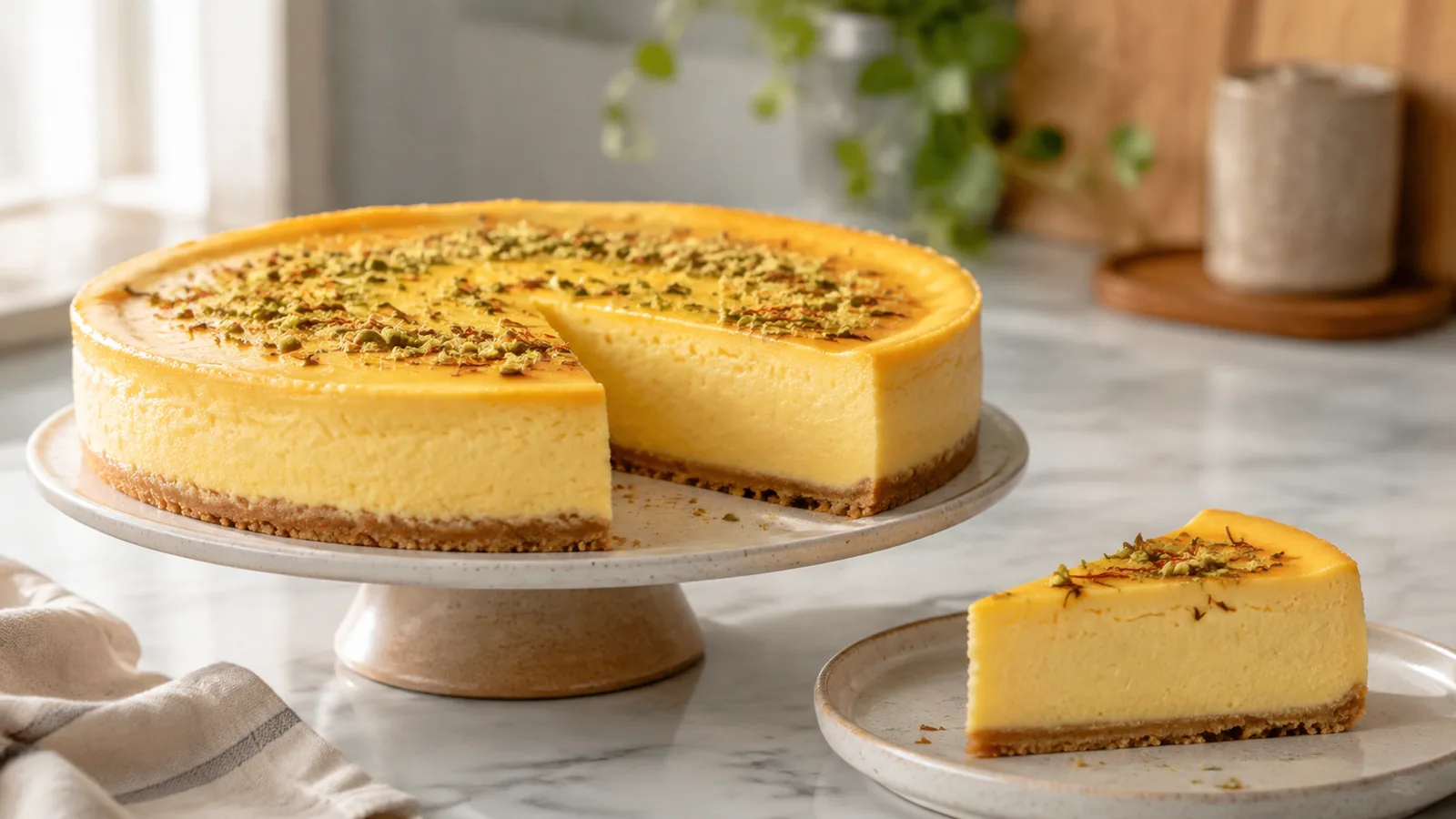
Chilled or baked saffron cheesecake?
Choose the chilled cheesecake when you want a light, mousse-like filling and no oven beyond melting butter. It needs at least six hours in the refrigerator, preferably overnight, so the gelatin and cream cheese can set cleanly.
Choose the baked cheesecake for a denser, smoother slice with a gentle custard texture. It requires eggs, a low oven and a slow cooling period. The former recipe described a “baked” method that baked only the biscuit base, then used the same gelatin filling as the chilled version. Here, the two methods are properly separated.
Whichever you make, use a 20 cm (8-inch) springform pan and line its base with baking paper. The recipes are alternatives; do not combine both fillings in one cake.
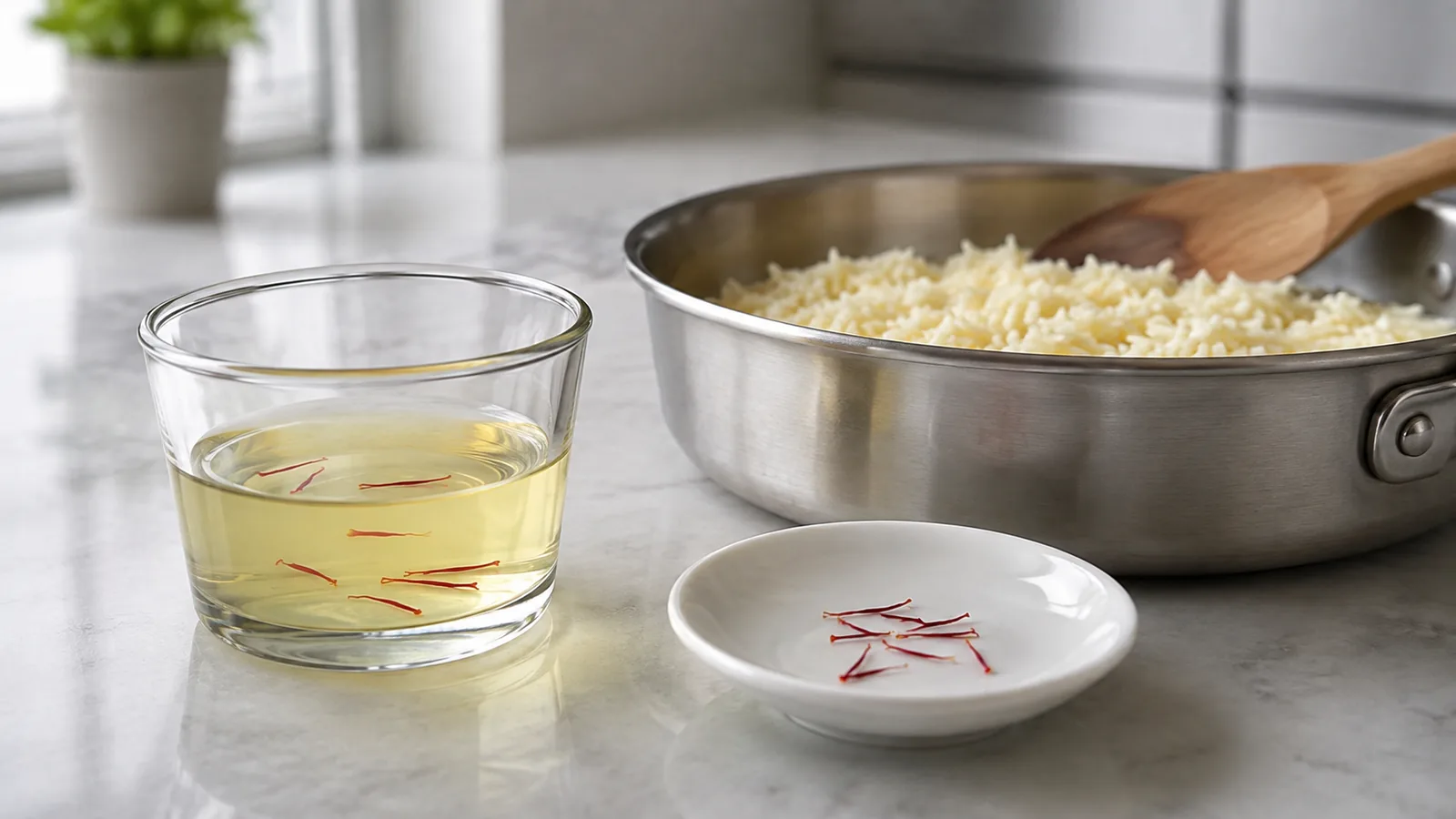
Prepare the saffron infusion
For either cheesecake, lightly crush 0.15 g saffron threads, roughly a loosely filled 1/2 teaspoon. Add 1 tablespoon hot water, cover and leave for 10 minutes. Let the infusion cool before mixing it with dairy.
A concentrated infusion distributes saffron more evenly than dry powder and adds very little water to the filling. If the threads are unfamiliar, our guide to brewing saffron with hot water explains the preparation.
Chilled Saffron Cheesecake Recipe
Ingredients for the biscuit crust
- 200 g plain tea biscuits or Petite Beurre biscuits
- 90 g unsalted butter, melted and cooled slightly
Ingredients for the chilled filling
- 400 g full-fat cream cheese or mascarpone, at cool room temperature
- 250 ml cold heavy cream or whipping cream
- 100 g powdered sugar, about 3/4 cup
- 2 teaspoons unflavoured gelatin powder, about 6 g
- 3 tablespoons cold water
- 1 cooled saffron infusion, prepared as above
- 1 tablespoon food-grade rosewater, or less to taste
- A small pinch of salt
1. Make and chill the crust
Crush the biscuits into fine, even crumbs. Stir in the melted butter until the mixture resembles damp sand. Tip it into the lined springform pan and press it firmly across the base with the bottom of a flat glass.
Refrigerate the crust for 30 minutes while you prepare the filling. A level, well-compacted base is easier to slice than a loose layer of crumbs.
2. Bloom the gelatin
Sprinkle the gelatin evenly over three tablespoons of cold water in a small heatproof bowl. Leave it for 5–10 minutes, until all the powder is hydrated. Warm the bowl gently over barely simmering water, stirring just until the gelatin becomes clear and fluid.
Do not boil gelatin. Let it cool until barely warm, but do not leave it long enough to set. Adding hot gelatin to cold dairy can create rubbery threads; adding set gelatin will leave lumps.
3. Mix the chilled filling
Beat the cream cheese, powdered sugar and salt until smooth. In a separate clean bowl, whip the cold cream to soft peaks. Stir the cooled saffron infusion and rosewater into the cream-cheese mixture.
Whisk two spoonfuls of the saffron mixture into the warm gelatin. This equalises the temperatures. Pour that mixture back into the main bowl while whisking, then fold in the whipped cream in two additions. Stop as soon as the colour is even.
4. Fill and set the cheesecake
Spoon the filling over the cold crust and smooth the top. Tap the pan gently on the counter to release large air pockets. Cover without touching the surface and refrigerate for at least six hours, preferably overnight.
To release it, run a thin warm knife around the inner edge before opening the springform ring. Keep the cheesecake cold until serving; gelatin softens as the filling warms.
Baked Saffron Cheesecake Recipe
Ingredients for the baked version
Use the same 200 g biscuit and 90 g butter crust, plus:
- 500 g full-fat cream cheese, at room temperature
- 140 g granulated sugar
- 2 large eggs, at room temperature
- 150 g sour cream or thick plain yoghurt
- 1 cooled saffron infusion, prepared as above
- 1 teaspoon food-grade rosewater, optional
- 1/2 teaspoon vanilla extract
- A small pinch of salt
The baked filling does not need gelatin or whipping cream. Eggs set it in the oven. Keeping those systems separate produces a smoother cake and removes the uncertainty in the old method.
1. Bake the crust
Heat the oven to 170°C (340°F). Prepare and press the biscuit mixture into the lined pan as described above. Bake for 10 minutes, then place the pan on a rack and lower the oven to 150°C (300°F).
2. Mix without beating in too much air
Beat the cream cheese on low speed just until smooth. Add the sugar and salt, then mix again briefly. Add the eggs one at a time, mixing on low only until each disappears. Finish with the sour cream, saffron infusion, rosewater and vanilla.
Scrape the bowl carefully so no plain cream cheese remains at the bottom. Vigorous beating adds air that expands in the oven and can encourage cracks as the cake cools.
3. Bake gently
Pour the filling over the cooled crust. Set the springform pan on a baking tray and bake at 150°C (300°F) for about 50–65 minutes. The outer area should look set while the centre still moves as one small, gentle wobble rather than rippling like liquid.
Because the filling contains eggs, check the centre with a clean instant-read thermometer. U.S. government egg-safety guidance uses 160°F (71°C) for egg mixtures. Remove the cake when the centre reaches that temperature; it will continue settling as it cools.
4. Cool slowly, then chill
Turn off the oven, prop the door open slightly and leave the cheesecake inside for 30 minutes. Move it to a rack and let it cool to room temperature. Cover and refrigerate for at least six hours before releasing the pan and slicing.
A crack does not spoil the cheesecake, but gradual cooling makes one less likely. Do not put a hot springform pan straight into the refrigerator, where condensation can wet the surface and warm nearby food.
How saffron, rosewater and cheese should balance
Saffron should remain clear beside the mild tang of the cheese. Rosewater is optional and should stay in the background. Mascarpone produces a softer, less tangy chilled filling; standard full-fat cream cheese gives both versions a firmer structure and more contrast.
Do not keep adding saffron simply to make the cake brighter yellow. Too much can taste bitter, and colour alone is not a measure of quality. Record the amount used and adjust the next cheesecake after tasting a fully chilled slice, when aromas are less intense than they are in a warm filling.
Troubleshooting the recipe
The chilled filling is runny
It may not have chilled long enough, the gelatin may not have dissolved, or the cream may have been under-whipped. Do not fix a finished loose filling by adding random amounts of extra cream or cheese. Chill it overnight first; for the next cake, weigh the ingredients and follow the gelatin package if its setting strength differs.
The chilled filling has gelatin threads
The gelatin probably cooled too far before it entered the filling, or it met cold cream cheese too quickly. Temper it with two spoonfuls of filling before whisking it into the bowl.
The baked cheesecake cracked
Overbaking, excess air or fast cooling are common causes. Mix on low speed, remove the cake when the centre reaches the safe temperature and use the gradual cooling sequence. A thin topping of softly whipped cream can cover a crack without changing the flavour.
The biscuit base crumbles
The crumbs may have been too coarse or pressed too lightly. Crush them evenly, mix until every crumb looks moistened and compact the base firmly. Let a baked crust cool before adding filling.
Serving and storage
Cut chilled cheesecake with a thin knife dipped in hot water and wiped dry between slices. A few chopped pistachios or two or three saffron threads are enough decoration. Heavy syrup can mask the delicate flavour and soften the crust.
Keep either cheesecake covered in the refrigerator and use it within 3–4 days. Return slices to the refrigerator promptly rather than leaving the whole cake on a warm table. The chilled gelatin version is generally a poor candidate for freezing because its texture can weep after thawing; the baked version can be frozen in well-wrapped individual slices for quality, then thawed overnight in the refrigerator.
The important choice is made at the beginning: chilled and airy, or baked and custardy. Once you use the ingredients and setting method designed for that version, saffron cheesecake becomes straightforward rather than a list of repeated steps that never quite explains how the cake is meant to set.