You can tell whether saffron is likely to be real by checking several clues together: the shape of the whole threads, their aroma, the way they infuse water and the information on the package. No single kitchen test proves purity, however. A careful home check can expose an obvious imitation; dependable confirmation requires a representative sample and laboratory analysis.
How to identify real saffron before you use it
Start with the product in good light. Genuine saffron consists of dried stigmas from Crocus sativus. Whole threads reveal far more than powder because you can examine their plant structure instead of relying only on colour.
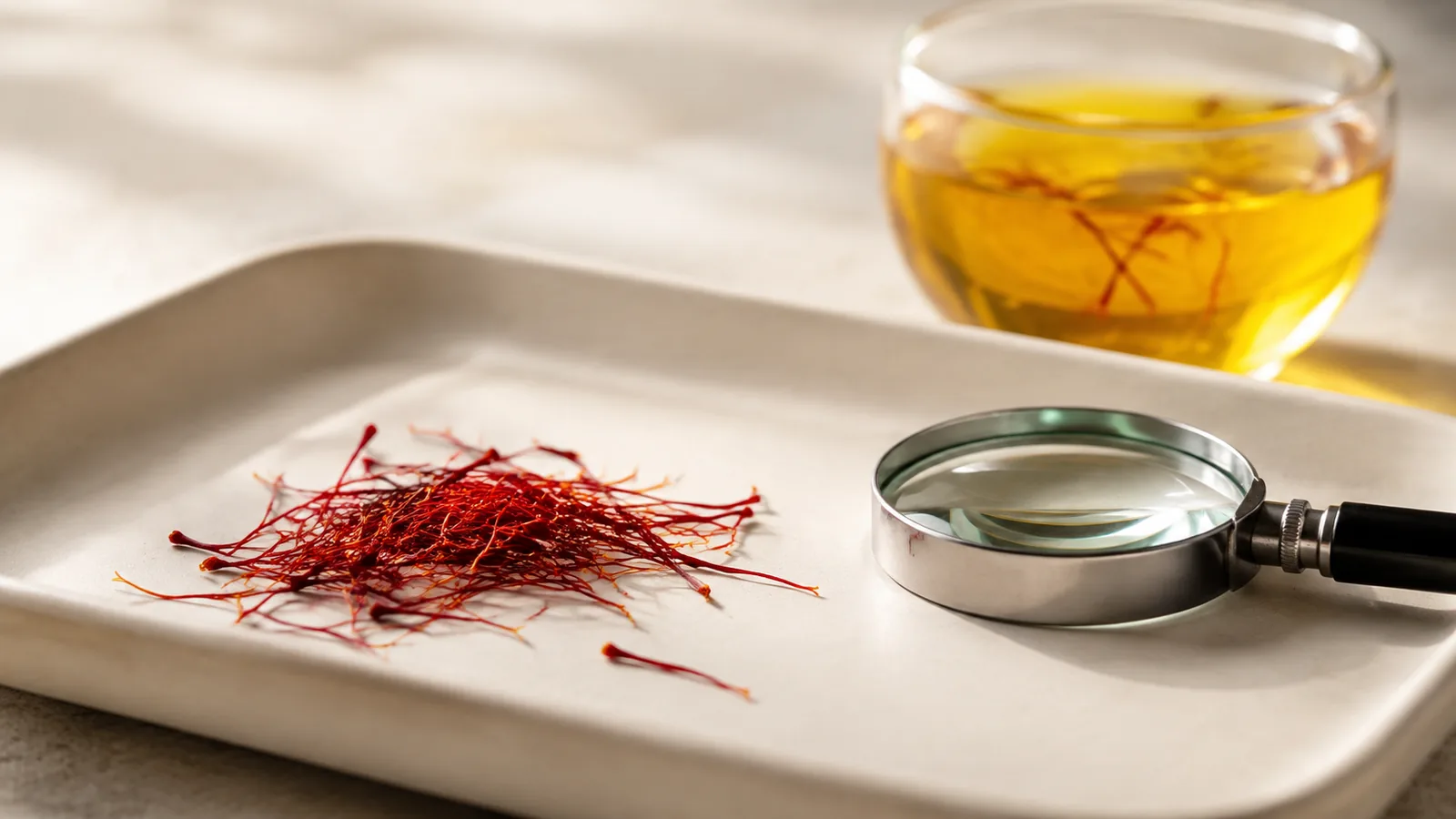
Look for fine, irregular threads that are deep red to red-orange rather than perfectly identical fibres. Many genuine stigmas widen or flare slightly at one end. A small yellow or pale-orange portion can be natural style tissue, although a package containing a large amount of it will usually have less colouring strength by weight. “All red” by itself is not proof of authenticity: other plant material can be dyed red.
Powder is harder to judge at home. Grinding removes the thread shape and makes added colourants or other plant material difficult to see. If authenticity is your main concern, buy intact threads in a sealed pack with clear batch information.
Real saffron versus fake saffron: clues that matter
A useful check combines appearance, aroma and behaviour in water. Treat each sign as evidence, not as a verdict.
Thread shape and texture
Real threads are delicate but recognisably fibrous. Their lengths, bends and flared ends vary naturally. Be cautious when every piece is flat, uniformly cut or looks like an unrelated petal or fibre coated with red dye. Excess crumbs can also make inspection difficult, though breakage alone does not make saffron fake.
Aroma
Good saffron has a strong, complex aroma often described as hay-like, warm, floral or faintly honeyed. The description is subjective, and storage changes intensity, so smell cannot confirm purity on its own. A harsh perfume-like scent or no aroma at all is a reason to inspect the product more closely, not automatic proof that it is counterfeit.
Taste
A tiny amount of known food-grade saffron tastes distinctly bitter, despite its warm aroma. Sweet-tasting threads may have been coated, but tasting an unknown product is not a safe authentication method. Appearance, traceability and infusion behaviour give you useful information without asking you to swallow something you already distrust.
Price and traceability
Saffron is expensive to produce because the flowers are harvested and their stigmas separated by hand. An implausibly low price deserves caution, but price is not a purity test: an expensive package can still be poor, and prices vary by grade, origin, pack size and seller.
Check for the botanical name Crocus sativus, net weight, country of origin, seller or packer details, and a batch or lot number. A sealed package with traceable information gives you a better basis for a complaint or verification than an unlabelled loose product. A brand name—including Zaran or any other brand—cannot establish whether a particular batch is real without evidence about that batch.
How to test real saffron in water
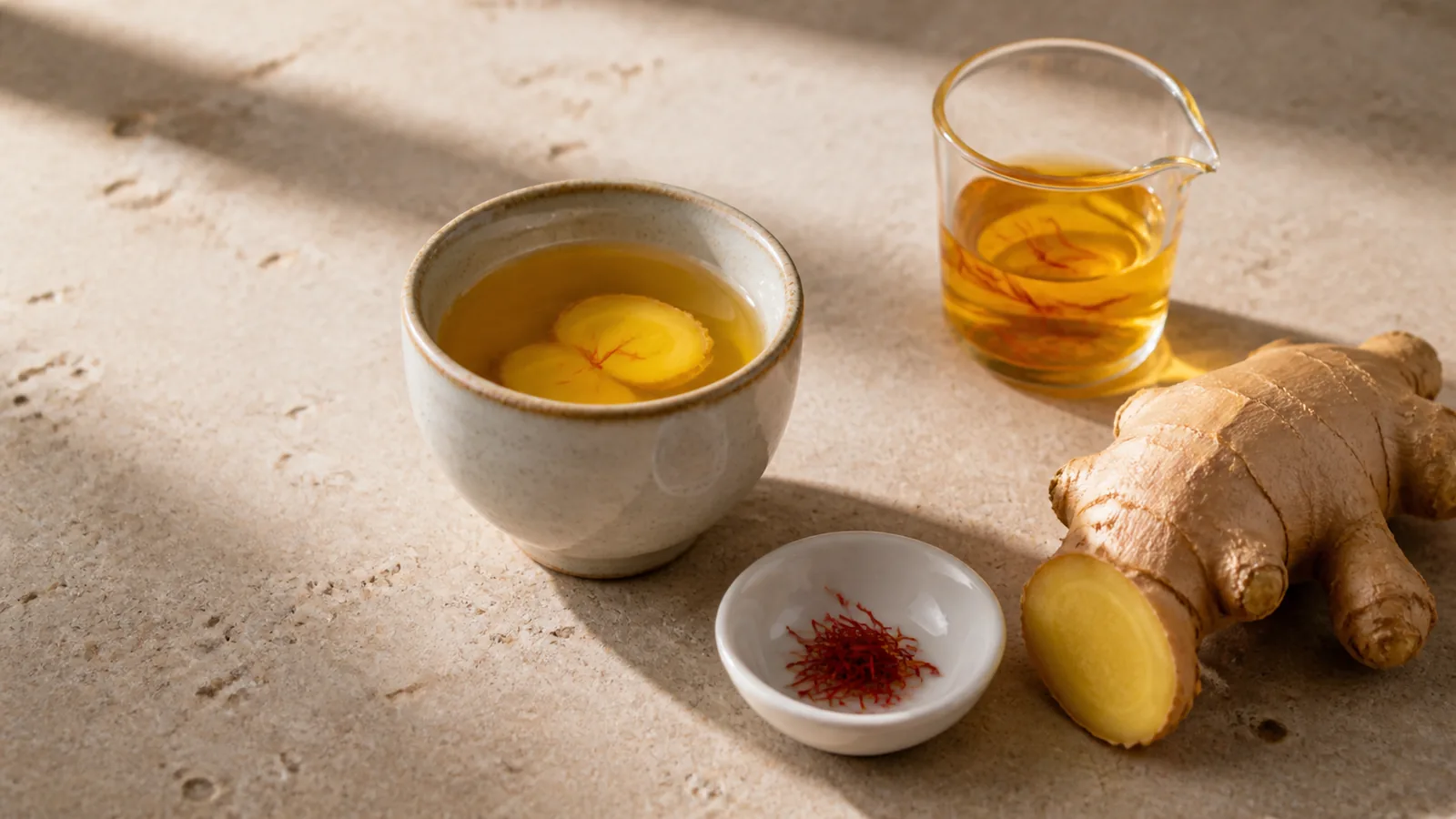
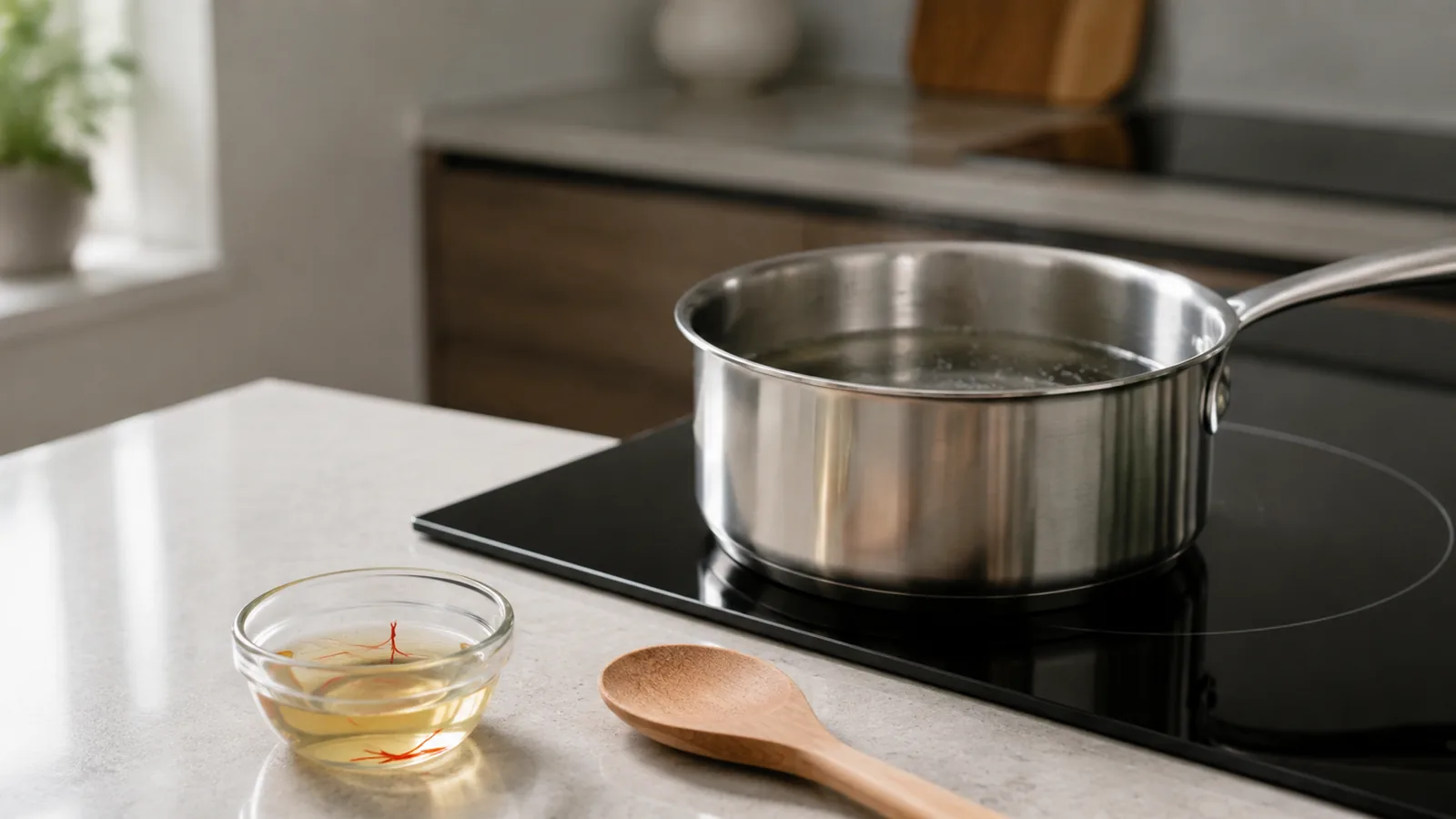
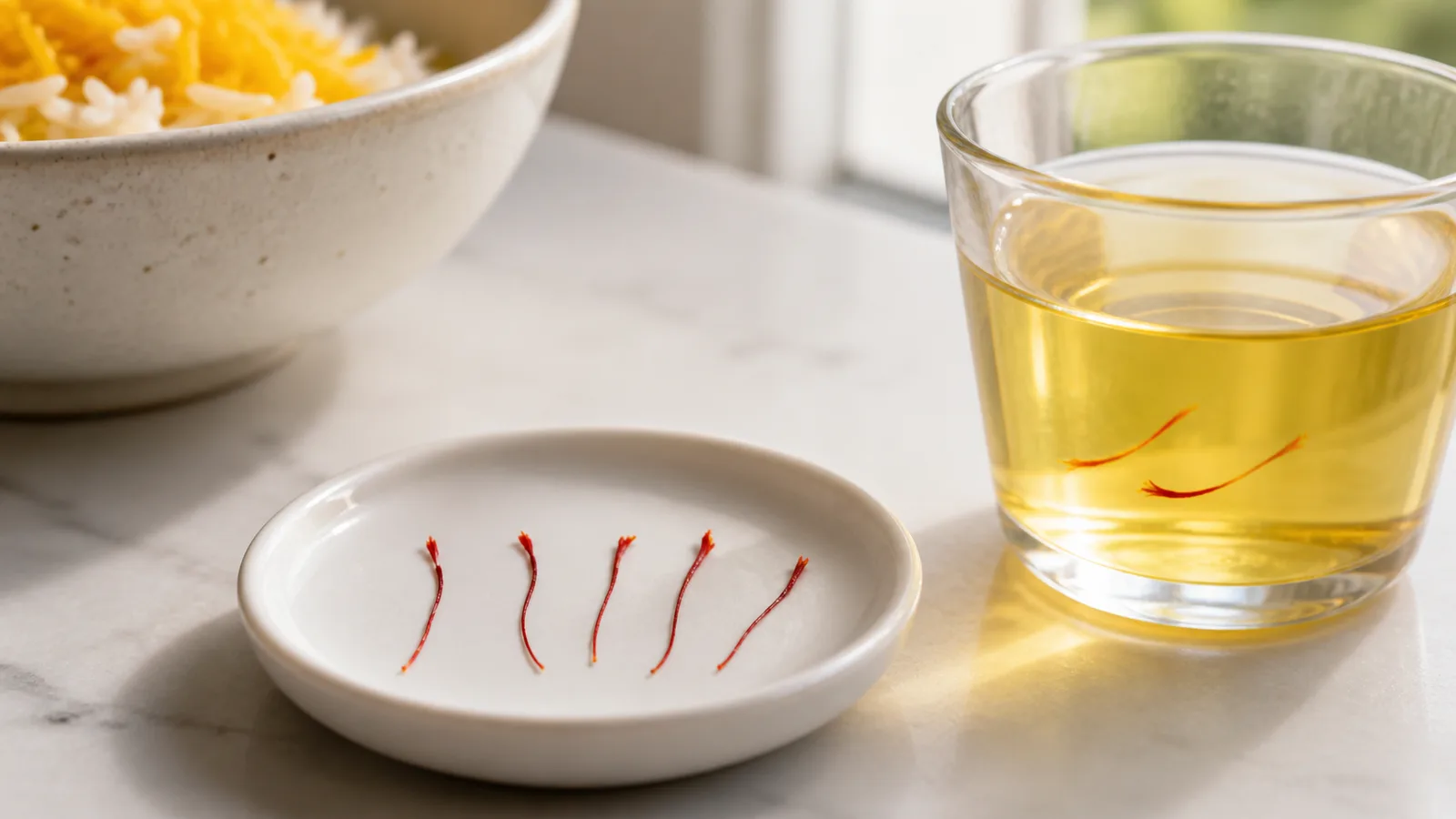
Place a few whole threads in a small clear glass of warm water. Genuine saffron normally releases a yellow-to-golden colour into the water while the threads remain visible. The colour spreads through the liquid as the compounds are extracted; the threads do not need to disappear for the infusion to work.
A sudden cloud of bright red dye is suspicious, especially if the fibres rapidly lose all their surface colour. Yet the familiar “slow colour means real saffron” rule is not conclusive. Temperature, thread size, storage and processing affect extraction, while a skilfully adulterated sample may be made to behave convincingly. For the same reason, floating or sinking is not a reliable pass-or-fail test.
Do not use internet tests involving flames, cleaning chemicals or concentrated acids. They add risk without turning a home observation into a validated laboratory result.
Real, pure and high-quality do not mean the same thing
A sample can come from genuine saffron flowers and still contain too much yellow style, moisture, dust or broken material. It can also be old or poorly stored. Authenticity asks whether the material is what the label says it is; quality also considers cleanliness, moisture, aroma, colouring strength and condition.
That distinction explains why one visual clue cannot identify good-quality saffron. The current ISO saffron specification and related test methods use controlled measurements rather than a single household trick. Scientific reviews of saffron quality and authentication methods likewise describe microscopy, spectroscopy, chromatography and DNA-based approaches, while noting limitations in individual methods.
When laboratory verification matters
For an occasional culinary purchase, thread inspection, a water infusion and a traceable seller may be a sensible screening process. Laboratory testing matters more when a business is buying a large lot, when a result will support a purity claim, or when a sample remains doubtful after inspection.
Testing must also match the question. A method designed to measure colouring strength is not automatically able to identify every botanical adulterant or synthetic dye. Laboratories may combine techniques when they need to confirm identity, find an added substance or assess commercial quality. Our overview of saffron detection methods explains that distinction in more depth.
A practical saffron check
- Read the label: look for Crocus sativus, origin, net weight, seller details and a lot number.
- Prefer whole threads: their shape provides evidence that powder cannot.
- Inspect several threads: look for natural variation, fine fibres and widened stigma ends rather than judging colour alone.
- Smell the dry saffron: expect a recognisable complex aroma, while remembering that age and storage affect it.
- Make a small warm-water infusion: watch the liquid turn yellow-gold and note any immediate artificial-looking red bleed.
- Consider the whole picture: an unusually low price, weak traceability and suspicious fibres together matter more than any one clue.
- Escalate when the stakes are high: use an appropriate accredited laboratory rather than claiming that a home test proves purity.
This is the safest answer to “How do you tell if it’s real saffron?”: use home checks to spot obvious problems, but do not ask them to provide certainty they cannot deliver. A sound buying decision rests on recognisable threads, plausible sensory behaviour and a traceable product; a defensible purity claim rests on suitable testing.