


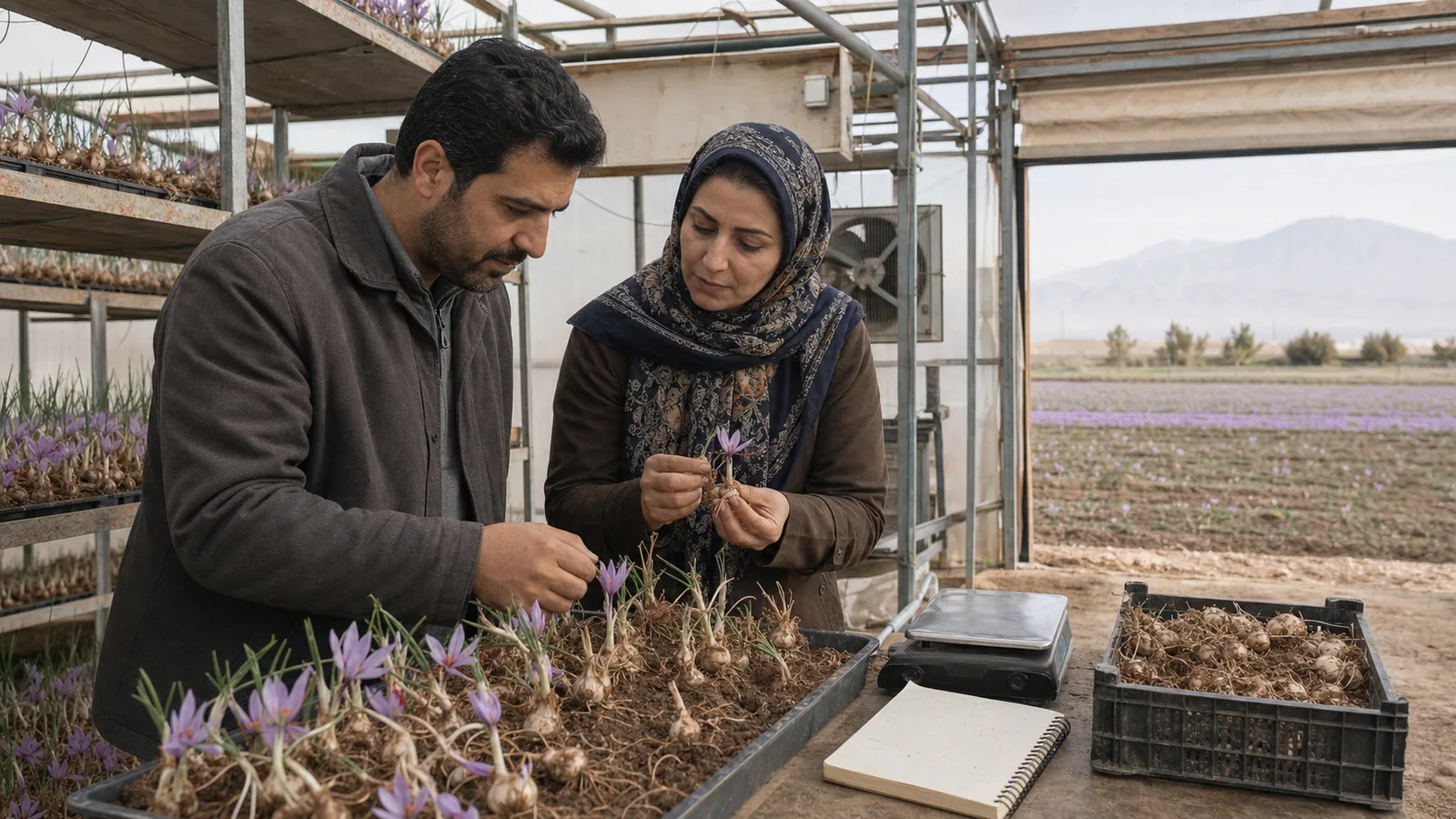
Growing saffron in a greenhouse is technically possible, but technical success does not prove that a commercial project will be economical. The original Lorestan report challenged promoters who promised high returns from lifting or buying large corms, storing them, forcing flowers on indoor trays, and then returning the corms to land.
That warning should not be turned into the opposite absolute claim that every greenhouse system fails. Controlled environments can change flowering time, density, labor, and climate risk. They also add corm, building, cooling, energy, handling, sanitation, and management costs. A serious decision needs a full production cycle and a local budget, not a yield photograph or a workshop promise.
“Greenhouse saffron” can describe different systems
The phrase is often used for several methods that do not have the same biology or cost:
- saffron planted in soil beds under a greenhouse or high tunnel;
- corms held on trays indoors for controlled flower forcing;
- hydroponic or aeroponic systems that manage water, nutrients, temperature, humidity, and sometimes light;
- a hybrid system that flowers corms indoors and transfers them to soil for leaf growth and daughter-corm development.
The destination mainly criticizes the tray-forcing business model marketed in Lorestan. It should not be read as an economic trial of every protected-cultivation design.
Why the corm’s full life cycle matters
A saffron flower can emerge using reserves already stored in the mother corm. That makes an indoor flowering display look productive even when the system has not yet demonstrated how it will renew planting material.
After flowering, leaves photosynthesize and support replacement corms. A project that removes corms after the flowers and gives them no successful vegetative phase may obtain one harvest while degrading the next cycle. The original expert, Rasoul Darvishian, therefore argued that corms forced on trays would need to return to suitable ground unless the controlled system could also support their continuing growth and reproduction.
Corm size does influence flowering potential, but large corms are not a greenhouse-only advantage. Darvishian’s point was that the same quality planting material can perform in a well-managed field, where its purchase, storage, and annual handling may cost less.
Research shows possibility, not automatic profitability
Controlled-environment research does not support dismissing greenhouse saffron as fake. Studies have successfully induced flowering, adjusted harvest timing, and produced replacement corms under managed conditions. Our review of the research behind aeroponic saffron cultivation explains the difference between an experiment and a commercial promise.
A recent peer-reviewed greenhouse study found that denser planting increased stigma yield per unit area but reduced performance per individual plant, while lower density favored larger replacement corms. Its authors said the optimum depends on corm cost, greenhouse and cooling costs, yield, saffron price, and the value and quality of new corms.
That study addressed a hot Saudi climate where cooling could make cultivation possible. It does not calculate profitability for Lorestan or validate a specific training package. Local climate changes the comparison: infrastructure that solves a genuine temperature constraint may have value, while the same equipment may be an avoidable expense where field conditions already suit the crop.
The Lorestan alternative was low-yield rainfed land
Darvishian proposed directing applicants toward saffron on low-yield rainfed land. The archived report says about 75% of Lorestan agricultural land was rainfed and claims the province had suitable climate and successful rainfed saffron experience.
Those are attributed historical statements; the article gives no land survey, rainfall series, trial design, or current provincial statistic. Rainfed production also carries risk. A field needs appropriate soil, drainage, seasonal moisture, healthy corms, and flowering weather. “Rainfed” does not mean a farmer can ignore establishment water or drought variability.
The report also attributes a yield of 25 kilograms per hectare to some growers using scientific field methods. That is an exceptional figure, not a safe planning average, because no sample size, field age, measurement method, or cost record is supplied.
What a greenhouse budget must include
A credible feasibility study starts before the corms enter the building. It should include:
- greenhouse, shelving, trays, irrigation, sensors, cooling, heating, ventilation, and backup power;
- the number, size, health, replacement rate, and resale value of corms;
- storage, disinfection, disease loss, transfer, and cleaning;
- labor for loading, monitoring, picking, stigma separation, drying, and returning corms to soil when required;
- yield per corm, per shelf, and per complete annual cycle—not only per square metre during flowering;
- energy and water use, product grade, sale price, finance cost, and unsold inventory.
Promoters sometimes multiply a dense tray’s short flowering yield by many shelves while leaving out corm renewal, building limits, labor, crop losses, and the months between harvests. The resulting revenue projection is not a profit calculation.
Training claims need evidence and accountability
The destination accused some workshop sellers of charging high fees, promising employment and profit, and blaming participants’ corms or environmental control when projects failed. It names no company, curriculum, contract, or audited result, so the allegation must remain the researcher’s warning rather than a finding about all trainers.
Before paying, a prospective grower should ask for results from complete cycles, the number of failed as well as successful projects, itemized capital and operating costs, measured grade and dry stigma weight, corm survival and replacement data, electricity assumptions, and a written buyer arrangement. A demonstration should use the same climate, scale, and corm costs as the proposed business.
When field saffron also stopped paying in Rashtkhar
The assigned source adds an important counterweight: avoiding a greenhouse does not guarantee that field saffron is profitable. During the COVID-era market disruption, Hassan Gholami, identified as a Rashtkhar Young Farmers Club representative, said saffron was selling for roughly 6.5–7 million tomans per kilogram after trading around 10–12 million tomans the previous year.
He contrasted that decline with an exchange-rate move from roughly 15,000 to 20,000 tomans per US dollar and argued that saffron prices had not responded in the way growers expected. The source contains a garbled additional price sentence, so it is not used here.
Gholami said harvesting labor and production costs could exceed the crop’s selling price, leaving growers to abandon or plow up fields. This was an urgent stakeholder account, not a cost survey. The report gives no farm budget, labor rate, grade, transaction date, or later outcome, so the magnitude cannot be generalized or compared with today’s market.
The commodity-exchange complaint must stay attributed
Gholami further alleged that farmers sold saffron for about seven million tomans while similar saffron appeared on the commodity exchange at about 12 million. He used the term “saffron mafia” to describe traders he believed had access that village growers lacked.
The archived source provides no matched lots, grades, dates, fees, warehouse records, or named traders. It therefore cannot prove that the same saffron was bought and resold at those prices or that unlawful coordination occurred. The accusation is retained as his complaint about unequal market access, not as a verified description of people or institutions.
The documented exchange process also involved more than taking saffron directly to a trading screen. An account published when saffron warehouse-receipt trading launched explained that farmers deposited qualifying product in approved warehouses, received a certificate, and traded through authorized brokers. Those requirements may create real practical barriers, but they are not evidence for the source’s stronger label.
Greenhouse and field systems share the same market risk
The two reports describe different cost structures. A greenhouse project risks high fixed and energy costs, repeated corm handling, and a model that looks profitable only during flowering. A field grower risks weather, concentrated harvest labor, falling farm-gate prices, and weak bargaining power.
Both ultimately sell into a market that cares about grade, purity, origin, timing, and supply. Higher biological yield does not help if the extra output costs more than it earns. A lower-cost field does not help if labor cannot be hired or the crop must be sold under pressure.
Our analysis of why a higher saffron price may still fail to cover farm costs expands on that distinction between nominal price and real margin.
How to decide whether a project is economical
Use a small local pilot, record a complete cycle, and compare it with the best realistic field alternative. Apply the same corm grade, quality standard, labor wage, financing rate, and sale channel to both. Include losses and the value of surviving daughter corms.
The defensible conclusion is narrower than the old headline. Growing saffron in a greenhouse can work agronomically, and it may make sense where climate control, harvest scheduling, research, or high-value corm production justifies the cost. It is not automatically economical in a region with suitable fields, and no return should be accepted until full-cycle local evidence supports it.

![Exporting Saffron to Turkey + Price Guide [Complete 0 to 100]](https://img.rowhanisaffron.com/20260827003933/saffron-export-turkey-quality-inspection.webp)



