


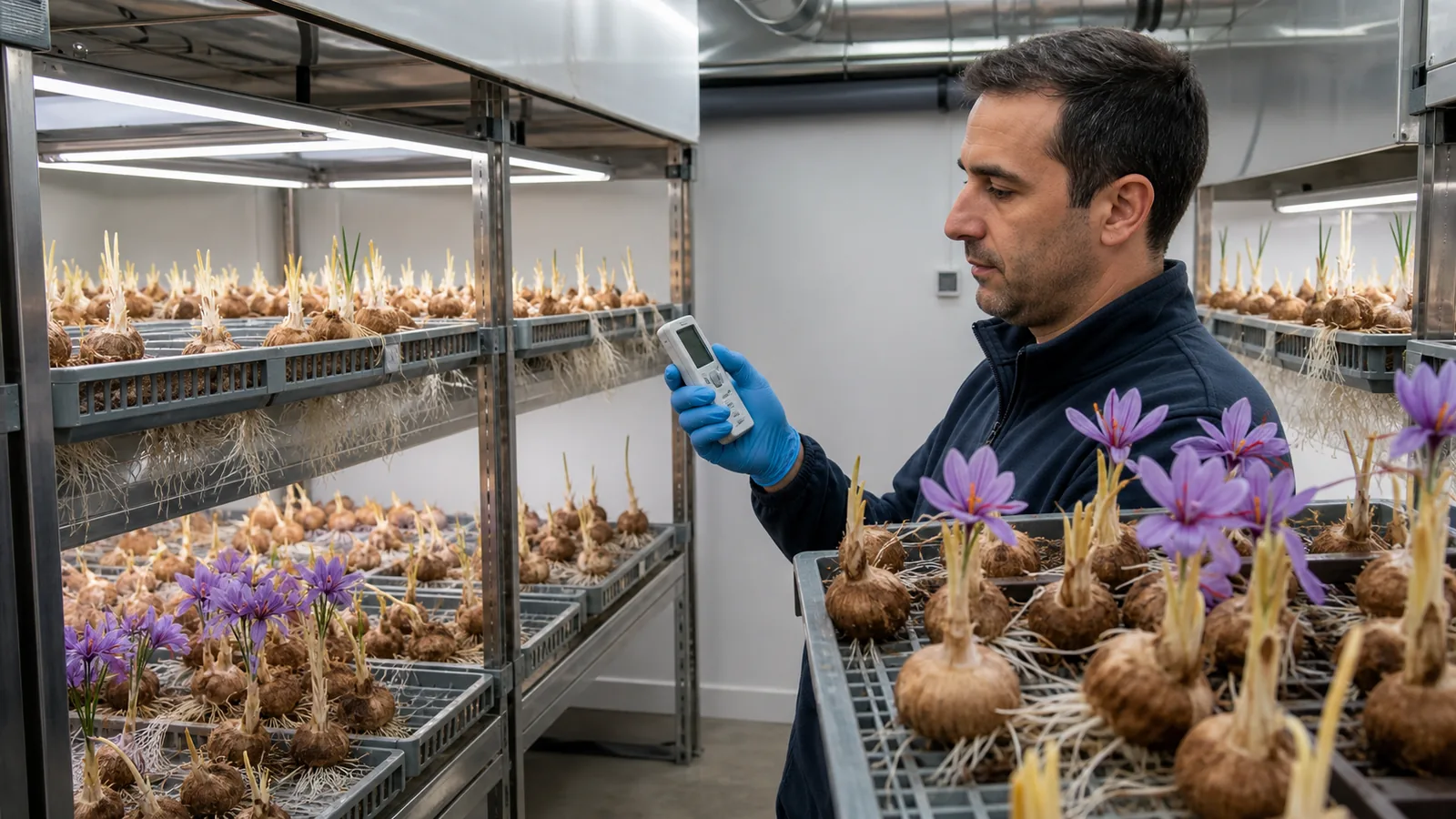
Aeroponic saffron cultivation can trigger flowering from corms held on trays in a controlled room, but it is not a proven shortcut to unlimited, irrigation-free profit. An experimental project at the Bardsir Agricultural Higher Education Center in Kerman Province explored how temperature, humidity, darkness, light, and corm preparation could be managed without conventional field soil.
The project is useful because it shows what controlled-environment saffron actually involves. It also reported that comparisons with field production were still underway. Claims about higher yield, lower cost, quality, or water savings therefore need measurements—not assumptions based on the word “aeroponic.”
What aeroponic saffron cultivation means
In a conventional aeroponic system, roots are suspended in air and receive water and nutrients as a mist. Saffron is unusual because a mature corm stores enough reserves to initiate flowers under carefully controlled conditions. Some systems use a dry flowering phase on stacked trays, followed by a rooted phase in soil or a soilless system so leaves can photosynthesize and daughter corms can develop.
That distinction matters. Producing flowers from stored reserves is only one part of the crop cycle. A system that harvests stigmas but fails to replenish healthy corms may depend on buying replacement corms for the next cycle. A complete commercial assessment must track both the spice and the planting material.
“Aeroponic,” “soilless,” “indoor,” and “greenhouse” are not interchangeable labels. A greenhouse may contain soil beds, containers, substrate, hydroponics, or aeroponics. Each configuration has different water, nutrient, disease, energy, and labor requirements.
The Bardsir research project
Marzieh Khosravi, then a master’s student in medicinal plants at the Bardsir center of Shahid Bahonar University of Kerman, implemented the reported project. Dr. Mehdi Naghizadeh, head of the center, presented it as a response to limited agricultural land, drought, and water scarcity.
The archived report describes corms being stored in darkness until late summer, then prepared and placed beside one another on wooden trays stacked at roughly 50-centimeter intervals. The growing room moved through controlled dark, gradual-light, humidity, temperature, and cooling stages intended to induce flowering.
The source also mentions treatment with fungicide and acaricide solutions before the corms entered the room. That is a description of one research protocol, not a safe formula for readers to copy. Product selection, concentration, protective equipment, legal registration, disposal, and residue implications require local professional guidance. “Two percent” without the named formulation is not an actionable instruction.
Corm size strongly affects flowering
The stored article says larger “onions” produced more flowers; it later mistranslates the same plant material as “coriander.” The correct term is corm. Saffron is commercially propagated from these underground storage organs.
Research supports the importance of starting size. A controlled aeroponic study of mother-corm weight found that flower number and stigma dry weight rose as corm weight increased across the tested groups, with the authors recommending 12.1–16 g corms for their balance of flowering and daughter-corm outcomes under that experiment’s conditions. Corms heavier than 16 g did not further improve the measured yield traits.
This does not create one universal minimum size. Cultivar material, storage history, health, temperature treatment, and production objective all matter. It does show why comparing systems without matching corm weight can produce a misleading result.
Temperature, darkness, and light are production inputs
Saffron flowering responds to the corm’s developmental stage and thermal history. The Bardsir sequence used darkness, gradual light exposure, moisture control, and a final cooling treatment. A separate aeroponic experiment at Shahid Bahonar University also examined pre-cold treatment in flower induction, illustrating that climate-room settings are part of the crop protocol rather than background conditions.
Control can reduce exposure to untimely rain or field frost during flowering, but it adds equipment, sensors, ventilation, cooling or heating, power, and monitoring. A reliable system needs acceptable temperature and humidity throughout the room, not merely a thermostat reading near one tray.
Does the method eliminate water and soil?
The flowering phase may avoid arable soil and use very little direct irrigation because the corm supplies stored energy. It is still inaccurate to say the crop needs no water. Humidity has to be managed, roots or daughter corms may require water and nutrients later, equipment must be cleaned, and replacement corms were themselves produced somewhere.
Soilless research explicitly measures irrigation and nutrient solutions. For example, a two-year saffron cormlet study varied substrate, nutrient concentration, and irrigation management, while another greenhouse study optimized nutrient-solution strength. Those systems differ from dry tray flowering, but they demonstrate that “without soil” does not mean “without water management.”
A credible water-saving claim should count the whole cycle and report water per gram of dried stigma and per usable daughter corm. It should also disclose water used to produce purchased corms if the system does not regenerate its own.
Pest and disease risks change rather than disappear
Protected cultivation can reduce rodent damage and shield flowers from some field weather. It can also concentrate risk. Closely packed corms under excessive humidity may allow rot or other disease to spread quickly, and one infected lot can expose many trays.
Pre-entry inspection, traceable healthy corms, sanitation between cycles, air movement, environmental records, and a plan for isolating affected material are essential. Pesticide use is not a substitute for those controls. Any comparison with field production should record crop losses in both systems rather than assuming the indoor room has none.
What determines whether indoor saffron is profitable
Stacked trays can increase the number of flowering corms per square meter of floor area, but floor-area productivity is not the same as profit. A financial model needs the purchase or production cost of corms, building and rack costs, environmental equipment, electricity, labor, sanitation, crop losses, drying, testing, and the actual grade and sale price of the stigmas.
The original report claimed that plowing and some field infrastructure costs could be avoided. That may be true for a particular facility, yet new controlled-environment costs replace them. It also suggested that a 100-square-meter hall or even a room in a house could be used. Physical possibility does not establish food-safety compliance, ventilation, insurance, local permission, or commercial viability.
The Bardsir team said quantitative and qualitative comparisons with natural conditions were still in progress and that economics would be assessed afterward. That is the correct order: measure flowering, dried-stigma yield, quality compounds, daughter-corm performance, water, energy, labor, losses, and saleable grade before promising returns.
Greenhouse saffron in Razan, Hamadan
A separate archived report said greenhouse saffron cultivation had been implemented in Razan County, Hamadan Province. It framed the project as part of a response to water scarcity and an effort to develop lower-water crops and more productive cultivation methods.
The Razan report provides no system design, area, yield, water-use measurement, cost, or quality result. It therefore demonstrates interest and implementation, not evidence that the project achieved self-sufficiency or outperformed field cultivation. Calling it “greenhouse saffron” also does not prove that it used the same aeroponic tray method as Bardsir.
Together, the Bardsir and Razan cases show controlled saffron spreading beyond one research site. They should remain separate examples until their technical designs and outcomes can be compared on the same basis.
How to evaluate an aeroponic saffron claim
A useful project report should identify the corm origin and weight distribution, number of corms, room area and rack levels, environmental settings, water and energy use, flower and stigma yield, drying method, ISO-style quality measurements, crop losses, daughter-corm outcome, and every major cost. Field and indoor groups should use comparable planting material and cover more than one cycle.
Aeroponic saffron cultivation is a legitimate research and production approach with potential advantages where land or flowering-season control is important. Its strongest case is not that it abolishes agriculture’s constraints. It makes many of them measurable and controllable—while introducing a new set of technical and economic demands that must be counted honestly.

![Exporting Saffron to Turkey + Price Guide [Complete 0 to 100]](https://img.rowhanisaffron.com/20260827003933/saffron-export-turkey-quality-inspection.webp)



