


Production of 16 kg of saffron in Siahkal city was forecast in a 2021 local agricultural report. The announcement described 10 hectares in 32 villages of Deilman and Pirkuh and said the dried spice had been assessed by specialist laboratories in South Khorasan.
The 16-kilogram figure was a forecast
Behzad Kouhestani, then director of Siahkal Agricultural Jihad, said the county was expected to produce 16 kilograms of saffron during that crop year. The wording matters: it was an estimate made before a final harvest total was available.
Dividing 16 kilograms by the reported 10 hectares gives an implied average of 1.6 kilograms per hectare. That is only a planning ratio. The original report does not say how much of the land was mature, how production differed between farms, or whether all 10 hectares contributed to the forecast.
For that reason, 1.6 kilograms per hectare should not be presented as a measured county-wide yield. A reliable yield figure would require the harvested dry weight and productive area from the same season, together with a clear method for moisture and grading.
Saffron fields were spread across 32 villages
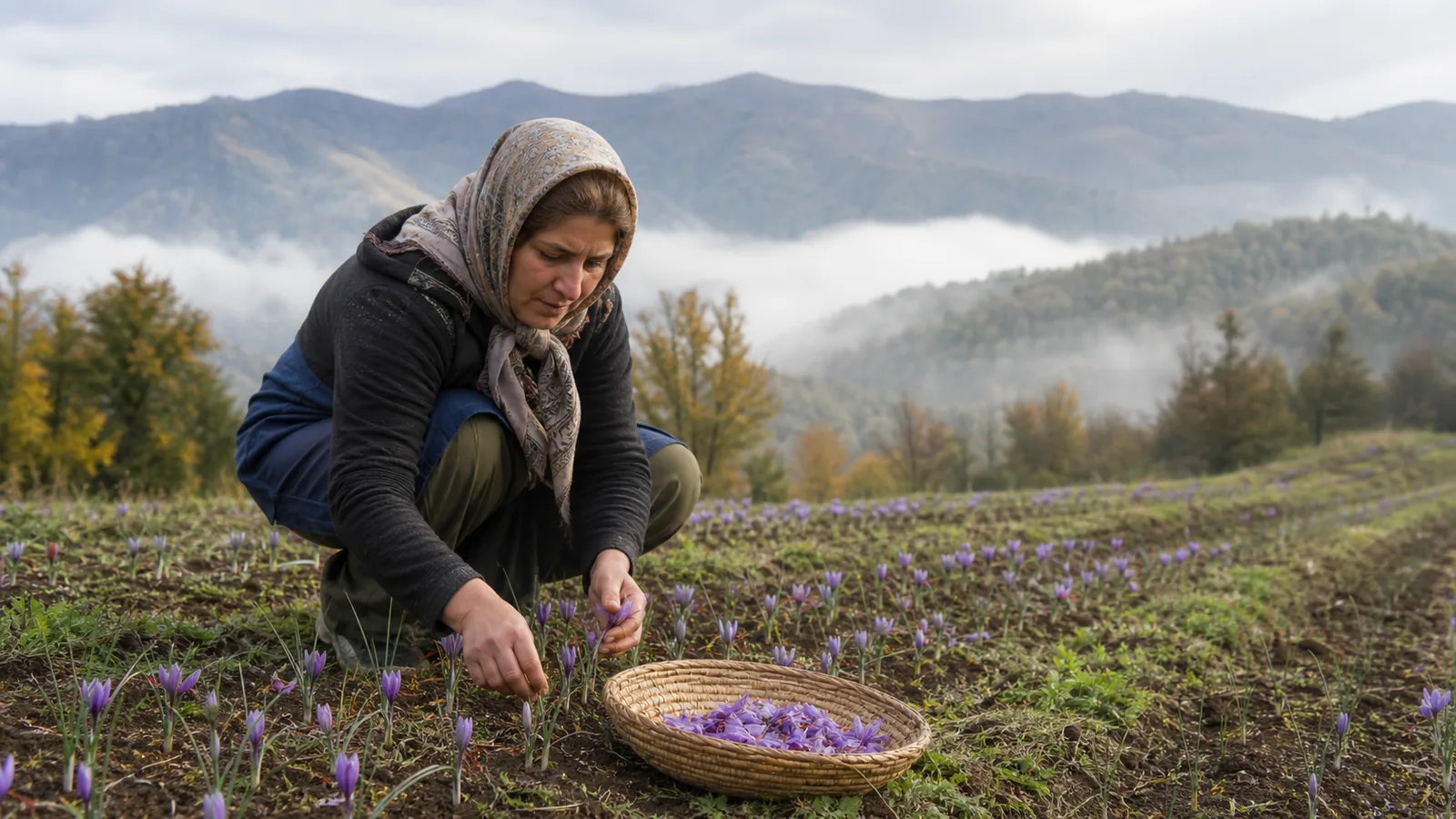
The local update placed the cultivated area in 32 villages of Deilman and Pirkuh, the mountainous part of Siahkal County in Gilan Province. This setting is important because it differs sharply from Gilan’s humid coastal plain.
An earlier official report on saffron in mountainous Gilan identified Siahkal among the province’s saffron-growing counties. It said the crop was being cultivated at elevations of roughly 1,200 to 2,300 metres across the relevant mountain districts.
That provincial elevation range should not be assigned to every Siahkal field. It does, however, explain why reports about saffron in rainy Gilan repeatedly refer to upland areas. Drainage, winter temperatures, summer dormancy and access to fields all change with elevation and local terrain.
Ten hectares and twelve hectares describe different statements
The archived English text gives two area figures. It says 10 hectares were under cultivation in the 32 villages, then refers to about 12 hectares in a crop-year planting statement.
The translation renders that crop year as “2009,” but it does not supply the original Persian date or make clear whether the 12 hectares were a future plan, an addition, or a new total. Turning it into a precise timeline would therefore create certainty the surviving text does not support.
The defensible reading is narrow: 10 hectares formed the stated production base for the 16-kilogram forecast, while a separate programme referred to about 12 hectares of planting. The figures should remain separate until the original dated Persian announcement or an official field register is found.
Corm requirements were substantial
Kouhestani said growers were introduced to suppliers in Khorasan for saffron corms. The report estimated that each hectare would require about seven to ten tonnes of planting corms.
That range implies 84 to 120 tonnes for a 12-hectare programme, but this is multiplication of the stated planning figures, not evidence of how much material was purchased or planted. Actual requirements depend on corm size, spacing, planting depth, field design and the intended production system.
Corm origin alone does not determine success. Planting stock also needs to be healthy and appropriately handled, and a field needs suitable drainage and management. Those practical details are absent from the local announcement, so the article cannot verify establishment quality or survival rates.
What the laboratory statement does and does not prove
The director said specialist saffron laboratories in South Khorasan had assessed the Siahkal product for colour, taste and aroma and had given it an excellent grade. The surviving post does not name the laboratory, identify a sample, provide a certificate, or report analytical results.
The statement can therefore be preserved as an attributed local claim, but it should not be converted into an independent guarantee that every batch from Siahkal has the same quality. Saffron quality can vary by field, harvest day, separation, drying, storage and sample.
“Pure saffron” in the forecast also should not be read as a laboratory finding. In context, it refers to the dried spice rather than flower weight. Authenticity and grade require testing of a specific lot.
How Siahkal fitted into Gilan’s saffron production
Siahkal was one part of a broader mountain-growing programme. An official 2019 Gilan harvest announcement reported 18 hectares across Rudbar, Rudsar, Amlash, Siahkal and Talesh and forecast 53.4 kilograms.
That provincial figure cannot be used as Siahkal’s own result. It describes several counties and an earlier season. It does show that the Siahkal forecast belonged to a wider effort to establish saffron in Gilan’s uplands rather than on the wet coastal lowland.
The 2019 report also described its number as a forecast. Both records should be read as dated agricultural announcements, not as current production statistics or final audited harvests.
Income comparisons need farm records
Kouhestani recommended saffron as an alternative to wheat and barley in Deilman because he expected higher income from it. The archived report provides no production budget, labour cost, corm cost, sale price or crop-by-crop calculation.
Saffron can generate high value from a small dry weight, but establishment requires a large amount of planting material and harvesting is labour-intensive. Wheat and barley have different machinery, labour, rotation and market requirements. A useful comparison needs the costs and yields of the specific farm, not the retail price of saffron alone.
The local recommendation is therefore best treated as a development proposal. It records officials’ interest in crop diversification, while leaving the financial result unproven.
What remains useful in the Siahkal report
Read carefully, the announcement preserves a clear historical picture: a 16-kilogram forecast based on 10 hectares, cultivation across 32 Deilman and Pirkuh villages, a separate 12-hectare planting statement, corm requirements of seven to ten tonnes per hectare, and an attributed laboratory-quality assessment.
It does not provide a final harvest, a current cultivated area, named laboratory evidence or a farm-profit calculation. Keeping those limits visible makes the record more useful, not less.
The value of the Siahkal experiment was that it tested saffron in Gilan’s mountain environment and gave local growers another crop to consider. Whether it succeeded over the long term requires later, like-for-like data on mature area, dry yield, quality and farm income.

![Exporting Saffron to Turkey + Price Guide [Complete 0 to 100]](https://img.rowhanisaffron.com/20260827003933/saffron-export-turkey-quality-inspection.webp)



