


“Iranian saffron, hero of drought control” was the phrase Behzad Sadeghi used at a conference on saffron literature and history at Ferdowsi University of Mashhad. His point was economic as much as agricultural: in water-scarce Khorasan, saffron can support rural livelihoods while demanding less water than many summer crops.
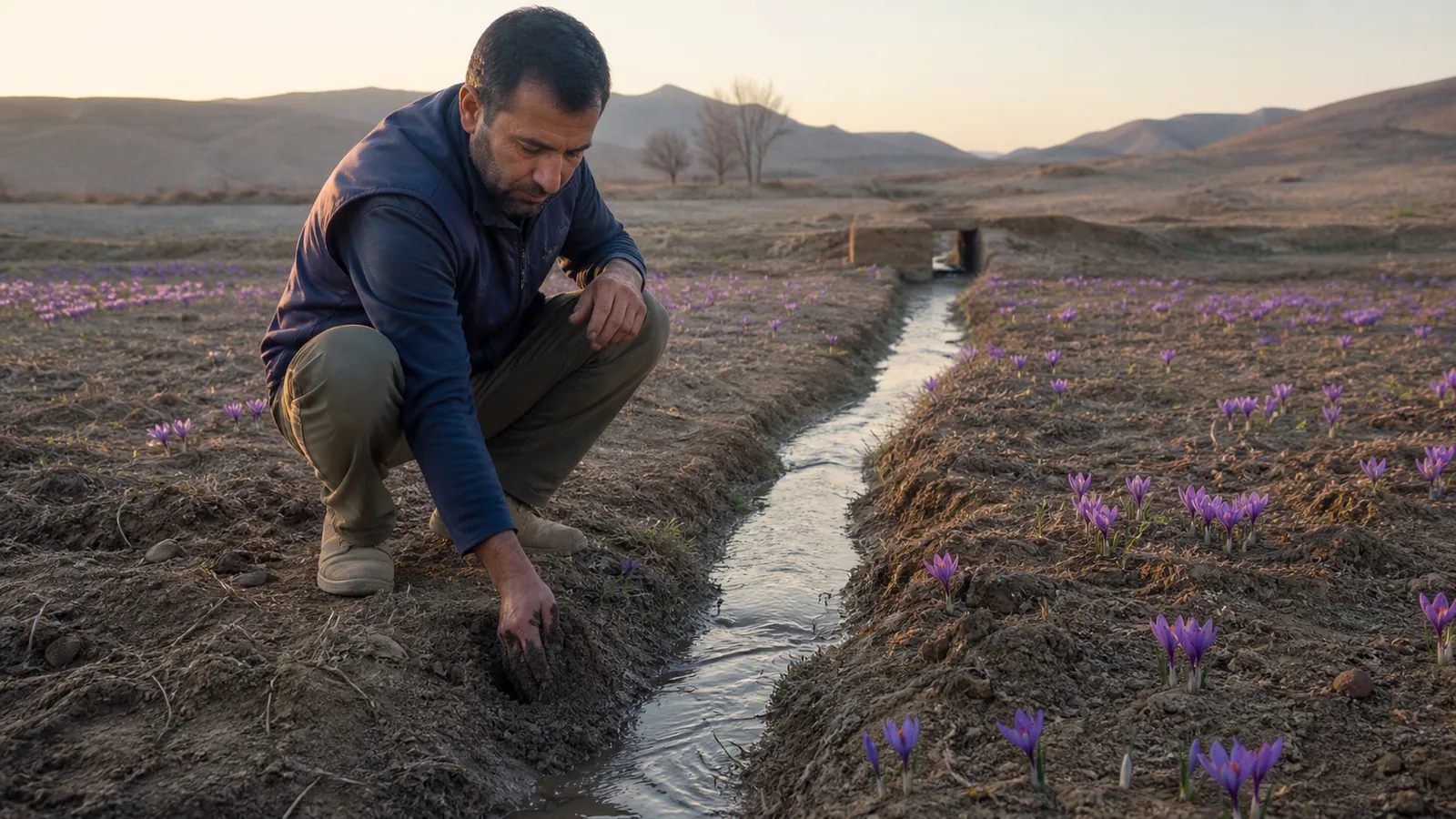
Why Sadeghi called saffron a drought-control hero
Sadeghi, introduced in the archived report as the “father of Iranian saffron,” argued that the crop had become essential in places facing persistent water shortages. He connected about 100,000 hectares of cultivation with roughly 100,000 jobs and said saffron income could help cover a farming family’s expenses.
Those were conference claims, not a statistical table. The post does not state the year of the area estimate, define whether “jobs” means full-time workers, growers, seasonal positions or person-years, or provide a source for the household-income statement.
The underlying idea is nevertheless credible. Saffron’s active growth occurs through the cooler part of the year, and the dry spice has high value relative to its weight. That combination can make it a useful crop where water and transport are constrained. It does not make every saffron farm profitable or drought-proof.
Low water demand is not the same as drought control
FAO’s account of the qanat-based saffron farming system in Gonabad says the crop does not require large quantities of water and plays an important livelihood role in a severely water-scarce region. The same account places saffron inside a managed irrigation system. It does not describe a crop that can produce indefinitely without water.
Recent long-term Iranian field research makes the boundary clearer. A study of irrigation depth, salinity and planting method found saffron sensitive to deficit irrigation and highly sensitive to salinity stress. Water depth, water quality and field design affected yield and economic water productivity.
Saffron can therefore be part of a water-scarcity strategy, but it cannot “control” a drought in the hydrological sense. It does not refill an aquifer, create rainfall or remove the need for irrigation. The headline is a memorable metaphor for crop choice, not a literal description of water management.
The 85-percent groundwater claim needs a source
Sadeghi said that 85 percent of Khorasan’s groundwater had been used over four decades and only 15 percent remained for future generations. The archived report does not name an aquifer, define “used,” identify the starting year, or link to a water-balance assessment.
Groundwater is normally evaluated by aquifer and basin through recharge, abstraction, storage change and water quality. A single percentage for all of Khorasan cannot be independently checked without those definitions.
The claim should remain attributed to the speaker rather than repeated as an established measurement. Its practical warning is still clear: crop policy cannot assume that groundwater withdrawals can continue unchanged.
Rural livelihoods were at the centre of the argument
Sadeghi warned that removing saffron from Khorasan could force one million farmers and family members to migrate. Elsewhere in the speech, the archived English text refers to one million new migrants.
No demographic model, household count, time horizon or migration study accompanies that number. It is best read as a warning about dependence on the crop, not as a forecast that one million people would inevitably move.
Saffron does create substantial seasonal work in flower picking and stigma separation. It also supports trading, drying, grading and packaging. Yet seasonal labour is not the same as a permanent job, and farm dependence varies by household. Good policy needs current grower, labour and income records rather than a dramatic round number.
Water savings depend on what saffron replaces
Sadeghi contrasted saffron with summer crops that require irrigation when water is under the greatest pressure. This is one reason saffron can fit the agricultural calendar of arid and semi-arid Khorasan.
The water benefit, however, depends on the comparison. Replacing a heavily irrigated summer crop may reduce seasonal demand. Converting rainfed land, expanding onto unsuitable soil, or allowing saved water to support additional irrigated area can produce a different basin-level result.
Yield matters too. A field with poor corm stock, salinity or badly timed irrigation may use less water but produce too little dried saffron to support a household. Water productivity must be considered alongside total abstraction, crop quality, labour and farm income.
Competition cannot be answered by price alone
The conference speech named Spain, India and the European Union as places interested in developing saffron production. Sadeghi was particularly concerned about Afghanistan and China, warning that lower-priced supply could challenge Iran.
He proposed two responses: give farmers stronger technical knowledge and promote saffron more widely to increase international consumption. Those ideas remain more defensible than his additional call to produce more and lower prices.
Lowering price without reducing cost can weaken the very livelihoods the speech sought to protect. Long-term competitiveness also depends on consistent quality, traceability, hygienic processing, reliable grading, efficient water use, credible origin claims and products that retain more value for growers and Iranian businesses.
The eight-thousand-year history claim is not established
Sadeghi said saffron had an eight-thousand-year history in Iran and had once been exported to Greece and Rome. The archived post gives no archaeological or documentary source for that precise timeline.
Modern research separates ancient crocus use from the domestication of Crocus sativus. A multidisciplinary review of ancient artworks and saffron genetics places clear early cultivation evidence much later, around the second millennium BCE, and supports an origin in ancient Greece. Iranian and Mesopotamian artworks remain part of saffron’s early cultural record, but they do not prove eight thousand years of Iranian cultivation.
The historical claim should therefore be treated as part of the conference rhetoric, not a settled date. Iran’s long and important saffron tradition does not need an unsupported number to be meaningful.
Other broad claims also need boundaries
Sadeghi connected saffron with economic, social, medical, foreign-exchange and employment benefits. He also referred to more than 7,000 plant species identified in Iran and called saffron unique among them.
These are themes rather than evidence. Medical effects require claim-specific human research; foreign-exchange value requires dated trade data; employment requires a defined unit; and a plant-species count needs a named botanical inventory. None is supplied in the archived conference account.
This article therefore does not turn them into health promises or current economic statistics. It records what the speaker wanted decision-makers to examine.
What drought-resilient saffron policy would require
A serious drought strategy begins with measured water budgets, not a slogan. For saffron-growing districts, that means monitoring aquifer conditions, irrigation volume and salinity; matching planting to suitable soil; protecting corm health; improving irrigation timing; and recording dry yield and quality.
It also means testing whether farm income survives labour costs and volatile prices. Training, transparent grading, traceability and stronger market access can improve the value earned from each kilogram without relying only on larger cultivated area.
Saffron deserves its place in Khorasan’s response to water scarcity. Its seasonal growth pattern and high value can make it a better fit than some alternatives. The safest conclusion is narrower than the headline: saffron is a useful water-conscious crop, but drought control still depends on responsible groundwater management, precise irrigation and viable rural economics.

![Exporting Saffron to Turkey + Price Guide [Complete 0 to 100]](https://img.rowhanisaffron.com/20260827003933/saffron-export-turkey-quality-inspection.webp)



