


Saffron yield research in the Mashhad region found that corms planted from 5 June to 5 July performed better than later planting in that trial. This supports an early-summer planting window under comparable conditions. It does not guarantee twice as much saffron on every farm.
The archived article, titled “Twice as much saffron based on research findings,” combined agronomy, processing, trade, health and public-purchase claims from Abdullah Mollafilabi, whose surname appears in the old English version as Malafilabi. Its central advice has a research basis, but the headline needs the conditions that the short report left out.
What the planting-date research found
Mollafilabi said about 80% of farmers were planting in August and September and described the first half of June as the best time. He contrasted a reported average dry-stigma yield of 3.8 kilograms per hectare with the possibility of at least doubling output under the recommended method.
A published three-year field experiment conducted in Mashhad from 2012 to 2014 supports the planting-window direction. The study found 5 June to 5 July to be its best saffron sowing period. It also concluded that management—including planting date, ecotype, density, and larger, higher-quality corms—was central to improving yield.
That is not the same as showing that planting date alone doubles a farm’s yield. The outcome can change with climate, soil temperature, corm origin and size, field age, density, depth, irrigation, nutrition and disease. Research in a cold Canadian climate, for example, identified a later local planting window. “Best time” must be interpreted for the production region.
How farmers should use the finding
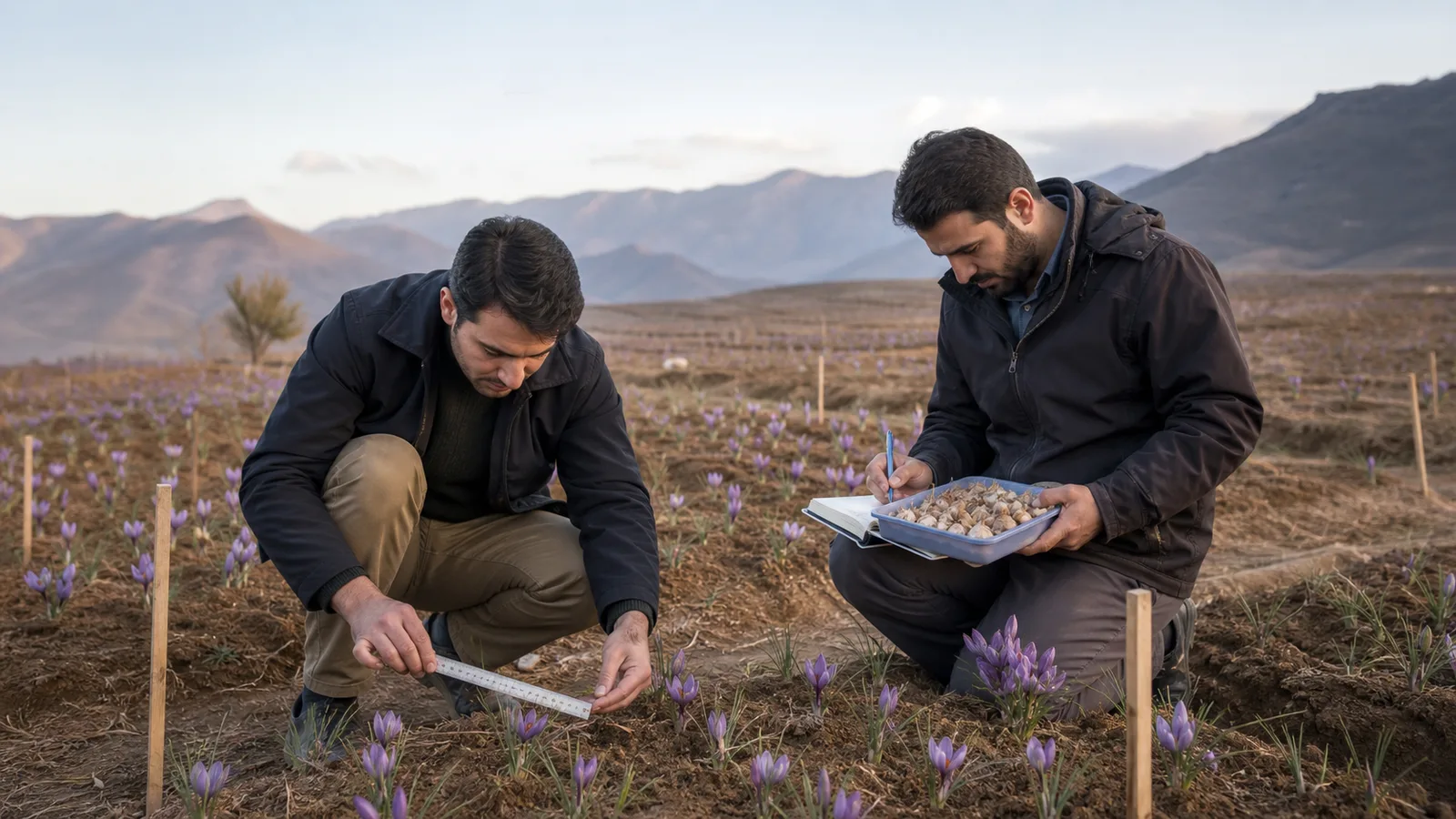
For a grower in conditions comparable to Khorasan, the evidence supports testing earlier planting when healthy dormant corms and prepared land are available. A side-by-side local strip trial is safer than changing an entire holding at once.
- Use the same corm provenance and size class in the early and usual-date plots.
- Keep density, depth, irrigation and nutrition comparable.
- Record emergence, flower count, fresh flower weight and dry stigma yield.
- Track daughter-corm size and disease, not only the first harvest.
- Repeat across seasons before treating the result as a farm rule.
The corms should come from a traceable source and be inspected for wounds, rot and pests. The old advice to “disinfect” corms is incomplete: any treatment must be registered for the crop and target problem, used at the label rate and selected with local plant-health advice. An unknown chemical dip is not good practice.
High density is not automatically optimal
Mollafilabi recommended high-density planting. Research confirms that density can raise flower yield per unit area in early years, but it also increases corm cost and can intensify competition and crowding. The best density depends on corm weight and how long the field will remain in production.
One Iranian field experiment found that medium-sized corms at 100 corms per square metre gave the highest stigma yield in one- and two-year fields, while 75 corms per square metre performed best in the third year. It notes 50–75 corms per square metre as a recommendation for perennial cultivation. That is evidence for matching density to field strategy, not copying the largest number.
Can four years produce what eight years once did?
The archived statement says research-based management could produce 40 kilograms over four years instead of maintaining a field for eight years to obtain the same amount. It does not identify the area, starting field age, trial design or whether 40 kilograms means cumulative dry stigma per hectare.
Field duration is a genuine management decision. Over time, daughter corms multiply, but crowding, competition and disease can eventually reduce flower production. A comparative study notes that Iranian saffron fields often run for six to eight years, while crop cycles differ widely among countries. Shorter cycles may enable corm sorting and disease removal, but they also add lifting, land preparation and replanting costs.
A grower should compare cumulative saleable stigma, corm value, labour and water—not assume that four years is always twice as efficient as eight.
Harvest before strong sun and dry promptly
Mollafilabi advised picking flowers before the sun reaches them and drying stigmas quickly to protect colour and active constituents. Early-morning picking is practical because flowers are fresh and cooler, and prompt separation limits delay before drying.
Fast does not mean uncontrolled heat. Drying must reduce moisture consistently while protecting colour, aroma and cleanliness. Flowers and stigmas should be kept off bare soil, handled hygienically and protected from condensation, dust and prolonged storage before processing.
Animal manure and the misuse of “organic”
The article says farmers should be careful with animal manure because contamination cannot simply be washed or disinfected from saffron. The hygiene principle is sound. Dried stigmas are not a product that can be routinely washed after harvest without changing quality.
However, calling saffron “organic” does not make every field or product certified organic. Certification depends on documented inputs and an approved system. Manure should be properly managed and applied according to agronomic and food-safety requirements, with harvest practices preventing contact between flowers and contamination sources.
Processing can add value, but product claims must be real
Mollafilabi argued against selling only raw spice and called for processing near production centres. The archived translation lists sunscreen, an “anti-itch gum ointment,” pills and beverage colourants abroad, and saffron cake powder, breadcrumbs, probiotic powder and saffron tablets in Iran.
Some wording is clearly damaged in translation, and the report gives no manufacturer, product registration or market data. These examples should be treated as possible product categories, not verified commercial inventory. Processing adds value only when there is demand, compliant formulation, stable quality, safe production and a margin after equipment, testing, packaging and distribution.
Food, cosmetic, supplement and medicine categories have different evidence and regulatory requirements. Moving “out of the spice state” is not automatically progress if the resulting claim or product cannot legally be sold.
Saffron is not an anti-cancer drug
The archived article calls saffron an anti-cancer drug and a possible “medicine of the third millennium,” referring to tests abroad and at Iranian medical and pharmacy schools. That language overstates the evidence.
Saffron compounds are studied in cells and animals, and limited clinical research exists for some outcomes. Preclinical anti-cancer activity does not establish that saffron prevents or treats human cancer. A medicine requires a defined preparation, dose, indication, clinical evidence, safety assessment and regulatory approval. Culinary saffron should never replace oncology care.
The trade and tariff claims are historical
Mollafilabi said Saudi Arabia, India and China imposed tariffs of 25–30% on Iranian saffron, while Afghanistan—described as the fourth-largest producer and third-largest exporter—did not face the same tariff. The article gives no tariff code, year, import schedule or data source. Tariffs are destination- and date-specific and must be checked against current customs rules before a sale.
He also said Spain produced about one tonne annually but bought Iranian saffron, packed it under its own name and supplied the European Union with a global brand. Trade data can show flows between countries; this short statement cannot establish the origin of every Spanish package. Its durable lesson is that production and ownership of the customer-facing brand are different sources of value.
Government purchasing and employment figures
The report says the Iranian government bought and stored 70 tonnes in the prior year and intended to repeat support purchases through agreements in the three Khorasan provinces. It provides no programme name, price or year, so this is not evidence that a current purchase guarantee exists.
It also says saffron was cultivated in 25 provinces and that “about 270 people are employed annually.” The employment unit is plainly incomplete—possibly person-days per hectare or another measure. It should not be converted into a national jobs total without the original source.
Water productivity needs a unit
Mollafilabi described saffron as more economical and less water-intensive than roughly 40 crops grown in Khorasan, and suitable where water is valuable and other crops or industries are limited. That is a strategic argument, not a universal farm comparison.
The final water statement in the translation says a product is harvested “hot” for each cubic metre—an unusable phrase, probably produced when a weight unit was mistranslated. Water productivity must be stated as a verified amount of saleable dry saffron or economic value per cubic metre, with irrigation and rainfall boundaries. No number should be invented here.
What “twice as much” should mean to a grower
The research case for earlier planting in Mashhad is real, but it belongs inside a complete management system. Healthy corms, an appropriate local planting window, density matched to field life, clean manure management, early harvest and controlled drying all influence saleable yield.
The safe promise is not “plant in June and automatically double saffron.” It is this: use the research to design a measured local comparison, then adopt the method only when several seasons of yield, quality, cost and water data show that it works on that farm.

![Exporting Saffron to Turkey + Price Guide [Complete 0 to 100]](https://img.rowhanisaffron.com/20260827003933/saffron-export-turkey-quality-inspection.webp)



