


Annual harvest of more than 3 kg of saffron in Khorasan Razavi province referred to average dry-saffron yield per hectare, not the province’s total crop. In the historical announcement, horticulture director Hashem Naghibi put the average at about 3.5 to 4 kilograms per hectare and total annual production at roughly 280 to 300 tonnes.
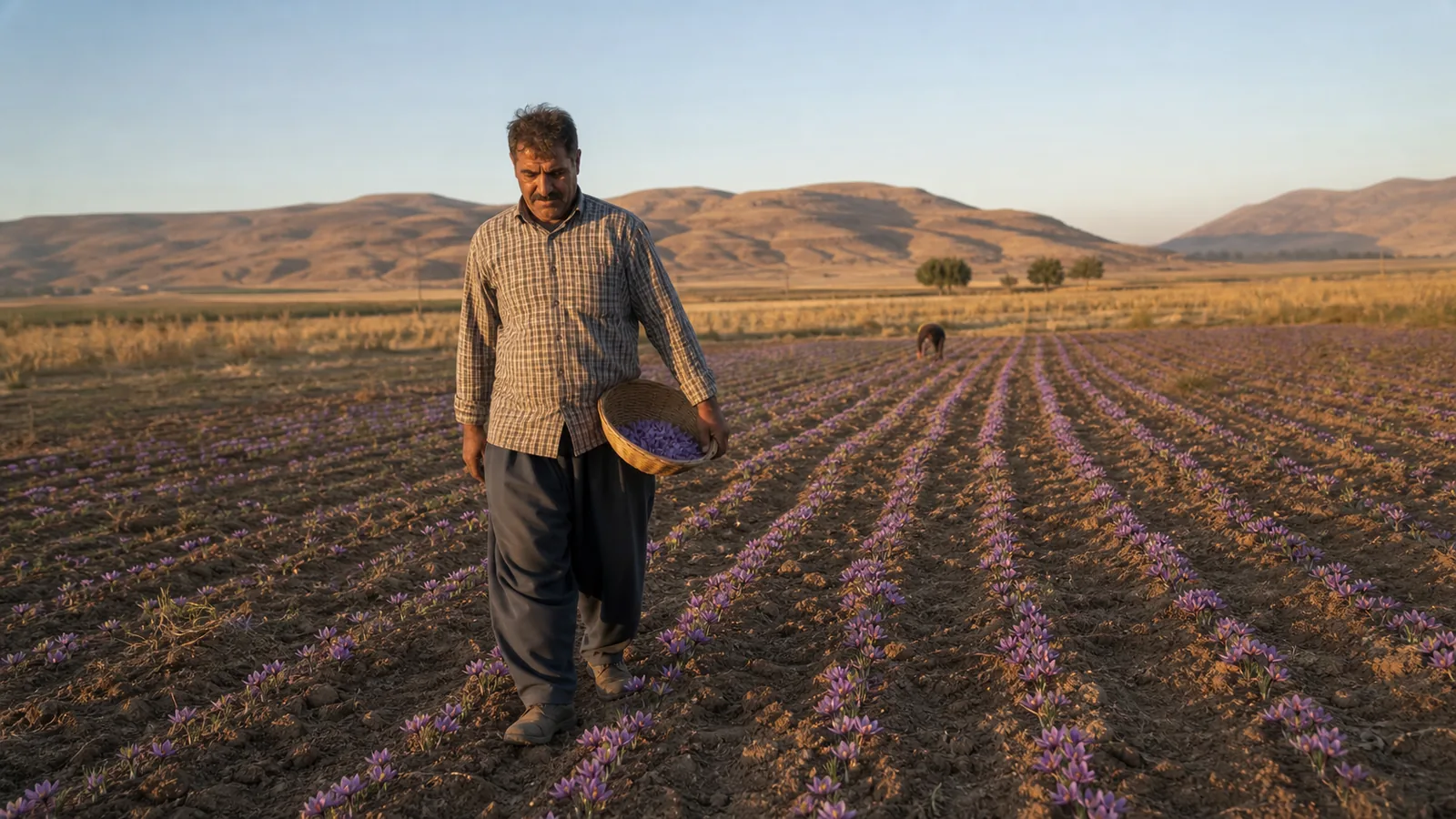
The headline figure is a per-hectare yield
The old headline is easy to misread. Khorasan Razavi did not harvest only three kilograms in a year. Naghibi was describing how much dried saffron an average hectare produced across a very large provincial cultivation area.
A provincial average also does not mean every field produced between 3.5 and 4 kilograms. Field age, corm density, irrigation, salinity, soil, weather, plant health, flower picking and drying all influence the saleable dry weight.
The distinction between an average and a farm result is important. A high-performing plot cannot be used to represent 84,000 hectares, and a province-wide average cannot predict the yield of a newly established field.
How 84,000 hectares relates to 280–300 tonnes
Naghibi said about 84,000 hectares in Khorasan Razavi were under saffron cultivation. He also said the province held roughly 80 percent of Iran’s saffron area at the time.
Multiplying 84,000 hectares by 3.5 kilograms gives 294 tonnes. At four kilograms per hectare, the result is 336 tonnes. The announced 280–300-tonne range therefore aligns with the lower end of the stated yield range but not the upper end if every planted hectare is treated as productive.
That does not necessarily make the report contradictory. Total planted area may include young or temporarily unproductive fields, while the yield figure may be rounded or calculated from a different denominator. The archived announcement provides no field-age split or calculation method, so the figures should remain approximate.
Earlier official reports show why dates matter
Khorasan Razavi’s saffron area changed quickly during this period. An official 2016 cultivation-area report described growth from 69,000 to about 73,000 hectares and cited an average yield of 3.7 kilograms per hectare for the previous crop year.
A separate official 2017 Khorasan Razavi report put the area at about 82,000 hectares and dry production at around 260 tonnes.
Those records do not replace Naghibi’s 84,000-hectare snapshot. They show that area, yield and production belong to particular seasons. Combining figures from different years can produce an apparently precise but meaningless result.
Khorasan Razavi’s broader medicinal-plant area
The announcement was not only about saffron. Naghibi put the province’s medicinal-plant area at 19,500 hectares, separate from its much larger saffron area, and said cumin accounted for the largest share.
He described Khorasan Razavi as first in Iran for both irrigated and rainfed cumin cultivation and for the development level of medicinal plants. Those rankings are historical statements from the official, not current positions.
The apparent separation of saffron from the 19,500-hectare medicinal-plant total matters. Adding 84,000 hectares of saffron to that number without knowing the reporting categories would risk double counting or mixing two administrative definitions.
Forty to fifty cultivated plant types
Naghibi said the province cultivated about 40 to 50 kinds of medicinal plants. The translated list named cumin, “syrup seed,” fennel, rosemary and peppermint.
“Syrup seed” appears to be a machine translation of the Persian crop name esfarzeh, commonly identified in English as psyllium. Without the original transcript, the safest wording is psyllium rather than treating syrup as a plant.
The list was illustrative, not a complete inventory. It does not provide the area, production or market share of each crop, and the 40-to-50 range should not be converted into an exact species count.
Raw exports to about 50 countries
Naghibi said most of the province’s medicinal plants were exported to about 50 countries as raw products. The report does not identify the customs period, commodity codes, tonnage, value, destination list or the share processed before export.
This limits what can be concluded. “Raw” may cover dried seeds, leaves, flowers or other minimally processed materials, while customs classifications may group products differently. A country count also says nothing about how much each market purchased.
The statement is still useful as a description of the sector’s concern: much of the product was leaving with limited processing. More local cleaning, grading, extraction or packaging can retain value only when it meets buyer specifications and remains economically viable.
Medicinal plants do not all use water alike
Naghibi emphasized that irrigation needs differ by crop. He grouped cumin, psyllium and rosemary among plants with relatively low water demand or potential for rainfed cultivation, while saying other plants needed more water and were grown on smaller plots.
That is a planning principle, not a universal irrigation recipe. Water need changes with climate, soil, cultivar, growth stage, rainfall, planting density and target yield. Rosemary that survives dry conditions is not automatically producing the biomass or oil quality a buyer requires.
Saffron also needs managed soil moisture. Its relatively modest demand and cool-season growth make it suitable for water-scarce regions, but drought stress, poor irrigation timing and salinity can still reduce flowers, corm development and dry yield.
What the historical figures can safely tell us
The report captures Khorasan Razavi at a particular stage of expansion: about 84,000 saffron hectares, an official 3.5–4-kilogram yield range, approximately 280–300 tonnes of annual production, and a claimed 80 percent share of national cultivated area.
Alongside saffron, officials described 19,500 hectares of other medicinal plants, strong cumin production, dozens of cultivated plant types and raw exports reaching many markets.
None of those numbers should be treated as current without a newer record using the same definitions. The lasting point is that “more than 3 kg” was a yield measure. Keeping the unit, season and denominator attached to it is what turns an easy-to-misread headline into useful agricultural information.

![Exporting Saffron to Turkey + Price Guide [Complete 0 to 100]](https://img.rowhanisaffron.com/20260827003933/saffron-export-turkey-quality-inspection.webp)



