


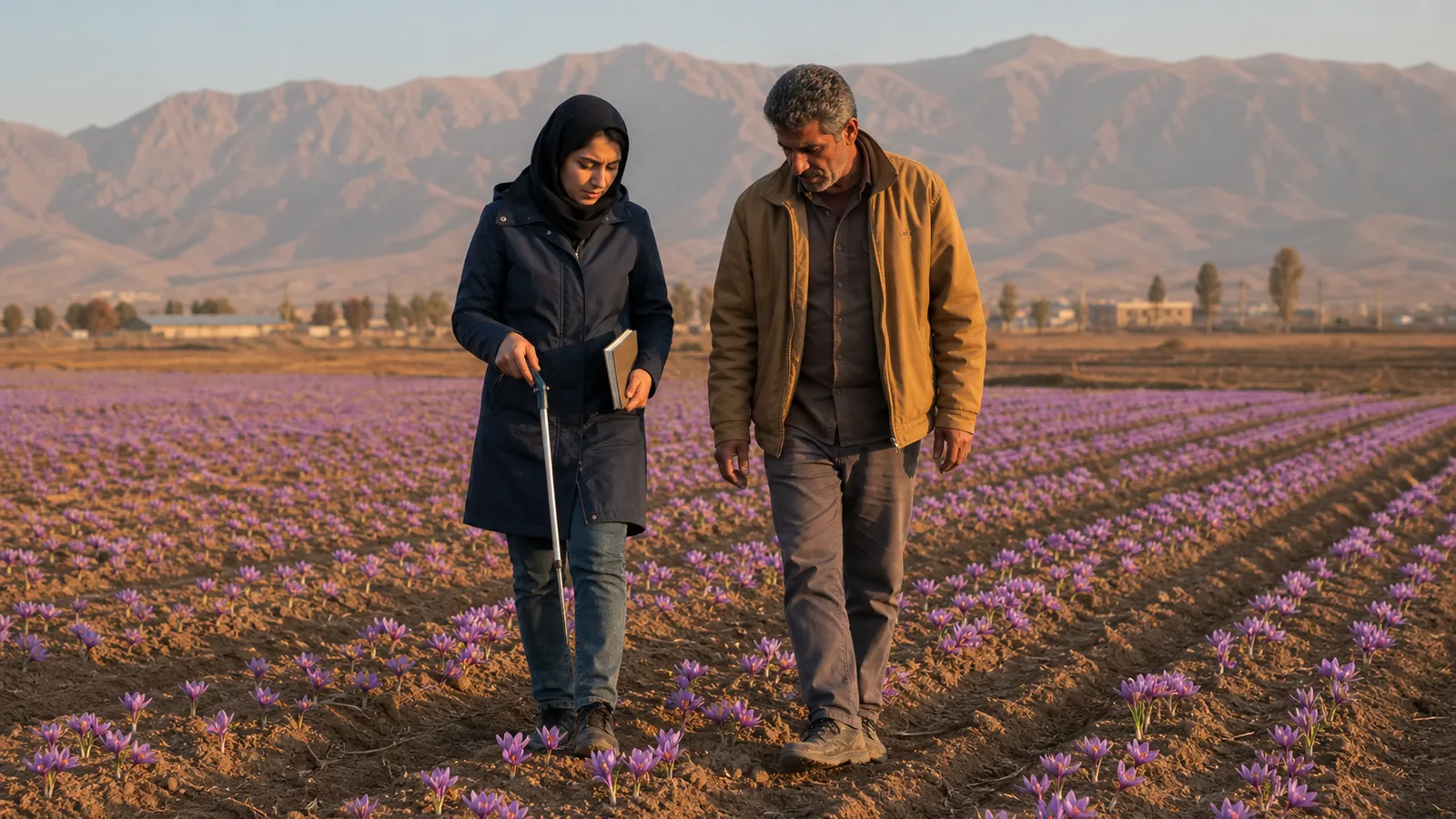
An archived agricultural report placed 42 hectares of saffron in Alborz province, with more than 30 hectares—over 70%—in Nazarabad. Local officials expected the area to more than double, citing water pressure, the crop’s perennial field life, storage and market value.
The article is a historical snapshot, not a current land survey. It does not give the reporting year or confirm whether the expansion target was reached. The URL also has an external backlink, so its exact identity, title and full Nazarabad meaning are being preserved.
How much saffron was cultivated in Alborz?
Iraj Almasi, identified as Director of Jihad-e-Agriculture in Nazarabad, said 42 hectares of provincial land had been planted with saffron in the season described. More than 30 hectares were in Nazarabad, making the city the clear centre of Alborz saffron cultivation in that report.
Using the minimum figure of 30 hectares gives 71.4% of the provincial area. Because Almasi said “more than 30,” the actual share would have been slightly higher. The article does not provide a county-by-county breakdown for the remaining area.
The plan to more than double the area
Almasi said he hoped the cultivated area would more than double in coming years. From a 42-hectare base, that would mean exceeding 84 hectares across the province. It was an ambition, not a documented later result.
An expansion decision should be based on more than area. Useful evidence includes dry stigma yield by field age, corm survival and disease, irrigation, picking labour, quality grade, production cost and the price growers actually receive. Doubling hectares without solving labour or market constraints can dilute returns.
Why water scarcity drove interest
Almasi connected saffron expansion with Iran’s water crisis and the crop’s comparatively low water demand. Saffron can fit dryland strategies because it is dormant through much of summer and active in cooler months. The FAO’s account of Gonabad’s qanat-based saffron system likewise describes a crop requiring relatively little water in a severely water-scarce region.
Relatively little does not mean none. Iranian field research found that providing only half the crop’s water requirement reduced later flower and stigma yield. Alborz growers still need suitable irrigation timing, water quality and well-drained soil.
One planting can support several harvests
The report says saffron can be harvested for up to seven years from one planting. That is possible in Iran’s perennial system because daughter corms replace the mother corm and continue the stand.
Seven years is not guaranteed. Field life depends on initial corm health, planting density, nutrition, drainage, weed and rodent pressure, disease and crowding. A field should be assessed annually; declining yield or rising corm problems may justify lifting it earlier.
Planting cost is therefore spread across several seasons, but eventual lifting and replanting remain part of the economic calculation.
Profitability depends on the whole production system
Almasi cited product price and high profitability as reasons the crop could occupy more land. Saffron’s high value per unit weight can reduce transport and storage pressure, but gross price is not net return.
- Healthy, sufficiently large corms are expensive at establishment.
- Flowers must be picked quickly during a short season.
- Stigmas need prompt, hygienic separation and controlled drying.
- Quality and authenticity affect the price a lot can earn.
- Packaging, testing, finance and marketing add further cost.
A realistic farm budget should use local labour and sale records rather than the general reputation of saffron as an expensive spice.
What was said about Nazarabad quality
Almasi described the aroma of Nazarabad saffron as a special local feature and said tests by the standards organization showed high quality. The article does not identify the laboratory, sample, year, method or result.
Aroma is associated particularly with volatile compounds including safranal, while a complete saffron assessment also considers colouring strength, bitterness-related compounds, moisture, extraneous matter and authenticity. A regional quality claim needs representative sampling and published test values; one unnamed test cannot establish that every Nazarabad lot is superior.
Storage was another attraction mentioned in the report. Dried saffron is compact and storable, but light, oxygen, heat, moisture and poor packaging can weaken quality. “Storage properties” should not be read as unlimited shelf life.
The 300-million-toman rural-development support
In Solar Hijri year 1397—mainly 2018–2019—the Nazarabad agricultural administration reportedly paid applicants more than 300 million tomans from rural-development credits identified as the Kara Fund. The stated purpose was to expand saffron cultivation.
The report does not give the number of recipients, loan-versus-grant terms, hectares financed, repayment status or later performance. It is evidence that financing was offered at the time, not that the same programme is open today.
What should be measured before further expansion?
The case for saffron cultivation in Alborz rests on a sensible idea: use a high-value perennial crop where water limits other options. The next step is a transparent production record for Nazarabad and the rest of the province.
That record should compare the original 42 hectares with later area, dry yield, quality, water used, farm cost, jobs and actual sales. It would show whether the forecast expansion became durable farmer income—and whether Nazarabad’s reported aroma is supported by repeatable quality results.

![Exporting Saffron to Turkey + Price Guide [Complete 0 to 100]](https://img.rowhanisaffron.com/20260827003933/saffron-export-turkey-quality-inspection.webp)



