


Production of 1100 kg of saffron in Golestan province was reported from a young, expanding sector centred on the mountain villages of Azadshahr. The figure makes more sense when the province’s 235 planted hectares, the age of its fields and the difference between planted and productive land are considered together.
What the 1,100-kilogram figure described
Golestan horticulture director Morteza Sadeghi said the province produced 1,100 kilograms of saffron in the reported season, up from 980 kilograms in the Iranian year 1395, which overlaps 2016 and 2017.
These are historical figures, not a current production estimate. The announcement did not give a publication date for the underlying crop survey, a harvest methodology or a district-by-district breakdown. It is therefore safest to read 1,100 kilograms as the official’s rounded provincial total for that season.
Sadeghi also described a plan to expand Golestan’s saffron area to 400 hectares by the end of Iran’s Sixth Development Plan. That was a policy target rather than proof that 400 hectares were eventually planted or became productive.
Why 235 hectares does not give a simple yield calculation
About 235 hectares were said to be under saffron cultivation. Of that area, 65 to 70 percent consisted of fields more than three or four years old. The remaining fields were in their first or second year and, according to Sadeghi, had not yet reached production.
Dividing 1,100 kilograms by all 235 planted hectares gives about 4.7 kilograms per hectare. That result is not directly comparable with the official’s stated average yield of eight kilograms, because the total area included young fields that were not producing.
If 65 to 70 percent of the planted area is treated as mature, the implied productive area is roughly 153 to 165 hectares. Dividing the reported crop by that range gives about 6.7 to 7.2 kilograms per productive hectare. The calculation is only a sense check: “older than three to four years” is not a precise productive-area definition, and the report does not say which fields were included in the eight-kilogram average.
Modern field research also shows why a single average needs context. A multi-region study of saffron yield found that field age, temperature, soil properties, irrigation frequency and the length of the growing period all influenced dry-stigma yield. The study observed rising average yields through roughly the sixth or seventh year before a decline in older fields.
The reported cultivation area was concentrated in Azadshahr
Sadeghi identified four mountain villages in Azadshahr County as the main supported production area: Wamnan, Kashidar, Sibchal and Narab. Saffron was not yet being promoted province-wide under the same programme.
Experimental plots had also been established at Shahkuh, Chaharbagh and Maraveh Tappeh. The official said expansion in those places would depend on suitable trial results and coordination with the agriculture ministry. That distinction matters. An experimental planting shows that a location is being tested; it does not establish commercial suitability on its own.
An Azadshahr climate-suitability study indexed by FAO AGRIS likewise evaluated local temperature, rainfall, humidity and elevation before identifying suitable areas. Site selection should still be made at field level because drainage, soil condition, water quality and local frost exposure can vary within a district.
Eight kilograms per hectare was an average, not a promise
Sadeghi put Golestan’s average saffron yield at eight kilograms per hectare, about two kilograms above the national average cited in the announcement. He said individual farms had reached 20 kilograms per hectare.
The 20-kilogram result should be treated as a reported farm outcome, not as a normal target for a new grower. It is not accompanied by a named farm, measured plot size, field age, sampling method or laboratory record. A strong result from one established field cannot safely be projected across all soils and seasons.
Field maturity provides part of the explanation for variation. Saffron is propagated through corms, and the number and condition of daughter corms change as a stand develops. Weather, irrigation, planting density, weeds, nutrition, flower collection and drying practice also affect how much saleable dried stigma remains at the end.
What the quality claim does and does not establish
The official described Golestan saffron as a healthy product grown without “toxins.” In agricultural context, that translation appears to refer to pesticide use rather than the literal absence of every toxic substance. The claim should not be converted into “organic,” “chemical-free” or “residue-free” without certification and residue-test results.
Sadeghi also said tests at reputable laboratories in Khorasan Razavi placed the province’s saffron among the country’s best for quality indicators. No laboratory, sample set, test date, certificate or measured ISO characteristic was named. The statement records an official assessment, but it does not let a buyer verify colour strength, aroma, moisture, foreign matter or residue status for a particular batch.
For commercial saffron, quality belongs to the lot being sold. Current documentation, representative sampling and traceable processing are more useful than applying a province-wide description to every producer.
Wamnan’s cooperative supported local processing
The report linked saffron cultivation with four direct jobs per hectare. As with the yield figures, it did not define whether those positions were full-time equivalents, seasonal harvest jobs or a headcount across planting, picking and processing. The number is best kept as the official’s historical estimate.
Wamnan’s saffron-growers’ cooperative was said to have operated since the Iranian year 1392, approximately 2013–2014. It provided local processing and drying capacity and supported a provincial brand. This addressed a practical weakness identified in earlier research on the village: growers needed infrastructure, drying equipment, labour and access to markets.
A study of 110 experienced Wamnan growers found that farmers valued saffron’s climate resilience and economics, while reporting those same infrastructure and market constraints. The findings explain why a cooperative dryer could matter as much as adding hectares. Prompt, controlled handling after picking protects the delicate stigmas and produces a more consistent dry product.
Healthy corms were central to the expansion plan
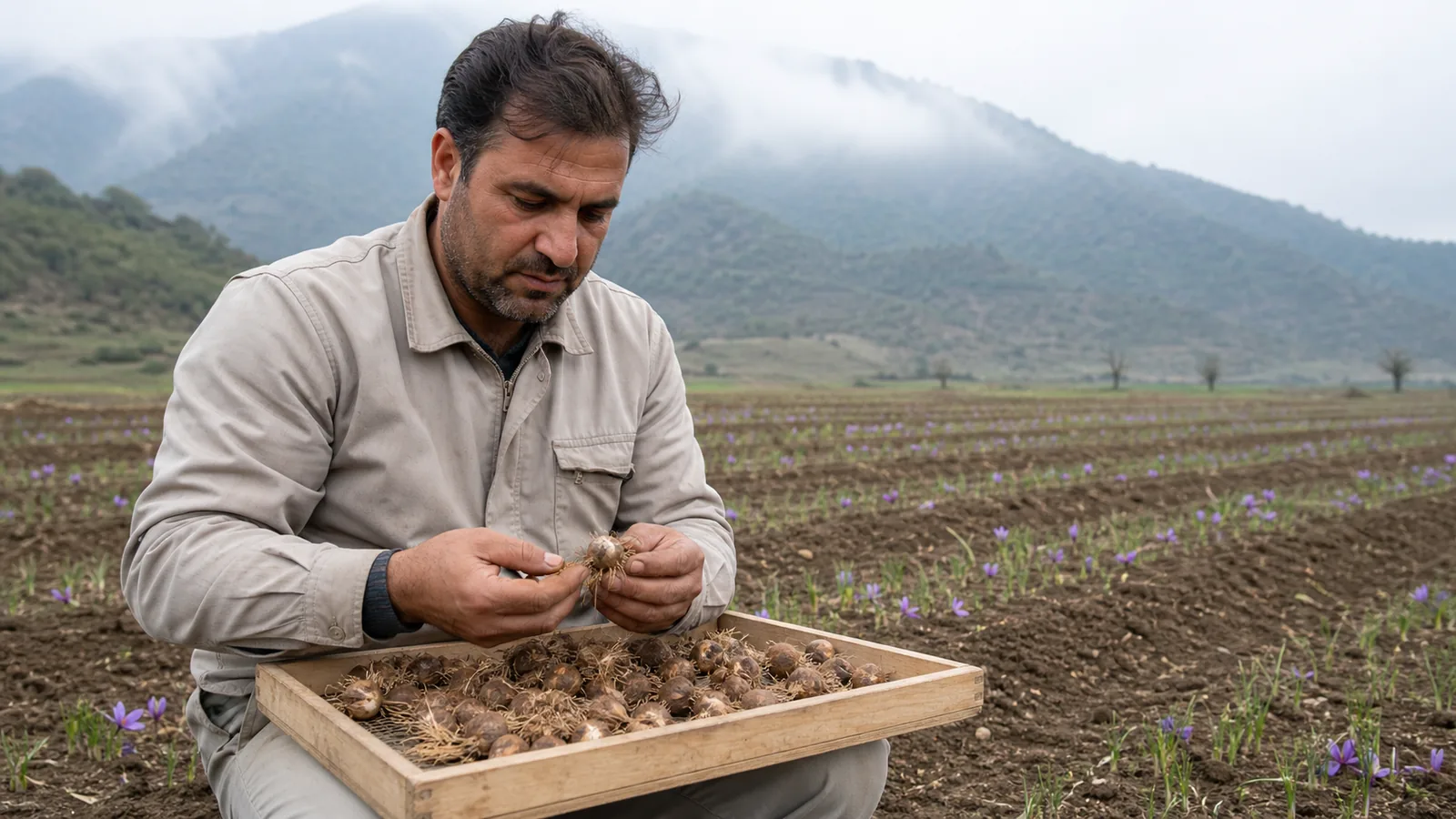
Sadeghi advised new growers to obtain saffron corms from local fields known to be free from fungal infection. He warned against unexamined movement of corms from North Khorasan, Razavi Khorasan and other provinces because corms and attached soil can carry field problems into a new production area.
The useful principle is plant-health screening, not a claim that every corm from another province is contaminated. A sound purchasing decision considers the supplier’s field history, corm firmness and health, freedom from visible rot or injury, and any local phytosanitary requirements. Soil should not be moved casually between farms.
Local sourcing can reduce one route of introduction, but geography alone is not a guarantee. An infected local field remains a poor source. Clean planting material, suitable drainage, careful storage and inspection before planting are essential wherever the corms originate.
How to read Golestan’s historical saffron report
The announcement records a province in the early stages of building a saffron sector: 1,100 kilograms of production, 235 planted hectares, a majority of maturing fields, trials beyond the established Azadshahr villages and a 400-hectare expansion target.
Its most useful lesson is that production totals, planted area and yield do not share the same denominator automatically. Young fields explain some of the gap, while farm age and management explain why individual results vary. The quality and employment statements also need their original attribution and limits.
Golestan’s longer-term case rests on more than a headline harvest. Locally suitable sites, healthy corms, careful field management, verifiable lot quality and reliable drying and marketing determine whether an experimental crop becomes a durable rural business.

![Exporting Saffron to Turkey + Price Guide [Complete 0 to 100]](https://img.rowhanisaffron.com/20260827003933/saffron-export-turkey-quality-inspection.webp)



