


Increasing the area under saffron cultivation in Rafsanjan was presented as a way to diversify farming in a dry part of Kerman Province. An early report said the city’s planted area had risen from 10 to 35 hectares in two years, while also making ambitious claims about water value, harvest labour and room for further expansion.
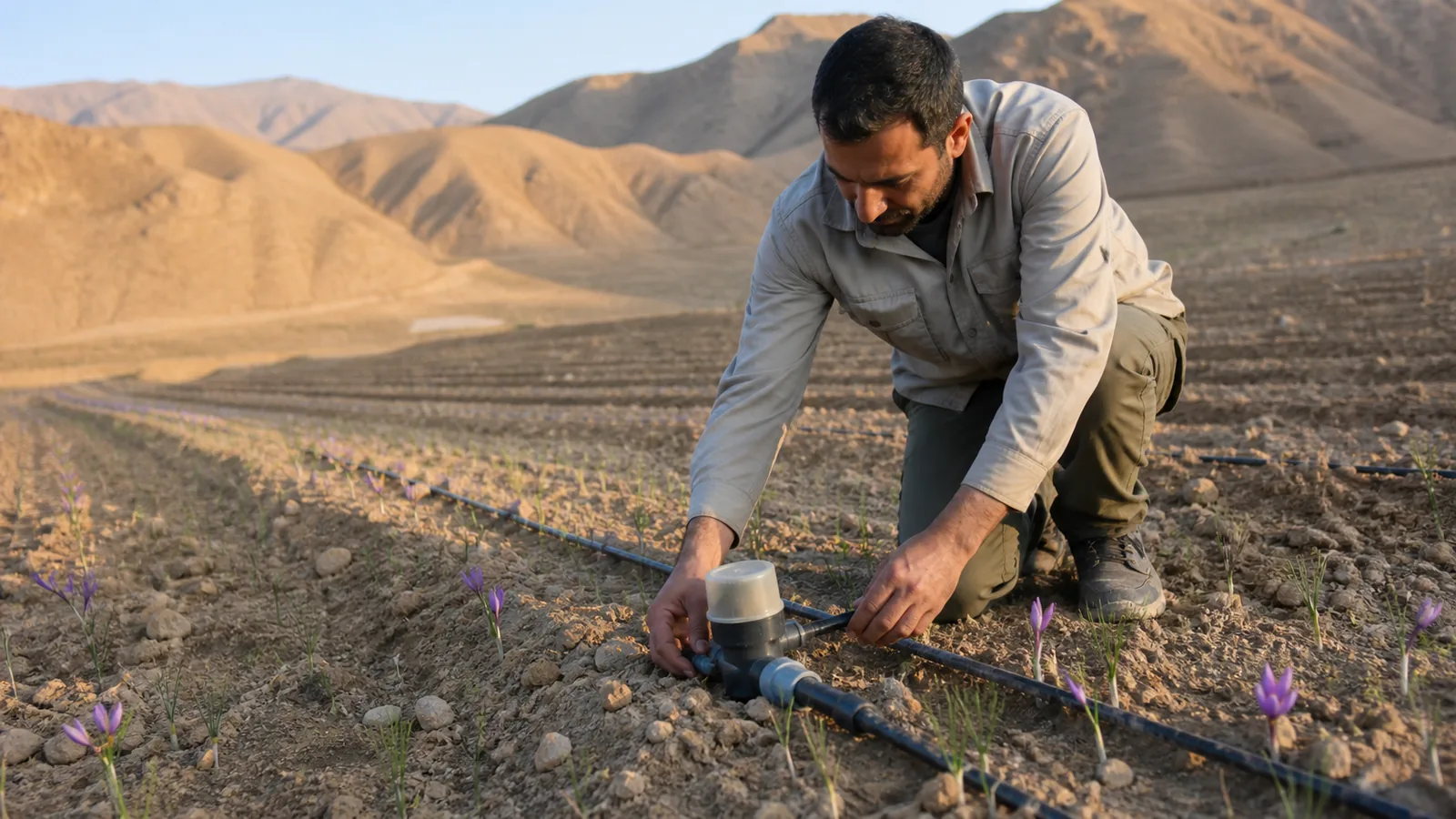
From 10 hectares to 35 hectares in two years
Hossein Rezaei, then director of Rafsanjan Agricultural Jihad, said the local saffron area had grown from 10 hectares to 35 hectares over the preceding two years. That is an increase of 25 hectares and makes the final area 3.5 times the starting area.
The same announcement said the area was nearly 20 percent higher than in the previous year. These figures can fit together only if they describe different comparison periods. A 20 percent rise to 35 hectares implies a previous-year area of roughly 29 hectares, whereas the 10-hectare figure belongs two years earlier.
The report does not provide annual records or exact survey dates, so this remains a plausible reading rather than a reconstructed time series. It would be misleading to call the full rise from 10 to 35 hectares a 20 percent increase; mathematically, it is 250 percent growth relative to the starting area.
Later official reporting recorded 40 hectares
A later 2017 report from Iran’s Agricultural News Agency put Rafsanjan’s saffron area at 40 hectares. It said about 60 percent was in Raviz, the district’s earliest established production area.
The same official source named Khenaman and Sarcheshmeh as other cultivation areas, and described Davaran and nearby villages as potentially suitable. It also reported an average dry-saffron yield of 12 kilograms per hectare in Raviz, compared with a six-kilogram national average cited at the time.
That yield is a dated local average, not a guaranteed result for every new plot. Raviz’s colder mountain conditions differ from the lower, warmer parts of Rafsanjan. Field age, planting material, soil, drainage, water quality, irrigation timing and harvest practice can all move the result substantially.
Why saffron was proposed as an alternative crop
Rezaei described saffron as an alternative, relatively low-water crop for Rafsanjan. The logic was diversification: a farmer in a suitable cooler area could add a high-value autumn crop without relying entirely on the region’s dominant orchards.
“Low water” does not mean no water. Saffron needs well-timed irrigation, particularly around the start of its autumn growing cycle, and its corms can be damaged by waterlogging. A field can be unsuitable because of salinity, poor drainage, warm autumn conditions or unreliable water even when the annual volume looks modest.
A multi-region field study of saffron yield and water use recorded total irrigation volumes ranging from about 3,650 to 5,780 cubic metres per hectare across the Iranian sites it examined. Yield was more closely associated with irrigation frequency than total volume in that particular dataset. The result supports careful scheduling; it is not a universal prescription for Rafsanjan.
Understanding the 4,500-cubic-metre estimate
The Rafsanjan announcement assigned saffron an annual water requirement of 4,500 cubic metres per hectare. That number sits within the range observed in the later multi-region study, but a single planning figure cannot replace a local irrigation plan.
Rezaei also said the crop was valued at three dollars per cubic metre of water. The wording appears to describe the economic output attributed to water, not the price a farmer paid for each cubic metre. The article gives no saffron price, yield, exchange rate, irrigation measurement or calculation method with which to reproduce the value.
At 4,500 cubic metres, three dollars of output per cubic metre would imply US$13,500 of gross crop value per hectare. That is arithmetic, not a profit forecast. Corms, land preparation, labour, drying, grading, rejected material, finance and marketing still have to be paid for, and both yield and saffron price vary.
Water productivity should also be compared on the same basis. Gross revenue per cubic metre, net return per cubic metre and physical yield per cubic metre answer different questions. A grower needs the measure that fits the decision being made.
Harvest labour is intensive but highly seasonal
The original report said 180 to 200 workers were used to harvest flowers from each hectare. Taken literally as permanent jobs, that would be implausible. It more likely refers to seasonal labour inputs, worker attendances or worker-days during the short flowering period, but the unit is not defined.
Saffron flowers need to be picked promptly and the red stigmas separated soon afterward. A productive field can therefore require many hands for several concentrated mornings even though it employs far fewer people across the whole year.
Field maturity matters here as well. A newly planted hectare with few flowers will not need the same harvest crew as a mature, high-yielding stand. Labour plans should be based on expected daily flower volume, picking time, stigma separation capacity and drying space rather than a headline number.
What “ten times more capacity” would mean
Rezaei said Rafsanjan had capacity to expand its saffron area at least tenfold. If the baseline was 35 hectares, that points to 350 hectares or more. It was a development estimate, not evidence that this area had been mapped, planted or supplied with suitable water.
Expansion on that scale would need field-level screening. Suitable altitude and autumn temperature are only the beginning. Growers also need healthy corms, appropriate soil texture and drainage, dependable water, trained seasonal labour, drying facilities, lot testing and buyers for the additional crop.
Market capacity matters because saffron stores well but is not immune to quality loss. Poor drying, moisture, mixed grades or weak traceability can reduce the value of a larger harvest. More hectares are useful only when production and post-harvest systems grow with them.
Where cultivation was most credible
The later official report strengthens the case for Rafsanjan’s mountain districts rather than the entire county. Raviz already had the greatest concentration and a reported 12-kilogram average. Khenaman and Sarcheshmeh had established cultivation, while Davaran and surrounding villages were described as suitable prospects.
Even within these areas, one successful farm does not qualify every neighbouring plot. Saffron remains in the same ground for several years, so a poor choice of drainage, contaminated corms or unsuitable soil is expensive to correct after planting.
A cautious development programme starts with soil and water testing, local climate records and a manageable trial area. Results should be recorded by field age and dried-stigma weight. Only then can a farmer compare saffron fairly with pistachios, almonds or other alternatives.
What the Rafsanjan figures tell us
The early report captured genuine momentum: saffron cultivation in Rafsanjan grew from 10 to 35 hectares, and a later official account recorded 40 hectares. Raviz emerged as the main centre, with smaller areas elsewhere in the cooler parts of the county.
Its headline numbers need their units and dates. The 20 percent figure describes a shorter comparison than the full two-year increase; 4,500 cubic metres is a planning estimate, not a fixed requirement; three dollars per cubic metre is an unexplained economic value; and 180 to 200 workers most likely describes seasonal labour rather than permanent jobs.
Rafsanjan can support more saffron where the field conditions, water, labour and market are right. The safest measure of progress is not planted area alone, but consistent dry yield, efficient water use, sound corm health and a saleable, traceable product.

![Exporting Saffron to Turkey + Price Guide [Complete 0 to 100]](https://img.rowhanisaffron.com/20260827003933/saffron-export-turkey-quality-inspection.webp)



