


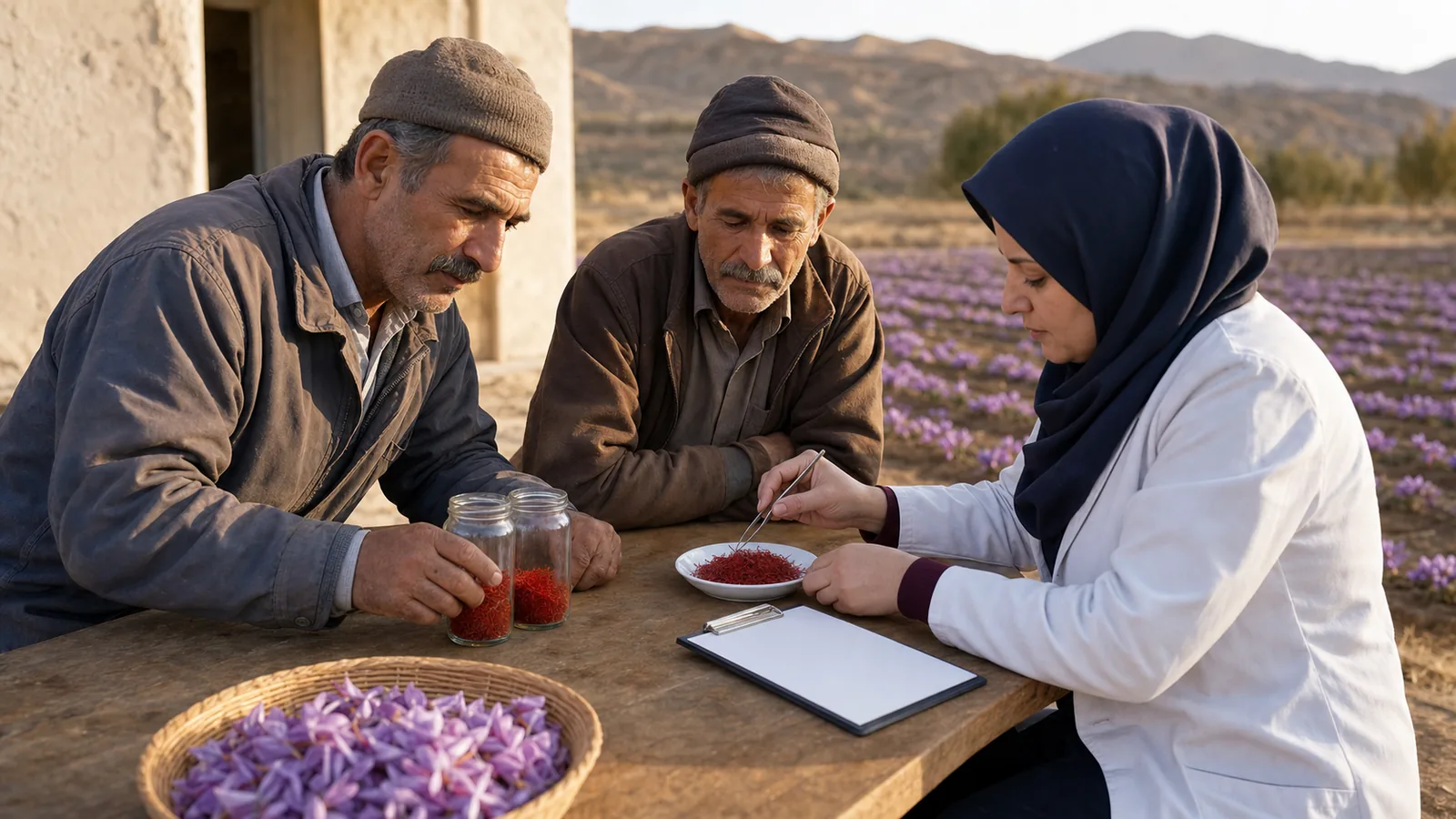
The call to compile a Ghaenat saffron ID card was a call to define the product behind the place name: where it comes from, which standards it follows, and who may legitimately market saffron under Ghaenat’s reputation. The original report connected that identity to local farming, processing, quality control, and export rather than treating “Ghaenat” as a promotional phrase alone.
A second report from the same area broadened the idea. It argued that cultivation and value-adding industry should remain connected in South Khorasan, with permanent institutions supporting saffron and barberry. Some proposals were aspirations at the time. One major point, however, can now be checked against an official record: Ghayenat saffron subsequently appeared in WIPO’s international register of appellations of origin.
What the Ghaenat saffron ID card was meant to do
Farhad Falahati, then representing Ghaen and Zirkuh in parliament, said an identity card could help prevent misuse of the Ghaenat name. He also referred to a comprehensive saffron document at the Ministry of Agriculture Jihad and argued that its provisions should be applied locally.
In practical terms, a product identity document can bring scattered requirements into one specification. It may describe the production area, eligible producers, cultivation and harvest practices, post-harvest handling, quality measurements, packaging, traceability, and the controls needed before a geographic name is used. The archived article does not reproduce the proposed document, so it cannot establish which of those items were formally adopted.
Falahati’s position was not that saffron could only be grown in Ghaenat. He explicitly said cultivation elsewhere was not the objection. The claim was that Ghaenat had a quality reputation worth defining and protecting.
The geographic name later received formal recognition
The old article speaks about an identity card that “should” be compiled, while its assigned source says a world saffron brand “can” be registered. Those future-tense statements need a dated update.
WIPO’s official Lisbon System bulletin records “Iran’s Ghayenat saffron” as appellation of origin registration No. 1118, registered on June 19, 2018. The record identifies Ghayenat County as the production area and cites Iranian geographical-indication protection dated July 27, 2016.
This does not prove that every administrative proposal in the two news reports was completed. Nor is an appellation of origin identical to an informal “ID card.” It does show that the core idea—linking the Ghayenat name to saffron originating in a defined place—moved beyond a festival speech into a formal registration record.
Why origin protection is more than a logo
The World Intellectual Property Organization explains that a geographical indication connects a product’s origin with qualities, characteristics, or reputation attributable to that place. Authorized users can prevent use by products that do not meet the applicable requirements in jurisdictions where protection applies.
That makes consistent rules essential. A protected name loses commercial meaning if buyers cannot tell which farms, processors, tests, and records stand behind it. A logo or certificate can communicate the system, but it cannot replace the system.
Geographic origin also does not guarantee that every batch has the same grade. Buyers still need accurate batch information and appropriate quality testing. Our guide to saffron grades explains why color, aroma, taste, purity, moisture, and laboratory measurements should be considered separately from origin.
The production figures were a historical local snapshot
Mohammad Karimi, identified in the destination report as governor of Ghaen, described 22 tonnes of dried saffron from 5,300 hectares and 7,000 tonnes of dried barberry from 6,200 hectares in the county. He also cited 25,000 job opportunities, 15 processing units, and three export units.
These figures help explain the proposal’s economic weight, but the stored article gives no statistical year or underlying dataset. They should therefore be read as numbers attributed to Karimi at that event, not as current production or employment totals.
The same caution applies to the report’s claim that Iran then supplied 90–93% of world saffron and 95% of world barberry. A current official FAO account places Iran’s share of global saffron production at 85–90%. Different years, crop estimates, and methods can produce different shares; the archived percentages should not be silently updated or combined.
Keep cultivation and value addition connected
Javad Heravi’s remarks in the assigned source added an important condition to the branding argument: cultivation alone would not capture the full value. He said processing and related industry should also be developed in South Khorasan so that the region benefits from more than the sale of an unprocessed crop.
Karimi made a similar point. He called for coordination among producers, processors, and exporters and for affordable harvest-time finance for cooperatives and processing units. His warning about large saffron and barberry markets needing management was an argument for stable institutions and working capital, not evidence that a government-controlled market is the only viable model.
A place-based identity is stronger when quality survives every step: picking flowers promptly, separating stigmas cleanly, drying under controlled conditions, protecting the spice from moisture and contamination, testing it, and packing it so the batch can be traced. Otherwise, local origin may be genuine while the delivered quality is inconsistent.
The proposed secretariats were intended to provide continuity
Heravi reported that the Minister of Agriculture Jihad had agreed to establish a permanent saffron secretariat in Ghaenat, which he described as the capital of saffron. He also expressed hope that a scientific, permanent barberry secretariat would be created in Zirkuh.
The source gives no opening date, governance structure, or later status for either body. These points should remain attributed proposals rather than be presented as current institutions. Their intended role is still clear: research, standards, industry coordination, and promotion need work between festivals, not only during them.
The report also referred to reorganizing sites around Ghaen and using suitable public-facing spaces to present native saffron and barberry products. Its English wording is ambiguous, and it does not document implementation. The useful principle is to make regional products visible without confusing a display project with origin protection or quality assurance.
Quality evidence must support the regional reputation
Heravi warned that higher production should not weaken the qualitative approach. That concern is now especially relevant because origin fraud, adulteration, and uneven post-harvest handling can all damage trust in a regional name.
FAO’s current work with Iranian institutions focuses on authenticity, transparent value chains, and better post-harvest control. Its 2025 authenticity-testing initiative notes that commonly referenced ISO 3632 tests do not detect every subtle quality difference or sophisticated form of adulteration. It combines chemical fingerprinting with practical guidance for preserving color, flavor, and aroma.
For a Ghaenat saffron ID card to be useful to buyers, it should therefore be backed by evidence they can verify: a defined origin, producer or lot identification, test results suited to the claim, post-harvest records, and truthful packaging. The strength lies in traceability and consistent practice, not in repeating superlatives.
Saffron and barberry share a regional story, not one specification
Both archived reports discuss saffron and barberry because they are central crops in South Khorasan. Heravi argued that each could support regional branding, while Karimi linked both to jobs, processing, and exports.
They should still be handled as separate products. Each needs its own production area, product definition, quality criteria, tests, and authorized users. A barberry scientific secretariat could complement a saffron institution, but one crop’s reputation cannot serve as evidence for the other’s quality.
What the identity-card proposal means today
The strongest part of the original proposal has aged well: a respected place name needs a clear product definition and enforceable standards. WIPO’s registration confirms formal recognition for Iran’s Ghayenat saffron, while the local reports preserve the reasons producers and officials pursued it.
The next measure of success is not another slogan. It is whether growers, processors, exporters, and customers can follow a transparent chain from a Ghaenat field to a properly identified batch. Research, testing, careful handling, finance, and honest labeling all contribute to that result.
For customers, the sensible approach is to use origin as one meaningful signal and then check the product itself. Our guide to buying high-quality saffron covers the practical signs and records that should accompany a reputable name.

![Exporting Saffron to Turkey + Price Guide [Complete 0 to 100]](https://img.rowhanisaffron.com/20260827003933/saffron-export-turkey-quality-inspection.webp)



