


Mojtaba Taheri’s route into saffron cultivation in Malayer began with research and a 1,000-square-metre trial—not a large commercial planting. His first autumn flowers gave him the confidence to expand, produce mother corms and share what he learned with other farmers. His practical concern was rodent damage.
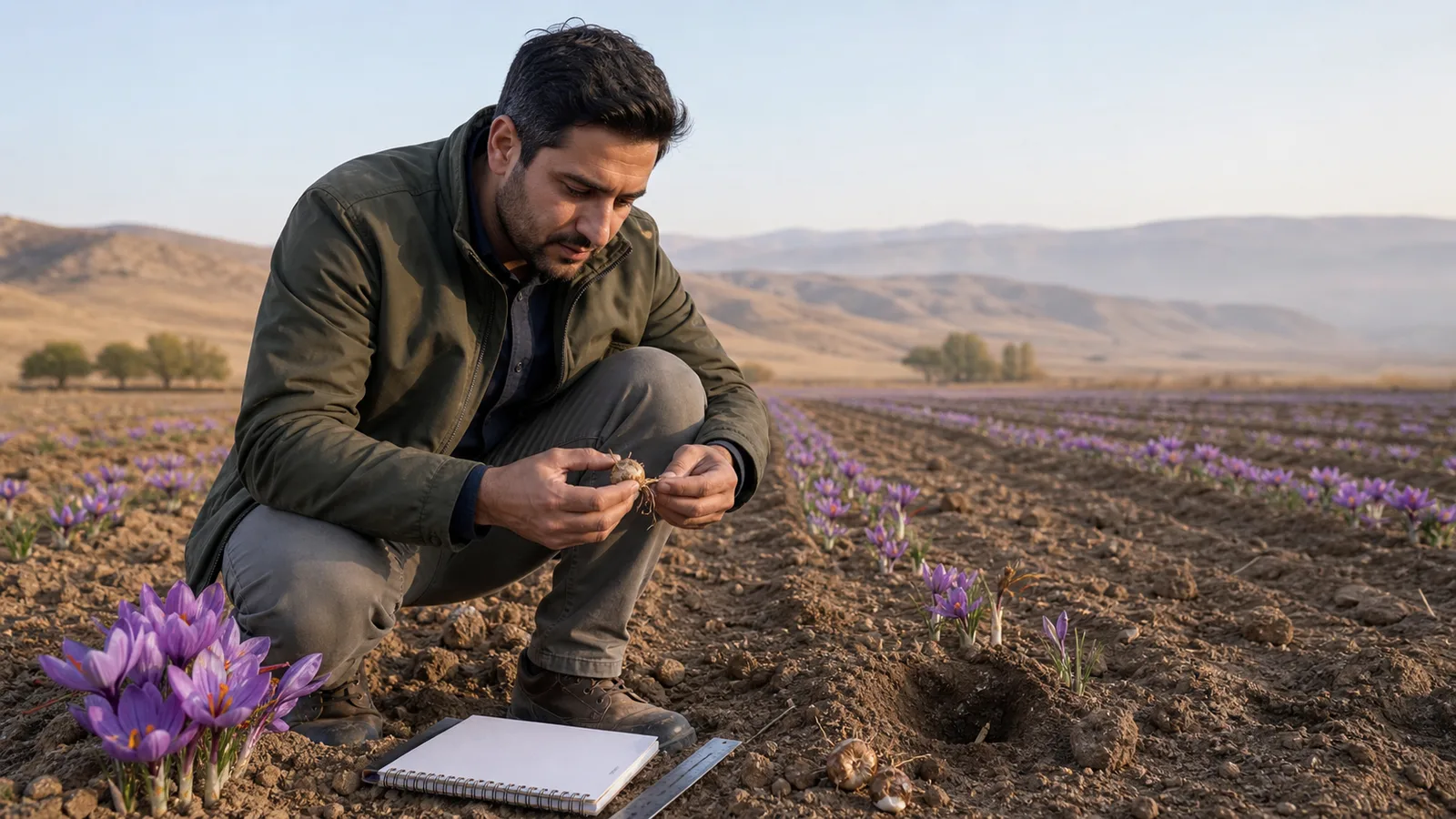
The archived profile called him a “successful saffron producer in Malayer” and said he wanted to pass his experience to interested growers. It did not report his yield, revenue, costs or current cultivated area, so success here means that the trial flowered and led to further cultivation—not that the article proves a particular return.
Who is Mojtaba Taheri?
Taheri was introduced as an agriculture graduate of Gorgan University of Agricultural Sciences and Natural Resources. At the time of the interview, he said he had worked with medicinal plants in Malayer for ten years.
He placed the beginning of his saffron work in Solar Hijri year 1390, corresponding mainly to 2011–2012. He researched saffron and other low-water crops suited to local climate and geography, including some laboratory work. After one year of study, he obtained 1,000 square metres for an experimental field.
Taheri described feeling stressed at the beginning. He planted anyway, relying on his research and faith, and harvested his first saffron flowers that autumn. That result became the starting point for his attempt to develop the crop more widely.
Why the small trial was a sound first step
Saffron is often introduced as a low-water, high-value crop, but those labels do not settle whether it works on a specific farm. Corm size and health, drainage, winter temperature, summer dormancy, irrigation timing, planting density, labour and drying all influence the result.
A 1,000-square-metre plot is large enough to reveal local problems while limiting the cost of a mistake. A grower can record flowering, dry stigma yield, corm multiplication, disease, rodent damage, labour hours and water use before committing to large-scale cultivation.
Taheri said he intended to enter large-scale production the following year. Because the article does not give the interview year or a follow-up, that remains a plan rather than a verified expansion.
Saffron’s history in Malayer
Taheri said saffron cultivation in Malayer had an ancient history and that the crop had “returned to its origin” after many years. The profile offers no archaeological, documentary or agricultural record to date that history. His statement can be preserved as local testimony, but it should not be presented as proof that Malayer was saffron’s botanical origin.
Genomic research identifies cultivated saffron as a sterile triploid lineage descended from Crocus cartwrightianus in Attica, Greece. That botanical origin is different from the long history of cultivation that many Iranian regions may hold. A place can have deep farming heritage without being the place where the plant first evolved.
From flowers to mother-corm production
After the trial produced a good result, Taheri said he promoted saffron among fellow residents. He planted several small plots according to the land available and produced what the translation calls “mother onions”—more accurately, mother corms. He reported a good corm harvest and sold the planting material.
This is an important second enterprise alongside stigma production. Cultivated saffron is sterile and propagates vegetatively through daughter corms. Healthy, well-sized planting material can carry value, but it also carries responsibility: sellers should avoid damaged or diseased corms and keep origin and field-health records where possible.
A recent study found that physical injury can be the primary trigger for saffron corm rot, with pathogens entering damaged tissue. Careful lifting, sorting, transport and storage therefore matter as much as the number of corms produced.
The concern: mice and other field rodents
Taheri said his only major problem was “fighting mice.” He found a solution and shared it with other farmers, who were satisfied. The article does not identify the animal, describe the damage or explain his method. Repeating an unknown control technique would be unsafe, especially if it involved poison.
The first step in a modern response is identification. Mice, voles and other burrowing animals leave different runways, openings, droppings and feeding damage. Control should match the target species, field conditions and current Iranian law.
The University of California’s integrated-pest guidance for voles starts with monitoring active runways, burrows, droppings and clipped vegetation. It recommends reducing dense weeds and ground cover that provide shelter, then using exclusion or trapping where appropriate. Its pesticide rules are specific to California and cannot be transferred directly to an Iranian saffron field.
A safer rodent-management sequence
- Confirm the pest: map fresh burrows, runways and new corm damage before acting.
- Measure the problem: distinguish isolated signs from economically important loss.
- Reduce shelter: manage weeds and dense cover around affected plots without creating erosion or harming the crop.
- Protect non-target animals: any trap or bait station must prevent access by children, livestock, pets, birds and beneficial wildlife.
- Use legal local advice: consult the local agricultural service before any rodenticide; product registration, crop approval and application rules differ by country and change over time.
- Record the result: compare activity and crop damage before and after the intervention.
Unlabelled poisons, improvised chemical mixtures and broadcast bait can harm predators and contaminate the production environment. The absence of Taheri’s actual method is a reason to supply a decision process, not to invent his recipe.
What Malayer growers can take from the experience
Taheri’s strongest lesson is procedural. He matched a crop idea to local conditions, researched it, tested it on a manageable area, observed the first harvest and shared a field problem with peers. That sequence is more transferable than an undocumented claim of success.
A grower following it today should add records: corm source and weight, planting density, irrigation, flower and dry stigma yield, daughter-corm health, labour, pest damage and actual sale price. Those measurements show whether saffron cultivation in Malayer is merely possible or sustainably profitable.

![Exporting Saffron to Turkey + Price Guide [Complete 0 to 100]](https://img.rowhanisaffron.com/20260827003933/saffron-export-turkey-quality-inspection.webp)



