


The archived 67 kg saffron forecast in Gilan implied an average yield of about 3.05 kilograms per hectare and a gross value near 251 million rials per kilogram. Those calculations come from the report’s 22-hectare area and 16.82-billion-rial valuation. They explain the forecast; they do not turn it into a confirmed harvest or a current price.
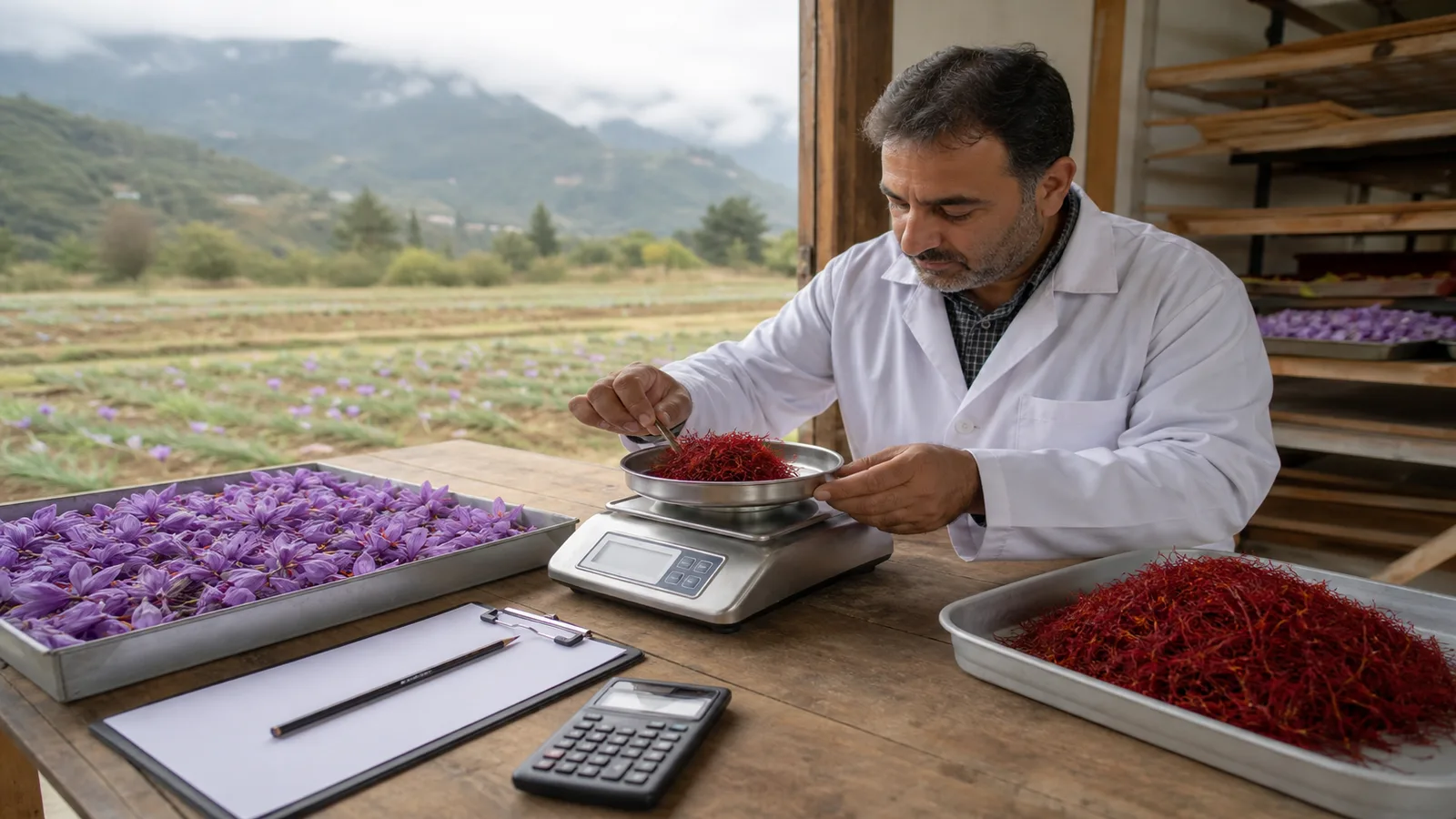
Manouchehr Parsafar, identified as Director of Horticulture at the Gilan Agricultural Jihad Organization, announced the production forecast of 67 kg of red gold—saffron—in Gilan. The archived item did not give the calendar year, final output, grade or sale records, so every commercial conclusion needs that boundary.
The forecast at a glance
- Cultivated area: 22 hectares in mountainous parts of Gilan.
- Expected dry saffron: more than 67 kilograms.
- Forecast economic value: 16 billion and 820 million rials.
- Implied average yield: roughly 3.05 kilograms per hectare.
- Implied value: roughly 251 million rials per kilogram.
- Largest producing area: Siahkal, with 14 hectares.
The last two figures are simple divisions, not separate official statistics. Actual field yield and price can vary by field age, corm size, cultivation method, grade, moisture, lot size, buyer and transaction date.
A forecast is not the final harvest
Parsafar said growers were expected to harvest more than 67 kilograms “this year.” The source supplies neither the year nor a post-harvest result. It also does not explain whether the estimate came from field sampling, past yield, planted area or grower declarations.
That missing method matters. A province-wide average can conceal new fields with low first-year output, mature productive fields and older crowded stands. Weather during flower emergence and the availability of early-morning picking labour can change the final quantity as well.
A verified result would report dried stigma weight after the season, not merely flower weight or an estimate made when picking began. It would also identify the area that actually flowered.
What does 16.82 billion rials represent?
The report calls 16.82 billion rials the crop’s economic value. At 67 kilograms, that works out to about 251 million rials per kilogram. The text does not state whether this is an expected farm-gate price, wholesale value or another estimate.
Gross value is not farmer profit. Corms, land preparation, irrigation, weed and pest management, harvest labour, stigma separation, drying, testing, packaging and selling all carry costs. A useful economic assessment subtracts those expenses and records the price growers actually received.
Where the 22 hectares were located
Parsafar named Siahkal, Rudbar, Amlash, Rasht, Rezvanshahr, Someh Sara and Fuman. The archived spellings “Soomehsara” and “Fooman” have been normalised here. With 14 hectares, Siahkal held nearly 64% of the total reported area.
The fields were said to lie at 1,200 to 2,300 metres above sea level. That elevation range is a useful description, but not a cultivation rule. Slope, aspect, winter cold, summer moisture, drainage, soil texture and corm health still determine whether an individual site suits the crop.
A separate account covers the beginning of the saffron harvest across Gilan’s 22 hectares and the province’s mountain-growing context. This page keeps its narrower purpose: testing what the 67-kilogram production and value forecast actually tells us.
The plan to expand cultivation
Parsafar said land with saffron-cultivation potential had been developed and that the organization planned to increase the area in coming years. The article does not give a target, budget, timetable or later result, so it cannot establish whether that expansion occurred.
Expansion is most defensible when it follows evidence from the existing 22 hectares. Before adding land, planners would want field-level records for:
- dry stigma yield and quality by field age;
- corm survival, multiplication and disease;
- irrigation water quantity and salinity;
- harvest and separation labour;
- production cost and actual sale price; and
- buyers, rejected lots and repeat orders.
More hectares create employment only if production can be harvested on time and sold at a margin. Otherwise, area expands faster than farmer income.
The 2008 starting point
Parsafar said saffron was first cultivated in Gilan in 2008. The source does not identify the first grower, site or documentary record, so this should be understood as the official’s reported start date for the province’s modern programme.
By the season described, the crop had reached seven named counties. That geographic spread shows experimentation beyond one site, while Siahkal’s concentration suggests that successful adoption was uneven.
Health claims do not belong in the valuation
The report justified saffron partly by saying consumption increases immunity, supports heart health, controls diabetes, reduces anxiety, prevents cancer and helps many other diseases. A provincial output forecast cannot substantiate those claims.
Research has tested standardised saffron preparations for particular outcomes, but findings depend on dose, formulation and population. An evidence map of 19 meta-analyses found heterogeneous results and called for better-quality reviews and larger, multi-country trials. A 2025 diabetes meta-analysis judged several observed biomarker effects not clinically important. Laboratory work on cancer does not show that eating saffron prevents cancer.
These are reasons for careful research, not disease-treatment promises. People with diabetes, heart disease, anxiety, cancer or another condition should not replace medical care with saffron.
What would confirm the 67-kilogram forecast?
A complete season report would compare forecast and actual dry saffron, explain variance, record quality grades and distinguish gross sales from net farm income. It would also show whether Siahkal’s 14 hectares performed differently from the other eight hectares.
Until that evidence is available, the production forecast of 67 kg of red gold in Gilan remains a clear snapshot of ambition: 22 highland hectares, seven counties and an expected 16.82-billion-rial crop. It should not be mistaken for a current provincial statistic.

![Exporting Saffron to Turkey + Price Guide [Complete 0 to 100]](https://img.rowhanisaffron.com/20260827003933/saffron-export-turkey-quality-inspection.webp)



