


An archived agricultural report announced the start of the saffron harvest in Gilan across 22 hectares of mountain land. It forecast more than 67 kilograms of dried saffron, valued at 16.82 billion rials, with Siahkal accounting for 14 hectares—the largest share in the province.
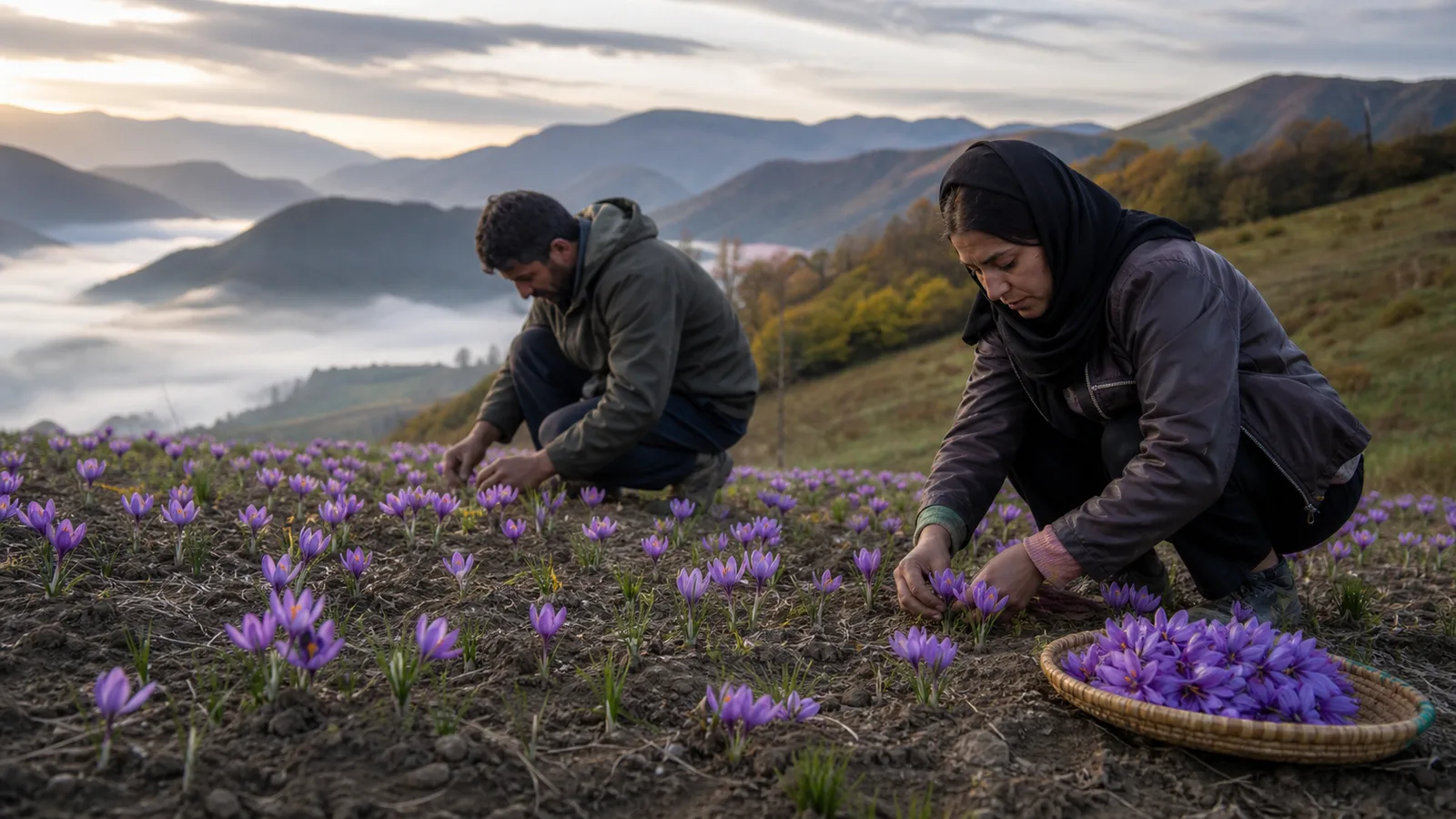
The figures describe one harvest forecast, not Gilan’s current cultivated area, production or market value. The source does not state the harvest year, although it says saffron cultivation in the province began in 2008. Keeping that time boundary prevents a useful local record from becoming a misleading present-day statistic.
Where saffron was grown in Gilan
Massoud Almasi, identified in the report as head of the Gilan Agricultural Jihad Organization, listed saffron cultivation in seven counties:
- Siahkal;
- Rudbar;
- Amlash;
- Rasht;
- Rezvanshahr;
- Someh Sara; and
- Fuman.
The archived English spellings “Soomehsara” and “Fooman” refer to Someh Sara and Fuman. Siahkal’s 14 hectares represented almost two-thirds of the reported 22-hectare provincial total, making its upland fields the centre of that harvest.
Why the crop was placed in mountain areas
The report placed Gilan’s saffron fields at elevations from 1,200 to 2,300 metres above sea level. This matters in a province better known for a humid Caspian climate: higher inland sites can differ sharply from the coastal plain in temperature, rainfall pattern, drainage and winter conditions.
Saffron needs a site that supports autumn flowering and winter leaf growth while allowing the corms to pass through summer dormancy without waterlogging. Elevation alone does not prove suitability. Aspect, soil drainage, frost, irrigation water, summer moisture and the health of planting corms must be tested field by field.
That is why Almasi’s wording was conditional: saffron could create income “if it is compatible with the conditions of the region.” A small local trial gives farmers better evidence than assuming that every mountain plot will behave like Siahkal.
What the 67-kilogram forecast implies
If more than 67 kilograms were harvested from 22 hectares, the forecast average was just over 3 kilograms of dried saffron per hectare. That arithmetic helps readers understand the scale, but it is not a confirmed yield. The source provides no final weigh-in, field-age breakdown or method used to produce the estimate.
Field age is especially important. Newly planted saffron often yields less than a mature stand, while an older crowded field can also decline. Corm size and planting density, irrigation, soil and harvest labour all affect the amount of marketable stigma produced.
The reported economic value
The report valued the expected harvest at 16 billion and 820 million rials. Dividing 16.82 billion rials by 67 kilograms gives an implied value of roughly 251 million rials per kilogram. This is only a reconstruction of the forecast. It is not a current saffron price and does not reveal grade, sale form, buyer, fees or farmer profit.
Revenue and income are also different. A grower still pays for corms, land preparation, irrigation, weeding, flower picking, rapid stigma separation, drying, packaging and sales. Saffron is light and valuable, but its harvest is intensely manual and concentrated into a short flowering period.
Can saffron create employment in Gilan?
Almasi presented saffron as an opportunity for jobs and local income. That case is strongest where the crop suits the site, families can organise labour at dawn during flowering, and the harvested stigmas can be dried and sold at a quality that justifies the cost.
A local value chain can create work beyond cultivation: corm selection, field advice, harvest coordination, hygienic separation, drying, quality testing, packing and buyer relationships. But expansion should follow measured results. More hectares do not automatically mean better farmer returns if quality or market access falls behind.
“Low water” does not mean drought-proof
The archived text uses “dehydration” where it appears to mean low water demand. Saffron can be attractive in water-constrained agriculture, but it still needs properly timed moisture. Iranian field research found that supplying only half the crop’s water requirement reduced flower and stigma yield in the second season.
The FAO’s account of the qanat-based saffron system in Gonabad likewise describes saffron as requiring relatively little water, not none. Gilan growers also face a different risk from arid producers: excess moisture and poor drainage can threaten corm health. Water management must respond to the actual upland site.
The health list in the old report needs restraint
The original article ended with a long list claiming that saffron increases immunity and blood circulation, protects the heart, controls diabetes, strengthens bones and nerves, treats inflammation, pain and stomach disorders, reduces anxiety and depression, and prevents cancer. That list goes far beyond what a harvest report can establish.
Clinical research has examined standardised saffron supplements for several outcomes. An evidence map of 19 meta-analyses found promising but heterogeneous findings and said the scientific quality of the reviews needed improvement. A newer diabetes review found some biomarker changes too small to be clinically important. Laboratory cancer research is not evidence that culinary saffron prevents cancer.
Saffron should not replace prescribed treatment for diabetes, heart disease, depression, cancer or another condition. Food use and a tested clinical preparation are not interchangeable; dose, formulation, population and medical supervision matter.
How to judge the Gilan saffron project
The start of harvest proved that saffron could flower at selected Gilan sites. A convincing long-term assessment needs final dry weight, quality grade, field age, farmer costs, labour, water use, sale price and repeat performance—not the forecast alone.
The 22 hectares, 67 kilograms and 16.82 billion rials are therefore best understood as the scale and expectation of one archived season. Their lasting value is the model they suggest: test the mountain microclimate, measure the result, protect quality and expand only where the farm economics work.

![Exporting Saffron to Turkey + Price Guide [Complete 0 to 100]](https://img.rowhanisaffron.com/20260827003933/saffron-export-turkey-quality-inspection.webp)



