


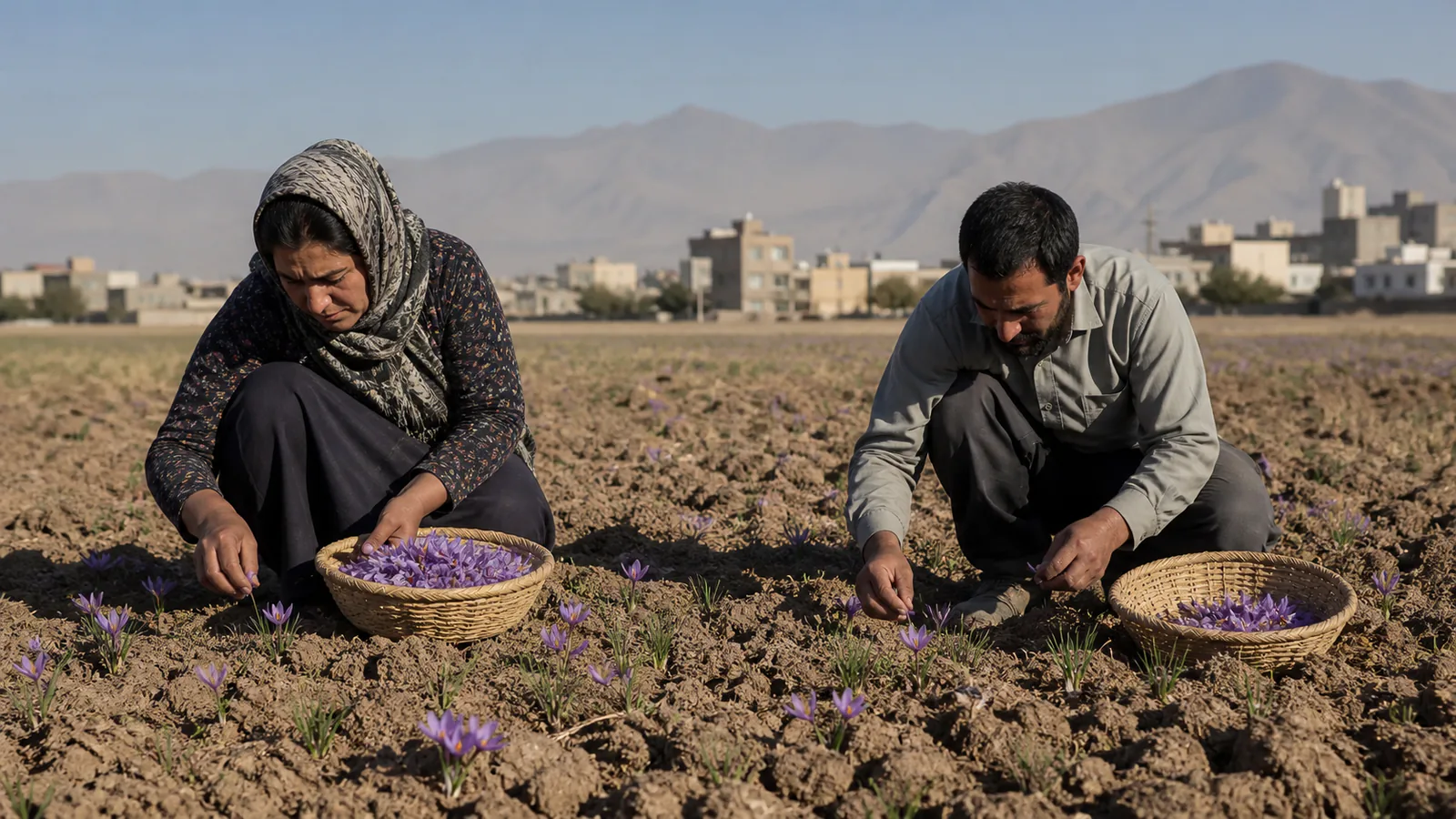
The Robat Karim saffron harvest covered a reported 100 hectares and carried a 600 kg forecast in the historical season described here. Picking was expected to start in early November and continue for about a month. A smaller account from Mianeh (spelled Miyaneh in the old URL) describes 12 hectares, an October harvest and training-led expansion in East Azerbaijan.
The two reports cover different places, seasons and scales. Their harvest windows cannot be merged into one calendar, and their quality and water claims are not laboratory or irrigation studies. This article preserves the useful local figures while separating forecasts, arithmetic and officials’ assessments.
Robat Karim’s 100-hectare harvest
Alireza Heidari, identified as director of Robat Karim Agricultural Jihad, said saffron harvesting had begun across 100 hectares. He described cultivation as increasingly popular with farmers and placed the usual local picking period from early November through roughly the next month.
The production forecast was 600 kg of dried saffron. Dividing 600 kg by 100 hectares gives an implied average of 6 kg/ha. That is valid only if all 100 hectares were bearing and the same area formed the forecast denominator. The report does not distinguish new from mature fields or provide a final weighed result.
The old article calls the forecast “pure saffron” without providing a purity test, grading record or sampling method. The final account uses the supported quantity—600 kg—without turning “pure” into a verified quality grade.
The villages named in the forecast
Heidari named farmers in Manjilabad, Yaqeh, Kikavar, Anjumabad and Peyghambar villages. The wording associates those communities with the 100-hectare programme and its expected income, but it does not allocate acreage or production among them.
No village should therefore be assigned a particular share of the 600 kg. The list is useful for local context, not for constructing a farm map or ranking communities by output.
Understanding the 120-million-toman gross-income claim
The report forecast 120 million tomans of gross income per hectare. If applied uniformly to all 100 hectares, that would imply 12 billion tomans in total gross revenue. If paired with the forecast 6 kg/ha, it would also imply 20 million tomans per kilogram.
Both calculations depend on the figures sharing the same acreage, yield, grade and sales assumptions. The source gives no transaction price, grade mix, harvest result or sales record, so they are scale checks rather than confirmed revenue.
Gross income is not profit. Corms, labour, irrigation, fertiliser, field care, flower separation, drying, packing and transport all carry costs, none of which is recorded. The historical 120-million-toman figure must not be used as a current per-hectare return or saffron price.
Water, jobs and crop replacement
Heidari promoted crops with lower water needs and linked saffron’s recent growth with economic efficiency and work for local families. This describes the policy rationale behind the programme.
The report does not provide irrigation volume, rainfall, comparison-crop water use, job count, person-days or household income. It therefore cannot establish litres saved, permanent jobs created or profitability relative to every alternative crop.
Saffron’s irrigation calendar can reduce competition with some summer crops, but local success still depends on soil drainage, water timing, corm health, frost, labour and post-harvest control. A county-wide statement is not a farm-specific plan.
Why 24,000 square metres of restored land is separate
The Robat Karim report also says authorities removed illegal construction and returned 24,000 square metres of agricultural and garden land to the agricultural cycle. That area equals 2.4 hectares.
Nothing in the text says the restored 2.4 hectares were planted with saffron or included in the 100-hectare total. The land-enforcement update is preserved as separate administrative context rather than added to the crop area.
Mianeh’s 12-hectare October harvest
In East Azerbaijan, the local agriculture office reported about 12 hectares under saffron in Mianeh. The old English spelling is “Miyaneh.” It characterised the county as one of the province’s saffron centres and said the area was increasing.
Flowering and picking were reported from early October through the end of that month. Robat Karim’s account starts roughly a month later. The reports do not share a crop year or weather record, so the difference is preserved rather than explained by an invented climate comparison.
Agricultural Jihad experts held training courses to promote cultivation. No participant count, curriculum, adoption rate or before-and-after yield is supplied, so training can be identified as part of the expansion effort but not credited with a measured increase.
Cold, drought and off-season water claims
The Mianeh account described saffron as resistant to cold and water shortage and said its irrigation need arrives when some other crops need less water. That timing was presented as a reason the crop suited local development.
“Resistant” does not mean immune. The source provides no minimum temperature, drought duration, irrigation schedule or comparison crop. Frost can still damage flowers or production, and insufficient or poorly timed water can affect corm growth and yield.
The supported conclusion is that local officials saw saffron’s seasonal water pattern as useful. The report cannot quantify water savings or guarantee performance under every cold or dry condition.
Was Mianeh saffron equal to Ghaenat saffron?
The report says Mianeh saffron matched the quality of Ghaenat saffron. It supplies no sampled lots, grade, ISO 3632 results, moisture measurement, colouring strength, aroma analysis, contaminant screen or authenticity test.
That comparison remains a local promotional claim, not a verified equivalence. A defensible comparison would require representative samples handled under comparable conditions and tested with the same methods. The South Khorasan and Qain harvest account explains why origin reputation and measured lot quality should remain separate.
What the two reports establish
- Robat Karim: 100 hectares, a 600 kg forecast and an implied 6 kg/ha if all reported land was bearing.
- The gross-income forecast was 120 million tomans per hectare, without costs or completed sales data.
- Manjilabad, Yaqeh, Kikavar, Anjumabad and Peyghambar were named, but their individual acreage and output were not.
- Mianeh: about 12 hectares, an October harvest window and training-led cultivation support.
- Mianeh’s Ghaenat-quality comparison is untested, and water/cold claims lack measured thresholds.
- Every area, output and income figure is historical and should not be treated as current.
For another emerging-area comparison, see the Damghan and small regional saffron harvests. It shows how yield, employment and local training claims should stay tied to their own place and reporting period.
Sources and reporting limits
- Historical local reports attributing the Robat Karim figures to Alireza Heidari and the Mianeh account to the city’s Agricultural Jihad public-relations office.
- FAO Iran: authenticity testing and quality integrity in the saffron value chain.
The sources lack crop-year labels, final results and common methods. Forecasts, open questions and unsupported comparisons remain visible rather than being rewritten as current facts.

![Exporting Saffron to Turkey + Price Guide [Complete 0 to 100]](https://img.rowhanisaffron.com/20260827003933/saffron-export-turkey-quality-inspection.webp)



