


Harvesting 36 tons of dried saffron from Torbat Heydariyeh farms was the result recorded in a local season report covering 8,200 hectares. The same account described frost losses, a small year-on-year increase and the concentrated labour behind the harvest. Its figures are historical snapshots, not current production estimates.
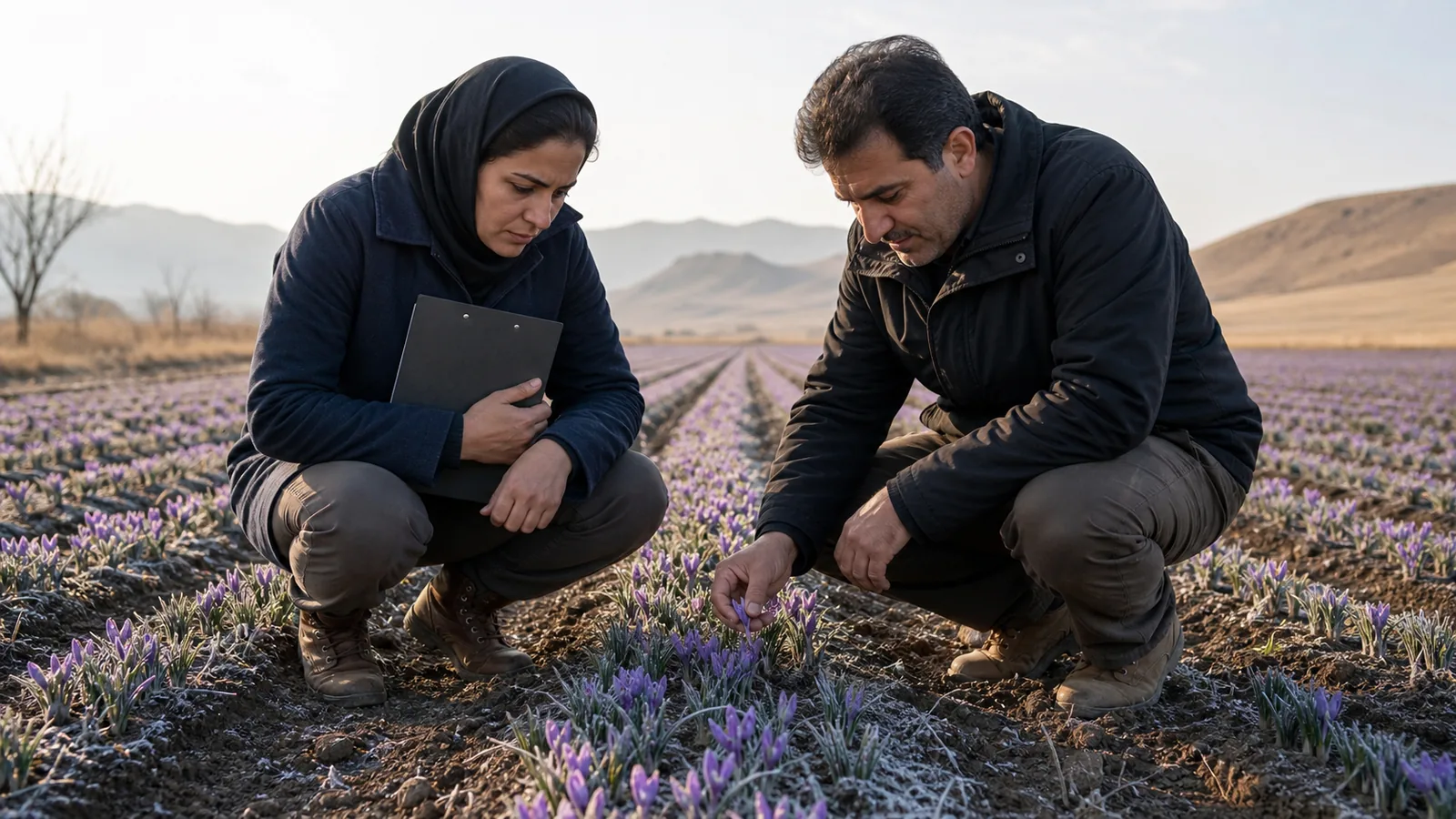
What the 36-ton Heydariyeh harvest report recorded
Mohammad Karimi Farzaghi, then director of Torbat Heydariyeh Agricultural Jihad, said the harvest had ended across the Rokh and Kadkan plains and the central district. Reports from those local agricultural centres put the total at 36 tonnes of dried saffron from 8,200 hectares.
Dividing those two reported figures gives an average of about 4.4 kilograms of dried saffron per hectare. That is a district-wide calculation, not the yield of every farm. Field age, irrigation, soil, weather, flower density and the care taken during separation and drying can all move an individual result above or below the average.
The 36-tonne figure also needs to remain tied to its season. It should not be read as a standing annual output for Torbat Heydariyeh or combined with figures from other reporting years.
How frost loss and a yearly increase can coexist
The official said cold and frost in the central district had caused an estimated loss equivalent to four tonnes of dried saffron. An earlier assessment had valued damage to central-district saffron farms at 225 billion rials after cold weather at the beginning of December.
Despite that damage, the reported harvest was still one tonne higher than the previous year. These statements are not contradictory. A crop can finish above the prior season while remaining below what growers expected before a damaging weather event. If “one tonne higher” was measured against the same district and reporting basis, the comparison points to roughly 35 tonnes in the preceding season.
The archived report does not provide a field-by-field loss survey, its valuation method or the prices used for the 225-billion-rial estimate. Both the tonnage loss and financial damage should therefore be treated as contemporary official estimates, not independently audited totals.
Why the labour figure means person-days
The old English text says saffron created work for about 400,000 “people” during planting and harvesting. The underlying regional reporting uses person-days: one person working for one day counts as one unit. A local account of Torbat Heydariyeh’s saffron economy likewise records about 400,000 person-days across planting, field care and harvest. It does not mean 400,000 permanent jobs or 400,000 different workers.
Another regional estimate puts saffron’s requirement at about 200 to 220 person-days per hectare. That broader estimate includes several kinds of work and was published for a different season. Multiplying it by acreage and comparing the result directly with the 400,000 figure would mix definitions and time periods.
The 45-day harvest economy
The report described a seasonal surge in activity from about October 6 through the end of November and called it a 45-day period. The exact start and length vary with weather and location: colder areas flower earlier or later than warmer fields, and not every plot reaches peak bloom on the same day.
What remains consistent is the compressed nature of the work. Flowers need to be picked promptly, moved without crushing, opened, and separated before their quality declines. Drying then has to control heat and moisture closely. This brings growers, seasonal pickers, transporters, flower separators, dryers, buyers and packers into the same short commercial window.
The timing also explains why employment statistics require care. A person may work on several farms or perform different tasks during the season. Person-days describe the volume of work more honestly than a headline count of people.
Torbat Heydariyeh’s wider agricultural setting
The archived article placed saffron within roughly 90,000 hectares of agricultural and orchard land and said 79% of the local labour force was engaged in agriculture. It also credited the district with 37 crop products and 31 horticultural products, ranking fifth and third respectively within Khorasan Razavi at the time.
It gave several wider saffron snapshots as well: about 8,000 cultivated hectares and 34 tonnes in one passage, then an older benchmark of 32 tonnes at 4.2 kilograms per hectare. It compared this with a provincial average of four kilograms per hectare and said 14,000 to 15,000 of the province’s 117,000 saffron-growing families were in Torbat Heydariyeh.
Those numbers do not all describe the same harvest. Acreage can expand, fields mature, weather changes and preliminary estimates are revised. The useful comparison is the direction and scale of local production, not an artificial single total assembled from several years.
What the report says about the region
Read carefully, the 36-tonne account shows why Heydariyeh is closely associated with saffron. The crop occupied thousands of hectares, supported a large volume of seasonal work and linked several plains and districts to one harvest economy.
It also records the uncertainty growers carry. A severe cold spell could remove an estimated four tonnes from the expected crop, yet the finished harvest could still edge above the previous year. Keeping the season, units and reporting limits attached to each number makes that story clearer—and far more useful—than presenting every figure as a current fact.

![Exporting Saffron to Turkey + Price Guide [Complete 0 to 100]](https://img.rowhanisaffron.com/20260827003933/saffron-export-turkey-quality-inspection.webp)



