


An additional 80 kg of saffron was harvested in Khash city, according to a seasonal report from the local Agricultural Jihad office. The account put production at more than 80 kilograms of dried saffron from 13 hectares and described the crop as part of a shift towards lower-water farming. Its dates and quantities are historical, not a current harvest forecast.
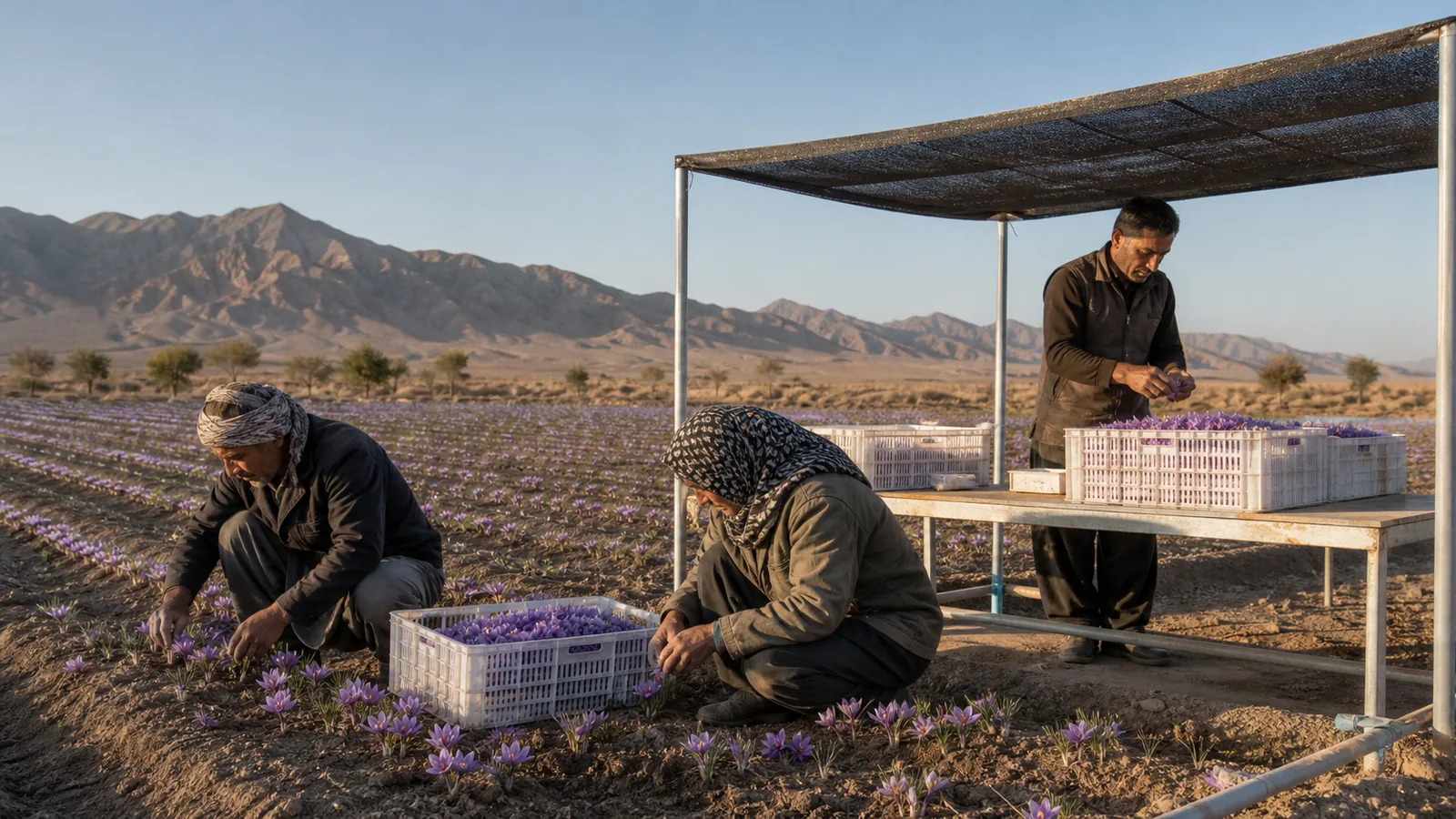
What the Khash harvest figures show
Shahrzad Kamali, then director of Khash Agricultural Jihad in Sistan and Baluchestan, reported that more than 80 kilograms of saffron had been collected from 13 hectares of farmland.
Using the minimum stated output, the district-wide average was just over 6.1 kilograms of dried saffron per hectare. Because the total was described as “more than” 80 kilograms, the actual average would have been slightly higher. This is a useful way to understand the scale, but it is not a yield guarantee for another field.
Saffron performance varies with the age and size of the corms, planting density, drainage, soil condition, irrigation timing, weather and post-harvest handling. The archived announcement does not provide farm-level yields or explain whether all 13 hectares were at the same stage of maturity.
Planting material came from the Khorasan provinces
Kamali said saffron was planted in October and that Agricultural Jihad had helped obtain the required planting material with participating farmers. The corms came from South Khorasan and Khorasan Razavi, Iran’s established saffron-growing regions.
The old English version calls them “onions,” but saffron is propagated by corms: compact underground stems that produce flowers and replacement corms. Good planting material should be healthy, undamaged and suited to the field plan. Moving corms between regions also makes inspection and disease hygiene important.
The report does not say that every hectare producing the 80 kilograms was newly planted that same October. Established fields and new plantings can sit within one district total, and their yields should not be treated as equivalent without field records.
Khash’s harvest window
The local harvest was said to begin in the second half of November and continue into early December. Temperature and the timing of the first effective irrigation influence when flowers emerge, so the exact dates can move from year to year.
Once flowering starts, work becomes urgent. Pickers revisit the field as new blooms open, usually collecting them before heat and handling reduce quality. The red stigmas then have to be separated cleanly and dried in a controlled way. A reported field yield only becomes usable saffron when that short chain is managed well.
The later Khash window distinguishes the local production calendar from some earlier-flowering districts. It may spread labour and processing demand across the wider Iranian season, but the original notice did not report worker numbers, drying capacity or the grade of the finished saffron.
Why saffron entered the local crop plan
The Agricultural Jihad office presented saffron as part of a change in cropping pattern and an effort to use water more efficiently. Continuous drought, falling groundwater levels and the need to improve farm economics were the reasons given for encouraging less water-intensive crops.
Saffron is well adapted to dry and semi-dry environments, but “low water” must not become “no water.” The FAO’s description of Iran’s qanat-based saffron system notes both its comparatively modest water requirement and the importance of a dependable irrigation source.
The plant’s seasonal cycle helps. It is dormant through much of the hot, dry summer, then resumes activity ahead of autumn flowering. FAO’s Crocus sativus profile describes a perennial crop suited to fairly dry climates, while also noting that rain or irrigation at key stages supports corm and flower development.
That makes saffron a candidate for water-constrained planning, not an automatic substitute for every irrigated crop. Soil drainage, suitable temperatures, labour, planting-stock health and a realistic market still decide whether the change makes sense on a particular Khash farm.
Profitability depends on more than water use
Kamali described saffron, often called red gold, as one of the country’s economically valuable agricultural products and said greater profitability could help make farming more sustainable. The reasoning is understandable: dried saffron carries high value in a small volume and can serve domestic and export markets.
Farm income, however, comes from the margin after costs. Corms, soil preparation, irrigation, weeding, hand picking, stigma separation, drying, testing, packing and finance all count. A grower also needs a buyer and a transparent way to establish grade. High retail prices do not automatically become high farm-gate returns.
Where groundwater is under stress, the comparison should include water productivity as well as revenue per hectare. A crop that earns more from less irrigation may strengthen a farm plan, provided the estimate uses local yield and cost data rather than a national headline price.
Saffron beyond Khash in Sistan and Baluchestan
The report named Khash, Mirjaveh, Zahedan, Zahak, Zabol, Hamun, Hirmand and Nimruz among the province’s saffron-producing counties. The original translation rendered two of those names as “Hamoon” and “Helmand”; the standard English county spellings avoid confusing Hirmand with Afghanistan’s Helmand Province.
That geographic spread shows saffron was being tested and grown in several distinct parts of Sistan and Baluchestan. It does not mean their acreage, harvest calendar or yields were identical. Each county needs its own records and agronomic assessment.
For Khash, the more-than-80-kilogram harvest from 13 hectares remains a clear historical marker: a measurable local crop, supported with corm supply and linked to water-saving policy. Reading it with its date, units and limitations intact gives farmers a better reference than treating an old seasonal result as a promise for the next harvest.

![Exporting Saffron to Turkey + Price Guide [Complete 0 to 100]](https://img.rowhanisaffron.com/20260827003933/saffron-export-turkey-quality-inspection.webp)



