


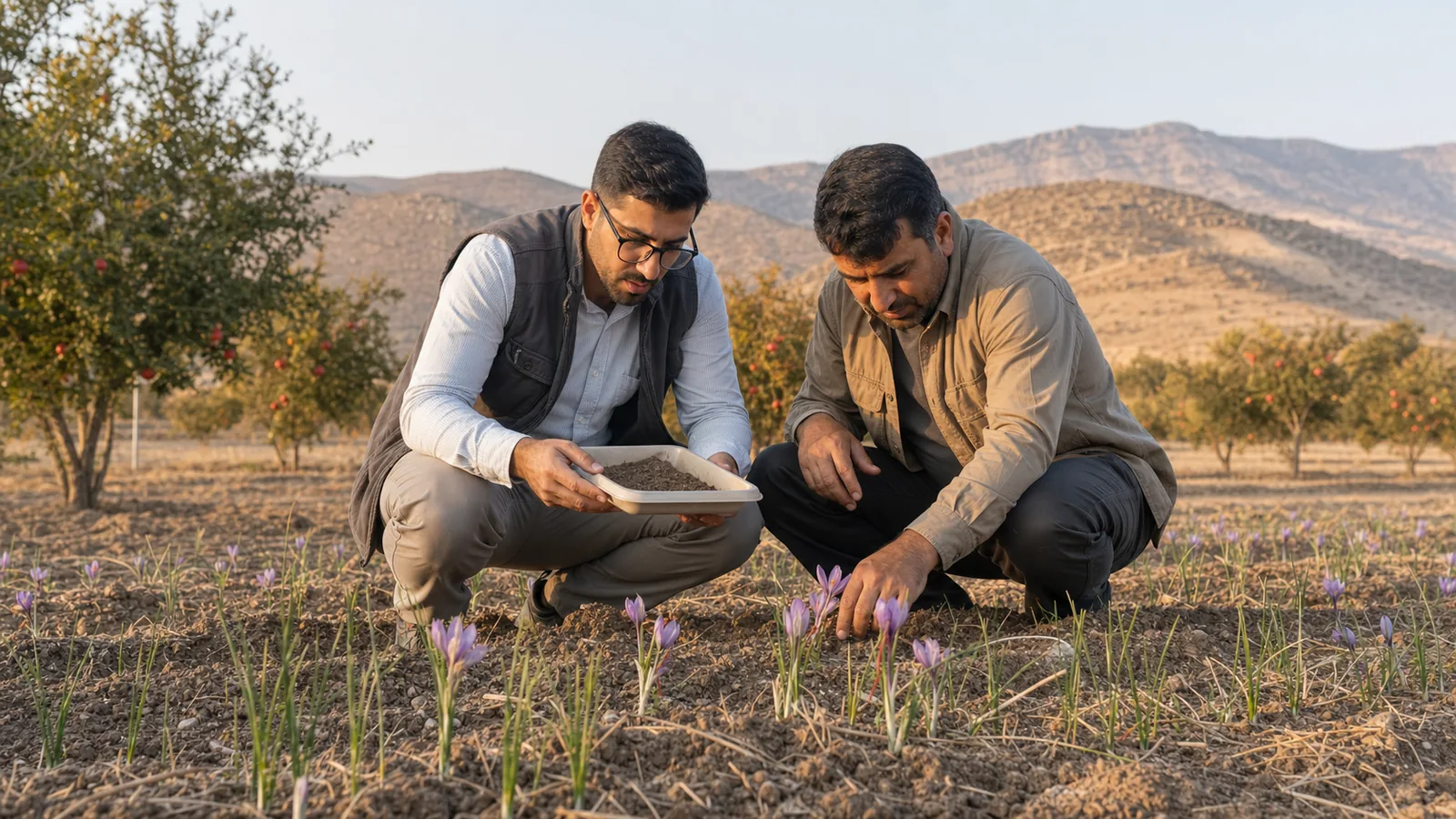
Saffron cultivation in Kazerun expanded to five hectares in the report behind this article, a rise of roughly 20% to 25% from the previous season. Local growers were testing the crop as a response to drought, damaged pomegranate orchards and the need for a different source of farm income.
How saffron cultivation developed in Kazerun
Mojtaba Hooshmandi, an expert at the Kazerun Agricultural Services Center, said local conditions had prompted advisers to promote crops with a lower irrigation demand. Saffron was introduced to more farmers not as a guaranteed answer to drought, but as one option in a broader change to the area’s crop pattern.
Zahra Panah, a horticulture expert with Kazerun Agricultural Jihad Management, put the cultivated area at five hectares for that season. A 20% to 25% increase implies a previous base of about four to 4.2 hectares, which is consistent with an official 2020 Kazerun report that recorded four hectares under saffron.
The five-hectare announcement expected 4 to 5 kilograms of dried saffron from each hectare. If every hectare had been mature and performed within that range, the arithmetic would suggest 20 to 25 kilograms in total. It was still a forecast. Newly planted fields can produce differently from established ones, and the original account did not publish a final measured harvest.
What the water figure really means
Hooshmandi estimated saffron’s seasonal water use at about 3,000 cubic metres per hectare. The report explained that as the equivalent of three 100-millimetre rainfall events: one millimetre of water spread over a hectare equals 10 cubic metres, so 300 millimetres equals 3,000 cubic metres.
That calculation is a volume conversion, not an irrigation recipe. Rain may arrive at the wrong time, run off, evaporate or fail to reach the root zone evenly. Saffron still requires a site-specific plan based on soil, drainage, local rainfall and the crop’s stage of growth. Describing it as a crop with lower water demand should never be shortened to “no-water crop.”
The timing can nevertheless suit a dry-region crop plan. Much of saffron’s active season falls outside the hottest months, and its irrigation schedule may compete less directly with summer crops. That was particularly relevant in Kazerun after repeated drought had weakened or destroyed some pomegranate plantings.
Why some pomegranate growers considered saffron
One farmer quoted in the original account said pomegranate growing had been the family’s work until drought and water shortages dried the trees. The grower then turned to saffron as an alternative and received a 40-million-toman facility from the Barakat Foundation to begin planting.
That story explains the local interest, but it is not a universal business case. The finance amount belongs to that farmer and that period. Establishment costs, corm prices, labour, field preparation, credit terms and saffron prices change. Nor does replacing a damaged orchard produce immediate income: saffron is a perennial crop, and its output can change as a field becomes established.
Hooshmandi and Panah also connected saffron with employment and farm income. Those benefits depend on much more than planting area. Flowers must be picked promptly, stigmas separated carefully and the product dried, protected and sold without losing quality. Small acreage can create concentrated seasonal work, but a durable return requires a buyer and sound post-harvest handling.
What support was offered to Kazerun growers
Panah said Kazerun Agricultural Jihad Management supported farmers with monitoring and advice from planting through harvest. The account also mentioned facilities and assistance with buying saffron corms.
Those details should be read as a record of the programme at the time, not a promise that the same funding or purchase arrangements are open now. A grower considering a field today would need to confirm the current position locally before buying planting material or borrowing against an expected crop.
Useful questions come before the purchase: Is the field well drained? What does a soil assessment show? Is the corm source healthy and traceable? How will the flowers be picked during the short harvest window? Where will stigmas be separated and dried? Who will grade and buy the finished product? The answer to each one affects whether saffron is genuinely suitable for a particular farm.
Later figures show gradual expansion, not a straight line
Kazerun’s saffron area continued to change after the five-hectare snapshot. A separate official report for the 2024 harvest described eight hectares, about 20 kilograms of dried saffron and seasonal work for more than 40 people.
That later result averages about 2.5 kilograms per hectare, below the earlier 4-to-5-kilogram forecast. It does not prove that cultivation failed. The reports cover different years and may include fields of different ages and conditions. It does show why a forecast should remain labelled as a forecast and why acreage alone is not enough to judge performance.
The 2024 account placed most of the fields in Kazerun’s central district and said harvest ran from late Aban to late Azar. It also stressed timely irrigation, plant nutrition and hygienic harvesting and processing. Those practical details are a stronger guide to quality than a broad claim that the crop is automatically profitable.
Reading the Kazerun record accurately
The original five-hectare announcement captures a small but meaningful shift in Kazerun agriculture. Farmers and advisers were responding to water stress, testing saffron on limited acreage and building local experience rather than converting the region wholesale.
Its key figures should stay together: five hectares, 20% to 25% growth, a forecast of 4 to 5 kilograms per hectare, an estimated 3,000 cubic metres of seasonal water per hectare and one farmer’s dated 40-million-toman facility. The later eight-hectare record adds context, but it does not rewrite what the earlier programme promised or what an individual farm can expect today.

![Exporting Saffron to Turkey + Price Guide [Complete 0 to 100]](https://img.rowhanisaffron.com/20260827003933/saffron-export-turkey-quality-inspection.webp)



