


The beginning of saffron harvest from 538 hectares in Estahban Fars marked an important season for growers in eastern Fars Province. The local forecast called for more than 276 tonnes of fresh flowers, while the report used three tonnes of dried stigmas as its production benchmark. Those figures belong to that harvest period and should not be read as today’s acreage or output.
What the 538-hectare Estahban report described
Mehdi Ayanmanesh, director of Estahban Agricultural Jihad, announced that saffron harvesting had begun across 538 hectares. Public-relations reporting from the office projected more than 276 tonnes of fresh saffron flowers, citing favourable weather conditions.
At face value, the forecast works out to a little over 500 kilograms of fresh flowers per hectare. The article also referred to three tonnes of dried stigmas. If both numbers were measured on the same area and season, the implied district average would be about 5.6 kilograms of dried saffron per hectare and roughly 92 kilograms of flowers for each kilogram of dried product.
Those calculations show how the quantities relate; they do not prove that every field performed alike. The archived English text is unclear about whether the three-tonne figure was a forecast, the previous year’s harvest or the expected final result. It should remain a reported benchmark rather than being recast as an audited outcome.
From fresh flowers to dried saffron
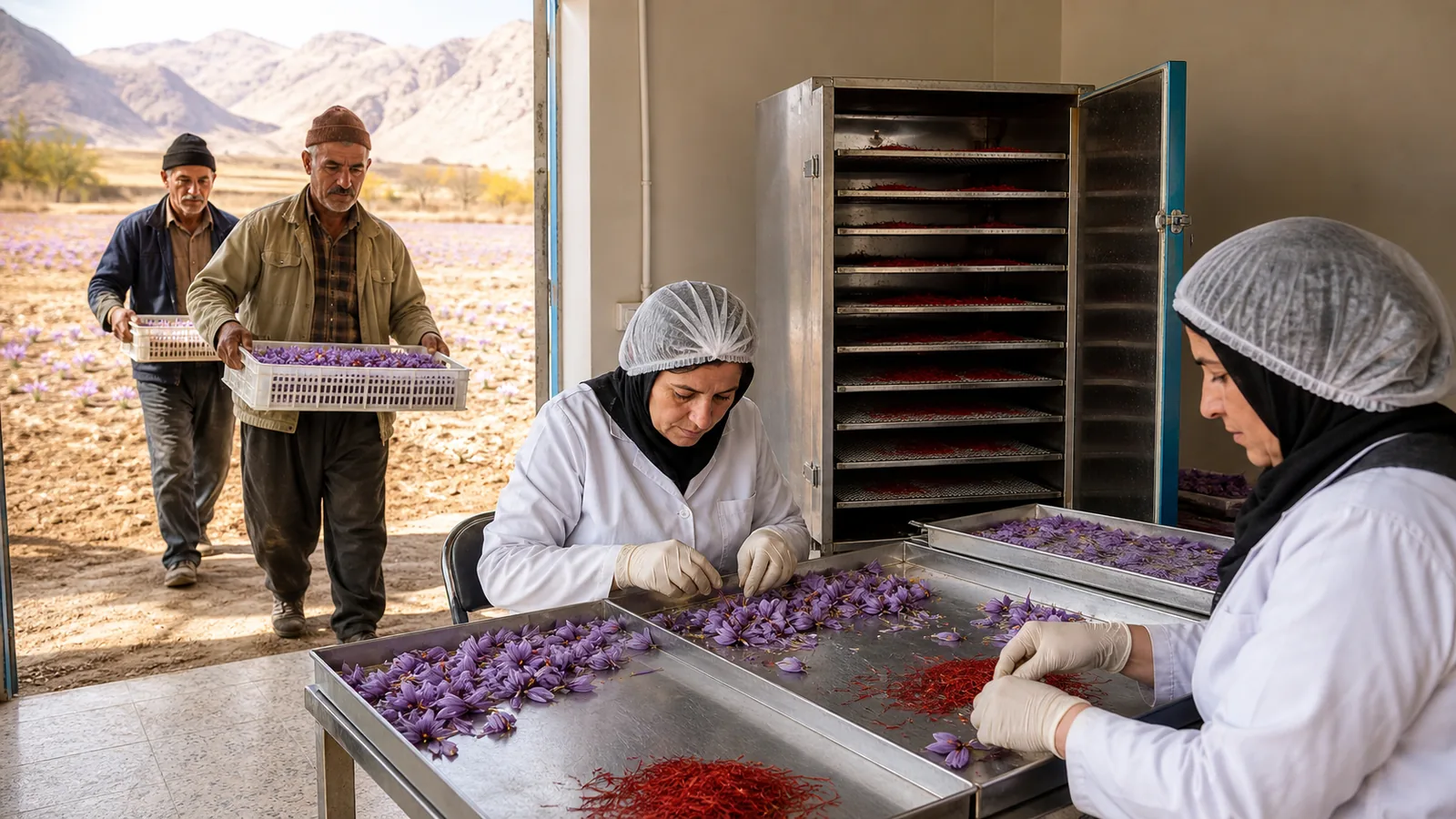
After picking, growers separate the red stigmas from the purple petals and the rest of the flower. The old translation calls the local task “flower filling,” but the intended meaning is flower stripping or stigma separation.
This stage cannot wait. Fresh blooms are delicate, and a delay creates heat, bruising and contamination risks. The separated stigmas then need even, controlled drying before they are graded, stored or sold. A large flower tonnage is therefore only the beginning of the post-harvest workload.
The reported flower-to-dry relationship is plausible as a broad district estimate, but actual conversion changes with flower size, how much style remains attached and the final moisture of the saffron. Buyers should compare lots by a defined grade and test result, not flower weight alone.
What makes Estahban saffron distinctive
Ayanmanesh described Estahban saffron as one of Iran’s strongest products for aroma, flavour and colour. He linked its character to the area’s weather and elevation differences. Those are reasonable quality influences, but a place name by itself does not establish the grade of a shipment.
Quality still depends on healthy corms, field management, clean picking, rapid separation, drying conditions, moisture, storage and protection from foreign matter. Objective testing is what turns a regional reputation into a specification a buyer can use.
Estahban sits in eastern Fars, with its centre about 160 kilometres from Shiraz. Its climate differs from the main Khorasan production belt, which makes the region useful in discussions of how Iranian saffron performs across different elevations and harvest calendars.
The processing and packaging gap
The original report’s central concern was not field production. It was what happened after drying. The agricultural director said Estahban lacked a processing factory able to package and export farmers’ saffron at the scale the county needed. A few workshops were operating, but he considered their capacity insufficient.
Without local grading, testing and packing capacity, growers may have to sell dried saffron as an undifferentiated raw lot. More of the final value then moves to businesses elsewhere that standardise the product, create retail or export packs and document traceability.
A local facility is useful only if it solves those practical problems. It needs hygienic handling, controlled drying or conditioning, calibrated weighing, moisture and quality testing, lot separation, suitable packaging and records that follow the saffron from grower to buyer. A building and a packing machine alone do not create export readiness.
Harvest timing in the original and later reports
The 538-hectare announcement gave a season from mid-November to the end of December. That window should remain attached to the historic article rather than being treated as a permanent calendar.
In a later IANA report on Estahban’s 2023 harvest, Ayanmanesh described flowering from late November to mid-December. That season covered 560 hectares, of which 552 were bearing, and produced 207 tonnes of fresh flowers and 2,185 kilograms of dried saffron.
The later figures should not overwrite the 538-hectare record. Together they show why each report needs a date: acreage, bearing area, flower output, dried output and the length of harvest all move from year to year.
How the cultivation area continued to change
An official 2024 cultivation update reported 562 total hectares, including 546 hectares of bearing saffron and 16 hectares not yet bearing. It also recorded a further five hectares of development.
That update helps explain why “area under saffron” and “area harvested” are not interchangeable. New plantings may be counted in the total before they contribute a mature crop. Comparisons must use the same definition.
The 2024 notice also identified drought, temperature stress, insufficient rain and prolonged heat as risks to corm weight. It advised growers to pay attention to corm size, freedom from pests and disease, planting depth, irrigation and timely nutrition. These details make clear that expansion alone is not the goal; productive, healthy bearing fields are.
What the historic harvest still tells us
The 538-hectare report captures Estahban at a useful point in its development as Fars Province’s main saffron area. It records the size of the harvest, the conversion from flower work to dried spice, the regional quality ambition and the local processing bottleneck.
For growers, the lesson is that acreage and reputation do not finish the job. Clean post-harvest work and documented quality determine whether the crop can hold its identity in the market. For buyers, the safest reading is equally practical: keep every figure tied to its season, ask whether hectares are bearing, and judge the finished lot by evidence rather than a geographic claim alone.

![Exporting Saffron to Turkey + Price Guide [Complete 0 to 100]](https://img.rowhanisaffron.com/20260827003933/saffron-export-turkey-quality-inspection.webp)



