


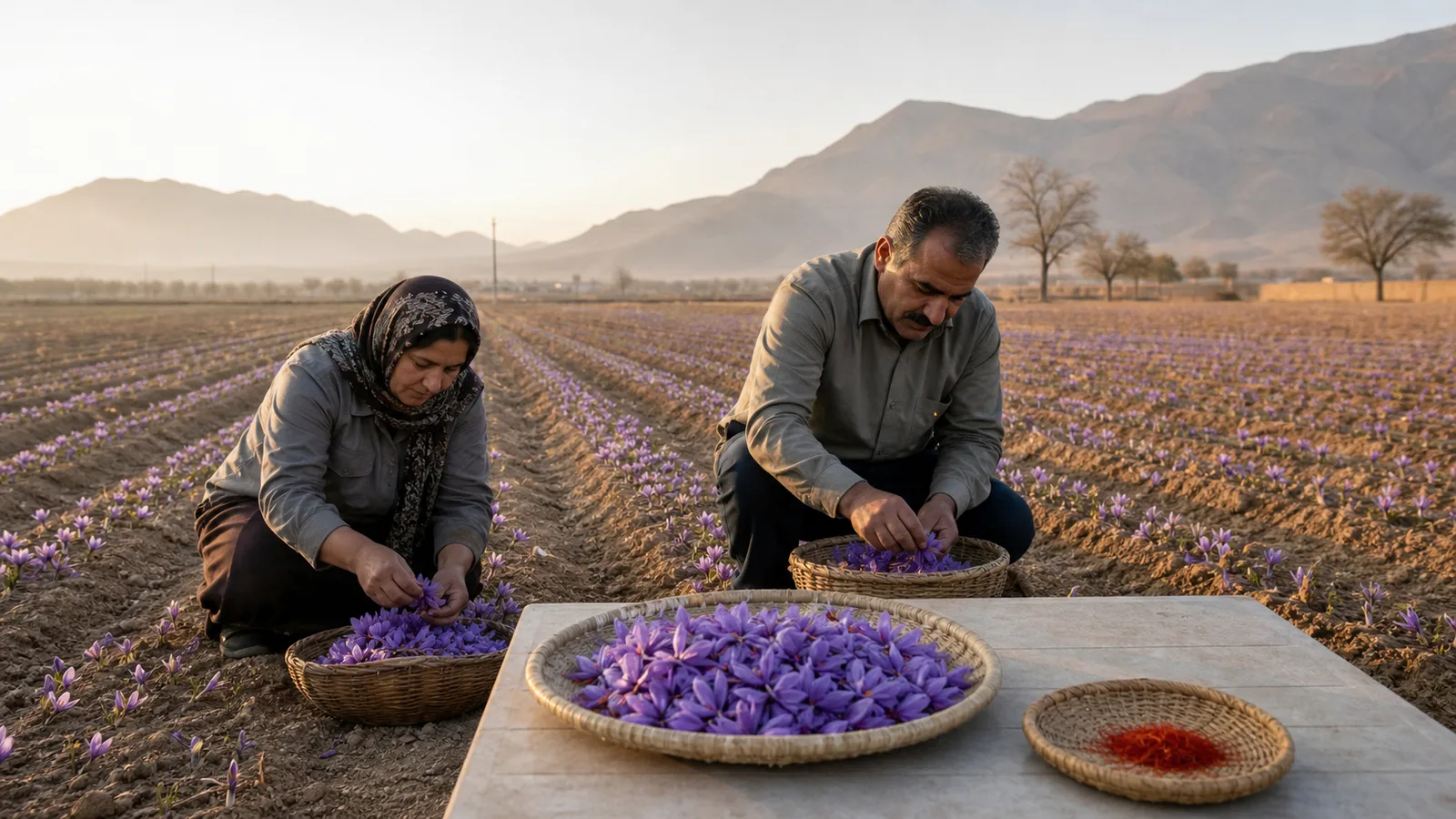
Kashan’s saffron harvest was forecast at more than 600 kilograms in a historical report that placed the region’s largest concentration around Alavi village in Mashhad Ardehal, with about 40 hectares. Harvest was said to begin in late October and continue through the end of November.
A second report from Mahvelat in Khorasan Razavi provides a useful scale comparison: 11,850 kilograms forecast from 3,950 hectares, or three kilograms of dried saffron per hectare. Both reports describe local expansion, but each contains wording that needs careful unit checking before its numbers are reused.
The Kashan 600-kilogram forecast
Majid Kafizadeh, then head of Kashan’s agricultural office, announced that the regional harvest had begun and expected more than 600 kilograms. Alavi village, in the Mashhad Ardehal area, was identified as Kashan’s largest producer with roughly 40 hectares.
The report linked saffron development to seasonal water management, farm income and employment. It estimated five jobs per hectare and said public facilities and grower support were being used to expand cultivation. That employment figure is historical and ambiguous: it may refer to seasonal jobs or labour equivalents rather than five permanent year-round positions on every hectare.
The text also states that 2.5 kilograms of saffron are obtained from each kilogram of harvested flowers. That is physically impossible because dried stigmas are only a small fraction of flower mass. ISO’s saffron overview notes that roughly 250,000 flowers may be needed for one kilogram of dried saffron. The Kashan sentence is therefore treated as a translation or unit error and is not used in any yield calculation.
What the Kashan report leaves unanswered
A 600-kilogram regional total cannot be assigned to Alavi village’s 40 hectares alone without evidence; that would imply 15 kilograms per hectare. The article does not say that all Kashan production came from those 40 hectares, and it does not give the full regional bearing area.
A useful harvest record would separate:
- the total planted area in the Kashan region;
- the area old enough to bear a commercial crop;
- Alavi village output versus the rest of the region;
- fresh flower weight versus dry stigma weight;
- permanent jobs versus seasonal harvest person-days.
Without those fields, the 600-kilogram number remains a historical forecast rather than a reproducible yield benchmark.
Mahvelat: 11,850 kilograms from 3,950 hectares
Ahmad Naderi, then director of agricultural affairs in Mahvelat, forecast 11,850 kilograms of dried saffron from 3,950 hectares. The calculation is internally consistent at three kilograms per hectare. Mahvelat was described as the fifth-largest producing county in Khorasan Razavi at the time.
The report expected output to rise five percent after favourable harvest weather and an absence of damaging frost. Flowering began in mid-November and harvest continued through the first ten days of December, later than the Kashan window recorded in the paired report.
It estimated one permanent job per hectare and recorded a local fresh-flower price of about 50,000 tomans per kilogram. That price is a dated market snapshot, not a current quote and not the price of dried saffron. Fresh flowers are perishable and contain petals, stamens and other material that is removed before drying the stigmas.
Why the two regions should not be compared by total kilograms alone
Mahvelat’s cultivated area was almost one hundred times the 40-hectare concentration cited for Alavi village, but the Kashan report refers to a wider region without stating its full area. Total output therefore cannot establish which location had better agronomy or quality.
Weather also affects the two calendars differently. A frost-free Mahvelat harvest was associated with a year-on-year increase, but one favourable season does not guarantee the next. In Kashan, the earlier late-October start changes when growers need pickers, separation space and drying capacity.
Quality claims require more than origin or yield. The current ISO 3632-1 specification defines requirements for dried saffron; representative testing, moisture control, purity and traceability determine what a lot can credibly claim.
How to read a saffron harvest forecast
Before using either historical figure in a farm or market decision, confirm the harvest year, bearing hectares, field age, dry-stigma weight and final result. Check whether employment is counted as people, permanent jobs or seasonal person-days, and keep fresh-flower prices separate from dried-saffron prices.
The paired reports still provide useful evidence. They establish a substantial Kashan-area harvest centred partly on Alavi village and a much larger, internally consistent Mahvelat program. Their main lesson is that a clear unit and denominator are as important as the headline kilograms.
References: ISO: How to recognize quality saffron; ISO 3632-1:2025. Kashan and Mahvelat figures are identified as historical details from the two local reports consolidated here.

![Exporting Saffron to Turkey + Price Guide [Complete 0 to 100]](https://img.rowhanisaffron.com/20260827003933/saffron-export-turkey-quality-inspection.webp)



