


Iran’s saffron cultivation area was forecast to exceed 100,000 hectares in the reporting period covered by this article. That milestone mattered, but planted area alone did not guarantee higher farmer income. National Saffron Council chairman Mohsen Ehtesham paired the forecast with a call for quality, fairer pricing and enough export demand to absorb the larger crop.
His later remarks at a Khorasan Razavi Chamber of Commerce symposium sharpened the same argument: Iran could dominate production while farmers and exporters remained unhappy with what they earned. The two reports together are less a celebration of hectares than a debate about who captures value after the flowers are picked.
The 100,000-hectare forecast in context
Ehtesham said Iran’s saffron area was increasing each year and expected it to pass 100,000 hectares that year. He linked the expansion to a target of more than 300 tonnes of exports, arguing that export growth was needed to balance supply and demand and sustain a fair price.
Both numbers are historical targets. The source did not provide an agricultural census, a harvest-year label or the later result, so “exceeds 100,000 hectares” should not be read as a fresh 2026 estimate. It records what the council expected at the time.
The underlying relationship is also not automatic. More hectares can raise potential output, but the harvested crop still depends on corm condition, climate, water, labour, field age and yield per hectare. Export tonnage depends on quality, price, finance, buyer access and customs conditions. A 300-tonne export target therefore cannot be inferred from planted area alone.
Iran leads production, but the share is not fixed
At the symposium, Ehtesham said Iran produced 95% of the world’s saffron. That was a rhetorical estimate, not a permanent share. FAO’s 2025 value-chain work places Iran at about 85–90% of global saffron production and describes the crop as supporting hundreds of thousands of smallholder farmers.
Using a range is more honest than repeating one old percentage as a constant. Iran remains the clear production leader, while annual output in Iran and other countries can change.
What the National Saffron Council said it was trying to protect
Ehtesham described the council’s mission in two directions. For growers, it wanted a price that reflected production costs and maintained an incentive to cultivate. For domestic and international buyers, it wanted pure, good-quality saffron presented under Iranian brands.
One phrase in the old translation called saffron “not a food colour but a pharmacy.” That is advocacy, not medical evidence. Saffron is a spice and food ingredient; this market article does not turn a promotional metaphor into a claim that it treats disease.
Quality needs measurable terms. The international Codex saffron standard CXS 351-2022 covers saffron styles, quality classes, contaminants, hygiene, packaging, labelling and analysis. A fair transaction can refer to a defined lot and grade instead of relying on “pure” or “high quality” as untested sales language.
Why the council warned farmers about selling corms
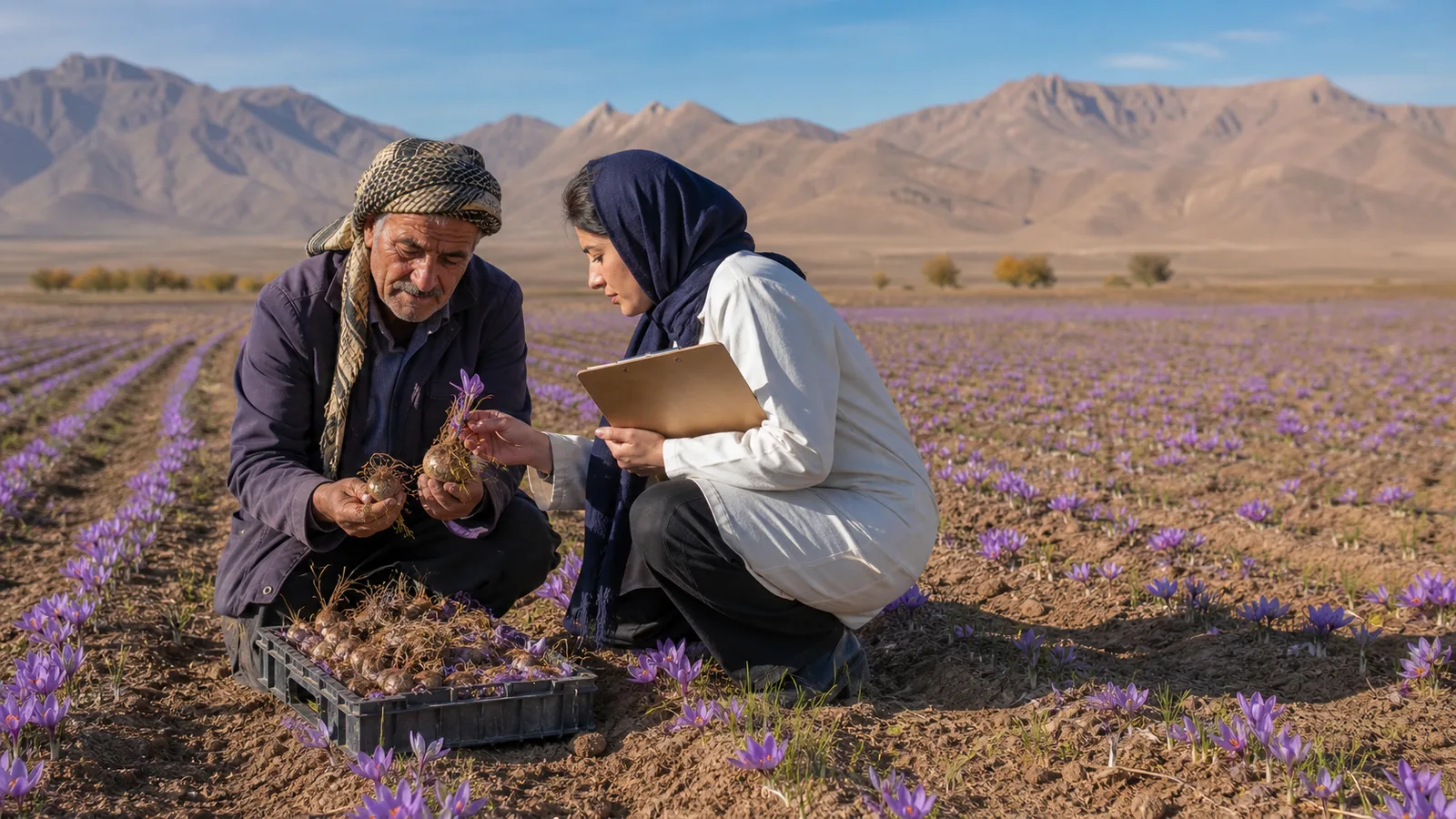
Saffron is propagated through corms, often called bulbs in the archived translation. Ehtesham urged farmers not to sell surplus corms to unknown buyers at an attractive short-term price. He preferred transfers through agricultural organizations that could place planting material with other farmers under supervision.
The report did not document the buyers, destination or a measured loss caused by those sales. Its warning should therefore stay narrow: uncontrolled transfers can leave growers without a reliable record of who received the planting material, under what quality conditions and for what future use. A supervised channel can document the seller, lot, condition, destination and agreed price.
The $300-per-kilogram complaint
At the September 25 symposium, Ehtesham said the dollar stood at 28,000 tomans while saffron sold for about $300 per kilogram. His point was that the export return was too low relative to Iran’s production position, farmers’ living costs and agricultural inputs.
This is a dated, attributed price snapshot. The report gives no grade, contract term, destination, transaction record or exact year in the English text. It cannot be used as a current market quote or compared directly with today’s exchange rate.
Ehtesham used forceful language about farmers’ resources flowing into foreign traders’ pockets. In the same speech, however, he praised Iranian exporters for returning currency and preserving markets under difficult conditions. His criticism was directed at the structure of value distribution, not a finding that every foreign buyer or Iranian exporter exploited growers.
The proposed base-price commitment
The chairman asked traders to make what he called a moral commitment: buy from farmers at an agreed base price, sell with reference to that base and let the saffron exporters’ union judge violations.
The source does not show that the arrangement was adopted, define the grade behind the price or explain how it would comply with applicable competition and trade rules. It should be recorded as a proposal, not copied as an operating recommendation.
A transparent alternative would publish a voluntary reference methodology: dated prices by tested grade, payment terms, sample size, exchange-rate source, pack size and destination. Growers could see the evidence without private parties being told to enforce one sale price.
A council with a large brief and limited capacity
Ehtesham said the National Saffron Council had no dedicated building, employed two people and relied on Chamber of Commerce funding. He also said a comprehensive production-and-export plan had taken six months to prepare.
The council asked the Ministry of Industry, Mine and Trade—mistranslated as the “Ministry of Silence” in the old article—to delegate powers to specialist organizations. According to Ehtesham, the ministry refused because it considered those powers sovereign. The archived report does not include the plan or the ministry’s written decision, so it can establish the disagreement but not adjudicate it.
What should be measured as cultivation expands?
Area remains useful, but it belongs beside outcomes that show whether expansion is healthy:
- harvested area and dried-saffron yield, not planted hectares alone;
- lot grade, rejected share and post-harvest loss;
- farm-gate price, payment time and net grower return;
- export weight and realised value by grade, pack size and destination;
- the share sold under traceable Iranian origin and branding; and
- corm transfers recorded by source, condition and receiving farm.
FAO’s current programme similarly brings farmers, processors, cooperatives, traders and experts together around production practice, post-harvest handling, safety, traceability and modern marketing. That wider system is what turns cultivation area into dependable value.
Passing 100,000 hectares was a significant forecast for saffron cultivation in Iran. The council’s harder question still matters more: can production growth deliver tested quality, reliable buyers and a transparent return to the people who grow and export the crop?

![Exporting Saffron to Turkey + Price Guide [Complete 0 to 100]](https://img.rowhanisaffron.com/20260827003933/saffron-export-turkey-quality-inspection.webp)



