


The historical estimate for average saffron yield in Khorasan Razavi was about 3.5 to 4 kilograms of dried saffron per hectare, with annual production placed at 280 to 300 tonnes. The article title rounds that to 3 kilograms, so the figures need to be read with their acreage and reporting period rather than treated as one permanent yield for every field in Khorasan or Iran.
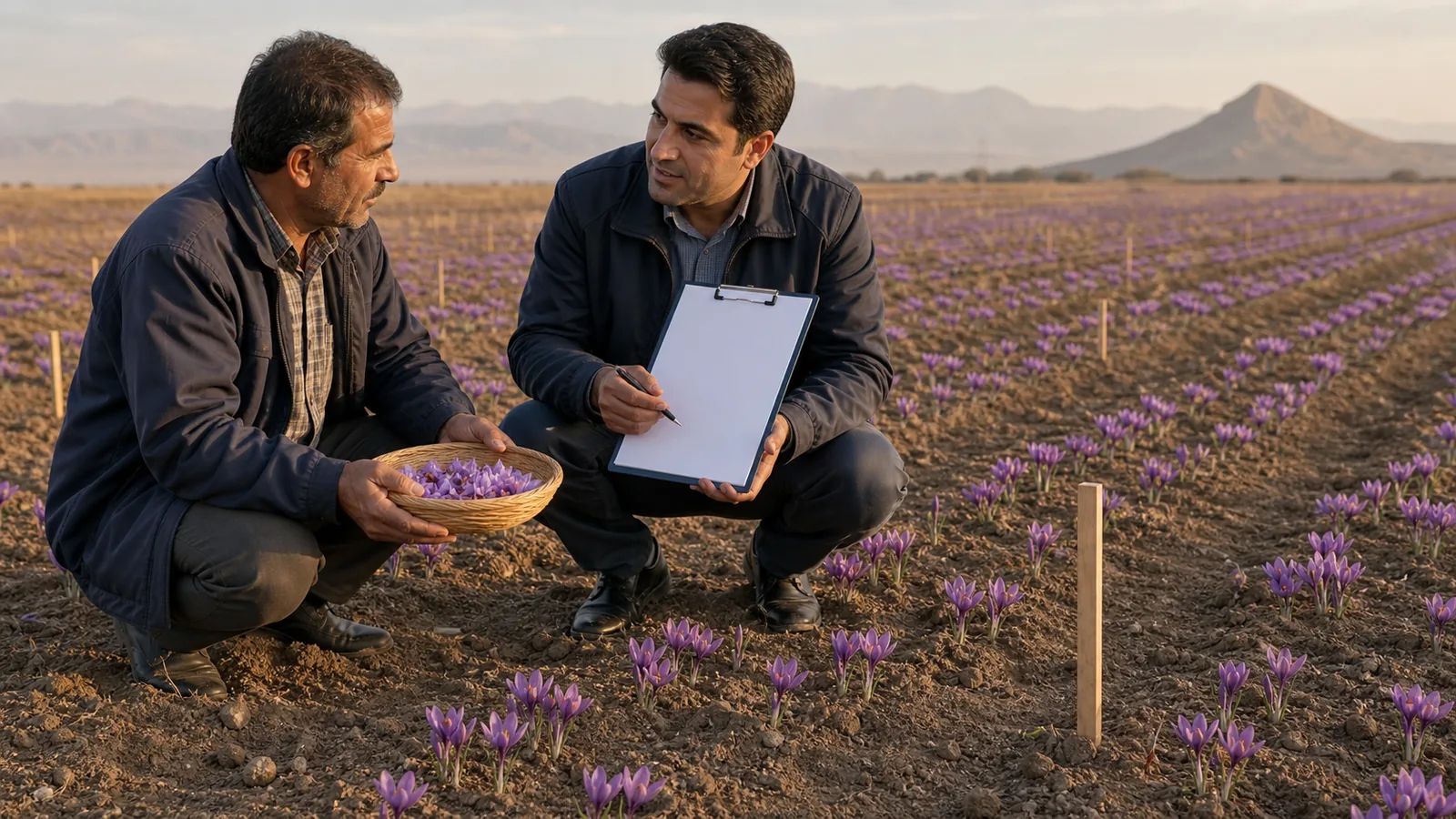
Average saffron yield per hectare in the report
Hashem Naghibi, then director of horticulture at the Khorasan Razavi Agricultural Jihad Organization, said the province harvested roughly 3.5 to 4 kilograms of saffron per hectare. He also placed the saffron area at about 84,000 hectares and annual production at approximately 280 to 300 tonnes.
These numbers describe dried saffron, not the much heavier crop of freshly picked flowers. They are provincial averages from a dated report. A grower should not read them as a promise that one hectare will produce the same amount every year.
The headline’s “3 kg” is a rough simplification. The article body gives the more precise quoted range of 3.5 to 4 kilograms per hectare, and that range is the better answer to preserve for readers searching for average saffron yield in Iran by hectare.
Why the acreage and tonnage do not match perfectly
Multiplying 84,000 hectares by 3.5 kilograms gives 294 tonnes. At 4 kilograms per hectare, the result would be 336 tonnes. The reported production range of 280 to 300 tonnes therefore overlaps the lower end, but not the full 3.5-to-4-kilogram range.
Working in the other direction, 280 to 300 tonnes divided by 84,000 hectares gives about 3.33 to 3.57 kilograms per hectare. That is close to the stated average, but it is not identical.
This does not justify inventing a single “correct” number. Agricultural reports may mix total planted area with bearing area, use rounded acreage, or summarize output across fields of different ages. The source did not define its denominator. The honest reading is that Khorasan Razavi’s reported average was around the mid-three-kilogram range, while the quoted field estimate extended to 4 kilograms.
How this compares with another official Khorasan figure
An official 2017 report from Khorasan Razavi, also attributed to Naghibi, used a range of 4 to 5 kilograms per hectare. It recorded about 82,000 hectares and roughly 260 tonnes of dried saffron.
That report contains the same kind of denominator issue: 260 tonnes across 82,000 hectares works out to about 3.17 kilograms per hectare, below its separately quoted 4-to-5-kilogram average. This is strong evidence that readers should not multiply every headline yield by every acreage figure without checking whether both describe the same productive land.
The 2017 report also mentioned an exceptional 39-kilogram yield achieved by one model grower in the previous year. That is not an average and should never be used in a typical farm budget. A record field and a province-wide figure answer different questions.
Why saffron yield varies between fields
One hectare is only a unit of area. It does not say how old the saffron stand is, how many healthy corms it contains or how evenly they are distributed. Nor does it capture weather during flower initiation and emergence, irrigation timing, soil and drainage, field nutrition, labour availability or losses during picking, separation and drying.
Even the definition of the output matters. Fresh flowers, fresh stigmas and dried saffron are not interchangeable weights. The Khorasan figures concern dried saffron, which is the relevant measure for comparing saleable production.
For planning, a range is more useful than a single optimistic number. A farm’s own multi-year records, separated by field age and measured after consistent drying, provide a better baseline than a provincial headline. The Khorasan estimate supplies context; it cannot replace a field history.
Khorasan Razavi’s share of saffron cultivation
Naghibi said about 80 percent of Iran’s saffron area was in Khorasan Razavi at the time and described the province as the national leader. With a stated provincial area of 84,000 hectares, that percentage would imply a national area of roughly 105,000 hectares. This is derived arithmetic, not a separate figure published in the report.
The footprint continued to change. A official 2020 account of the province’s medicinal-plant value chain put Khorasan Razavi’s saffron area at about 93,000 hectares and the national total at 120,000 hectares.
Those later areas should not be substituted into the older 280-to-300-tonne estimate. They belong to a different snapshot. Together, the reports show a large and changing production base, which is exactly why yield claims need dates and defined denominators.
Saffron within the province’s medicinal crops
The original interview was broader than saffron. Naghibi placed the area under other medicinal and aromatic plants at about 19,500 hectares and said cumin made up the main share. Khorasan Razavi was described as the country’s leading province for the development of these crops.
He named cumin, seed crops translated as “sorbet” or basil seed, fennel, rosemary and peppermint among roughly 40 to 50 cultivated types. The exact identity behind the translated “sorbet seed” wording is uncertain, so the English term should not be treated as a precise botanical identification.
The interview said much of this plant material was exported in raw form to about 50 countries. That was a market description, not proof that every named crop reached all 50 destinations. The later 2020 value-chain report helps explain the concern: it identified technical information, mechanisation, sorting and market development as areas requiring work.
Water needs were not the same for every crop
The account grouped cumin, the seed crop and rosemary among lower-water options and said some could be grown under dryland conditions. It contrasted them with plants that needed more water and were therefore grown on smaller plots.
That distinction is more useful than calling all medicinal plants “waterless.” Species differ, and so do soils, climate, establishment needs and yield targets. The report did not publish irrigation volumes or a field protocol, so it cannot support a universal watering schedule.
Saffron itself was presented as part of a production system shaped by water limits, but its yield still depended on field conditions and management. Low water demand relative to some crops does not mean zero water demand.
A practical answer to the yield question
For the historical Khorasan Razavi dataset in this article, the best-supported answer is about 3.5 to 4 kilograms of dried saffron per hectare, with province-wide acreage and output implying roughly 3.33 to 3.57 kilograms. The title’s 3-kilogram figure is a rounded lower shorthand.
For Iran as a whole, or for a farm being planted now, no single number should be lifted from this report and treated as current or guaranteed. Use a dated regional range, confirm whether the denominator is total or bearing hectares, and compare it with the field’s own age and harvest records. That preserves the value of the Khorasan estimate without turning an average into a promise.

![Exporting Saffron to Turkey + Price Guide [Complete 0 to 100]](https://img.rowhanisaffron.com/20260827003933/saffron-export-turkey-quality-inspection.webp)



